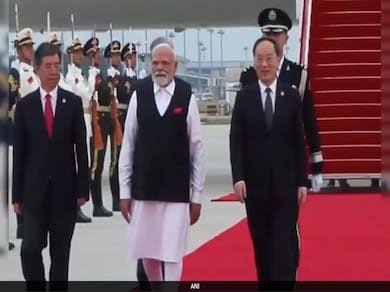
TIANJIN/BEIJING: Prime Minister Narendra Modi has arrived in Tianjin, China, for his first visit to the country in over seven years, marking a significant moment in the evolving global geopolitical landscape.
The Prime Minister received a rousing welcome upon his arrival at Binhai International Airport, with a large contingent of the Indian diaspora and cultural performers greeting him.
Modi is in China to attend the annual Shanghai Cooperation Organisation (SCO) summit, but the visit has assumed greater significance due to the scheduled bilateral meetings with Chinese President Xi Jinping and Russian President Vladimir Putin on the sidelines of the summit.
These high-stakes meetings are being watched closely by the international community, particularly by the United States, as they occur amid an escalating tariff war between Washington and key global players.
Chinese Media’s Positive Spin
Chinese state media has given significant coverage to Modi’s visit, highlighting it as a major step toward stabilizing and improving Sino-Indian relations. Reports from outlets like Xinhua and Global Times have underscored the importance of the two Asian powers working together to bring stability to the global economic order, especially in the face of what they describe as “unilateral and protectionist policies” from the West.
Chinese analysts view the visit as a powerful optic, demonstrating solidarity among major non-Western economies. They have also pointed to recent diplomatic efforts, such as the easing of trade restrictions and a renewed push to resolve border disputes, as evidence of a positive “up cycle” in the relationship.
International Reactions and Implications
The international reaction to the visit has been a mix of caution and concern.
The United States and its Western allies are particularly wary of the optics of the trilateral meeting, which they see as a challenge to the American-led international order. US officials, including former National Security Advisor Jake Sullivan, have publicly stated that the US’s own aggressive tariff policies have inadvertently pushed India closer to China.
Analysts, such as Michael Kugelman of the Wilson Center, believe that the meeting serves as a clear signal that India is “hedging against the West.” The fact that this visit comes days after the US imposed a steep 50% tariff on Indian exports over its purchase of Russian oil further amplifies this narrative.
On the other hand, Russia views the summit as a major diplomatic success. Russian state media has been highlighting the deepening ties between Moscow and its Asian partners, with Putin’s separate visit to China for a military parade underscoring the enduring partnership.
The visit’s timing makes it a critical moment for the global economy.
With a US-China trade war raging and the US imposing punitive tariffs on India, the potential for closer economic and strategic cooperation between the world’s three largest developing economies is a major factor that could reshape global supply chains and trade dynamics.