By Adinath | Source: The Astronomical Journal, University of California Irvine (UCI), and Penn State University.
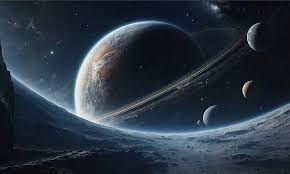
In a discovery that’s stirring imaginations across the globe, astronomers have spotted a “Super-Earth”—a rocky planet larger than our own—orbiting comfortably in the habitable zone of a nearby star. The newfound world, officially named GJ 251 c, lies just 18 light-years away, practically in our cosmic backyard.
This proximity, combined with its location in the so-called Goldilocks Zone—where conditions might allow liquid water to exist—has made GJ 251 c one of the most intriguing exoplanets ever detected.
A Close and Promising Neighbor
At roughly 3.8 times the mass of Earth, GJ 251 c belongs to a class of planets astronomers call Super-Earths—worlds heavier than Earth but lighter than icy giants like Neptune.
It circles a red dwarf star, Gliese 251, completing one orbit every 53.6 Earth days. Red dwarfs are smaller and cooler than our Sun, so even a planet orbiting this closely could have temperatures suitable for liquid water—a key ingredient for life as we know it.
In cosmic terms, 18 light-years is almost next door. That’s close enough for future telescopes to take a detailed look at the planet’s atmosphere, its surface conditions, and maybe—just maybe—signs of life.
“Given its nearness and favorable orbit, GJ 251 c is one of the best candidates yet for studying a potentially habitable world beyond our Solar System,” said Dr. Sarah Ballard, an exoplanet researcher at the University of California, Irvine.
How Scientists Found It
The discovery didn’t come from a telescope snapping pictures of the planet directly, but from a clever bit of cosmic detective work known as the radial velocity method.
Using ultra-sensitive instruments like the Habitable-Zone Planet Finder (HPF) at Penn State University’s Hobby–Eberly Telescope, astronomers measured tiny wobbles in the light of Gliese 251. These rhythmic wobbles revealed that something—something massive—was tugging on the star: a planet.
“Our data show clear, repeating signals that point to a Super-Earth,” explained Dr. Suvrath Mahadevan, who leads the HPF project. “This is one of the most precise detections yet in the nearby galactic neighborhood.”
Could It Really Support Life?
The fact that GJ 251 c sits in the habitable zone makes it a tantalizing candidate for life—but scientists are cautious. Being in the right zone doesn’t guarantee oceans, air, or warmth.
For life to take hold, the planet would also need a stable atmosphere and magnetic field to shield it from stellar radiation. Researchers are now planning follow-up observations to determine if GJ 251 c has these vital layers of protection.
In the coming years, advanced telescopes such as NASA’s James Webb Space Telescope (JWST) and the Extremely Large Telescope (ELT) in Chile may be able to analyze its atmosphere—looking for biosignatures like oxygen, methane, or water vapor that could point to biological activity.
A Step Closer to Finding Another Earth
If confirmed as potentially habitable, GJ 251 c would join a small but growing list of nearby worlds—like Proxima Centauri b and Teegarden’s Star b—that might resemble Earth in key ways.
Each new discovery like this brings us closer to answering one of humanity’s oldest and most profound questions:
Are we alone in the universe?
“This is a stepping stone toward finding another Earth,” Dr. Ballard said. “Every Super-Earth we uncover in our cosmic neighborhood teaches us a little more about how common—or rare—life might be in our galaxy.”
The Big Picture
The discovery of GJ 251 c is more than just another entry in the growing catalog of exoplanets—it’s a reminder of how rapidly our understanding of the cosmos is expanding.
Barely three decades ago, we didn’t know if planets existed beyond our solar system. Today, astronomers have confirmed over 5,000 exoplanets, and this latest find shows that some may not be as far—or as uninhabitable—as we once thought.
So while GJ 251 c is still a distant speck through our telescopes, it might just be one of the most promising worlds we’ve ever found—a possible mirror to our own blue planet, shining faintly across the stars.