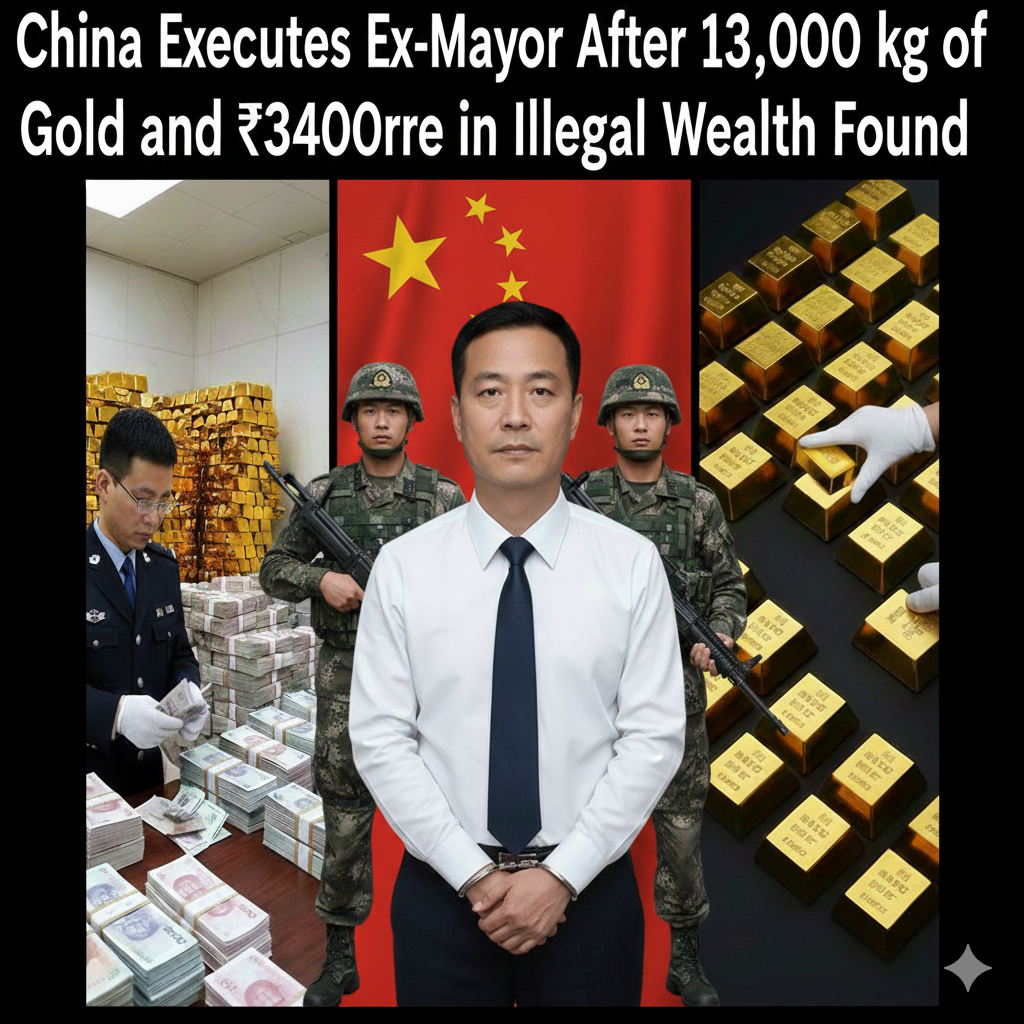
Beijing, January 3, 2026 — In an unprecedented crackdown on corruption, a Chinese court has sentenced a former mayor to death after investigators uncovered massive illegal wealth — including around 13.5 tonnes of gold and cash equivalent to about ₹3,400 crore — hidden in his possession. The case, widely reported across international news outlets, is being described as one of the most extraordinary corruption cases in China’s recent history.
Massive Corruption Uncovered
The former mayor, identified as Zhang Qi (also reported as Zhang Qiu), once led Haikou City — the capital of China’s Hainan province. As part of a long-running anti-graft investigation, Chinese authorities raided his residences and private properties. During the raids, investigators made astonishing discoveries:
- Approximately 13,500 kg (13.5 tonnes) of gold — described as a literal mountain of gold — found stored at multiple locations.
- Huge amounts of cash in Chinese currency (Yuan), estimated to be in the range of ₹3,400 crore.
- A portfolio of luxury homes, high-end vehicles, and foreign-based properties also seized by authorities.
The scale of the uncovered wealth is staggering and is considered rare even in a country that has pursued an aggressive anti-corruption campaign for years.
Charges and Verdict
Zhang was formally charged with serious corruption crimes, including:
- Bribery for awarding government contracts and facilitating land deals
- Embezzlement and abuse of official power
- Illegal accumulation of vast personal wealth at the expense of public funds
China’s courts found his actions in breach of national law and severely damaging to both the state and public trust. On these charges, the court handed down a death sentence — a punishment reserved for the most egregious corruption offences under Chinese criminal law.
Context: China’s Anti-Corruption Drive
Anti-graft efforts in China have intensified under the leadership of President Xi Jinping, who has repeatedly described corruption as a major threat to the Communist Party and national stability. In recent years, dozens of high-ranking officials — sometimes referred to as “tigers” under Xi’s crackdown campaign — have been investigated, disciplined, and, in some cases, sentenced to harsh penalties, including death or suspended death sentences.
While not every corruption case results in execution, Chinese legal statutes allow for the death penalty in cases where the amounts involved are exceptionally large and the societal damage is significant.
Global Reaction
News of this case has resonated beyond China’s borders. Analysts and commentators worldwide see it as:
- A warning to senior officials about the consequences of corruption
- A demonstration of China’s zero-tolerance policy toward graft
- A subject of debate among human-rights observers regarding the use of the death penalty for corruption crimes
Some international observers have expressed concern about the severity of capital punishment in such cases, while others note that China’s approach reflects its strict legal and political stance on official corruption.
This case adds to a growing list of high-profile corruption prosecutions in China, underscoring the government’s determination to root out deep-seated graft within its ranks. The sheer volume of gold and cash uncovered — worth billions of rupees — serves as a stark reminder of how deeply corruption can permeate government systems when left unchecked.
Whether this will have further implications for other officials or prompt legal reform debates remains to be seen, but for now, Zhang’s execution stands as one of the most dramatic anti-corruption actions in China’s modern era.