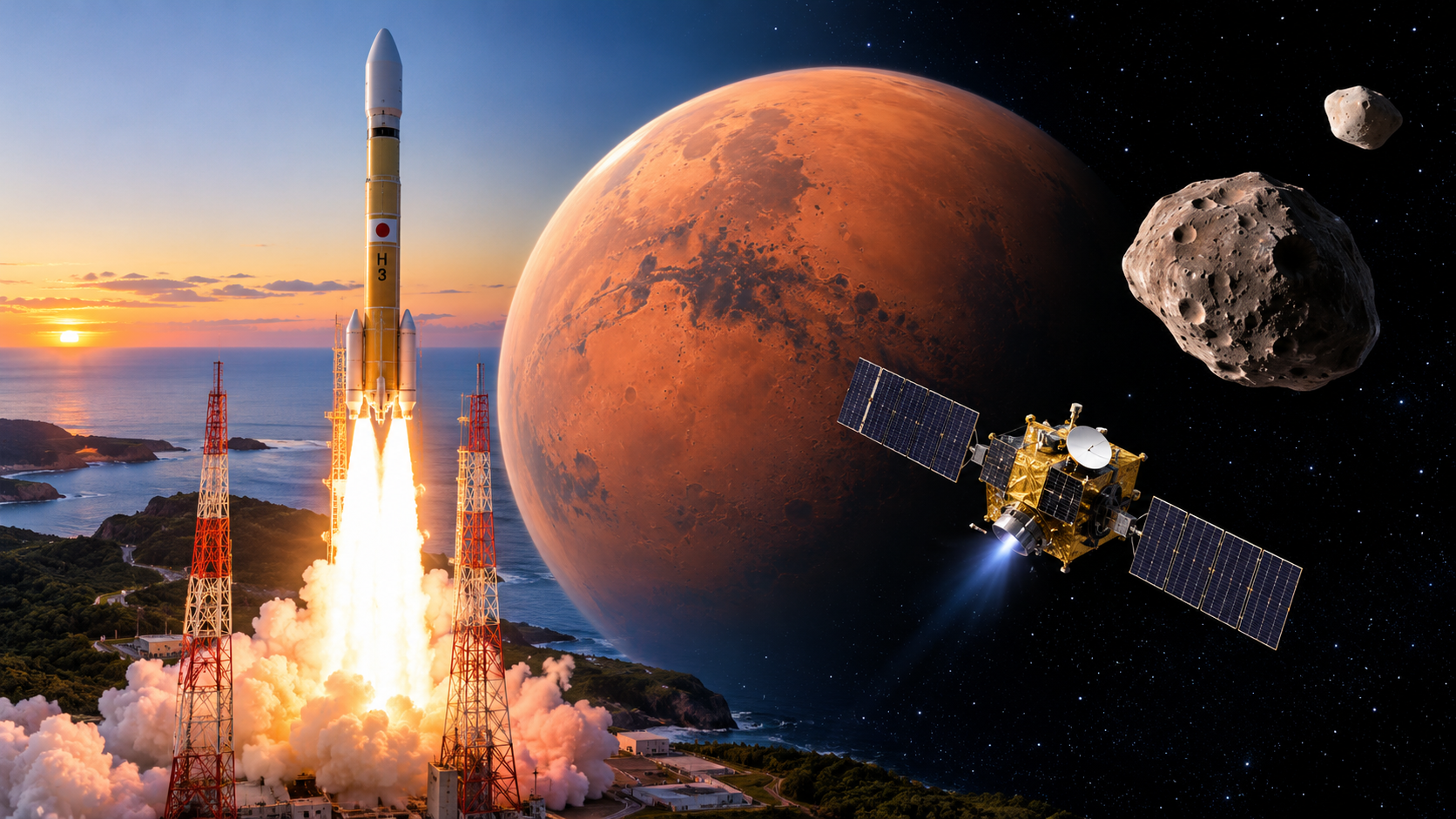
Tokyo, October 20: Japan has launched a landmark space mission to investigate the origin and evolution of Mars’ moons, Phobos and Deimos, and bring back samples from Phobos to Earth. The Martian Moons eXploration (MMX) mission, led by the Japan Aerospace Exploration Agency (JAXA), aims to provide new insights into the formation of planetary systems and the early history of the Solar System.
The mission is designed to collect material from Phobos, the larger of Mars’ two natural satellites, and return it to Earth for detailed laboratory analysis. If successful, it will significantly advance scientific understanding of the origin and composition of the Martian moons.
Investigating the Origin of Mars’ Moons
Mars has two small natural satellites, Phobos and Deimos. Despite decades of observations, their origins remain uncertain. Scientists are investigating two principal hypotheses: that the moons are captured asteroids or that they formed from debris produced by impacts on Mars.
The MMX mission is designed to help distinguish between these possibilities by analysing samples collected directly from Phobos. Determining the satellite’s mineralogical and chemical composition could provide important evidence about its formation and subsequent evolution.
Phobos is an irregularly shaped body measuring approximately 27 kilometres across at its longest dimension. It orbits Mars at an altitude of about 6,000 kilometres above the planet’s surface and is gradually moving closer to Mars.
Sample Collection and Scientific Objectives
One of the mission’s primary objectives is to collect at least 10 grams of material from Phobos and return it to Earth.
Although relatively small in quantity, the samples could offer substantial scientific value. Earth-based laboratories can perform detailed analyses that may not be possible with instruments operating on a spacecraft.
Researchers will examine the samples for their mineralogical, chemical and isotopic characteristics. These measurements could help determine whether Phobos originated from material formed in the early Solar System or from debris generated by a major impact on Mars.
The investigation may also reveal traces of Martian surface material transported to Phobos by impact events. Such material could provide additional information about the geological history of Mars.
However, the mission is not specifically designed to detect extraterrestrial life, and any conclusions about the origin of life would require separate evidence.
Mission Timeline and Spacecraft Operations
According to the mission plan, the spacecraft will travel to the Martian system and conduct detailed observations of Phobos and Deimos. It will characterise their surfaces, examine their physical properties and identify suitable locations for sample collection.
The mission also includes a small rover developed through cooperation between French and German research institutions. The rover is intended to investigate the surface characteristics of Phobos and support scientific assessments of its terrain.
After completing its observations and sample-collection operations, the spacecraft is expected to begin its return journey to Earth. The mission plan targets the delivery of the samples in 2031.
The success of the mission will depend on several technically challenging operations, including precise navigation around Mars, controlled contact with Phobos, sample acquisition and the safe return of the sample capsule to Earth.
International Scientific Collaboration
Although led by JAXA, the MMX mission involves international scientific and technological cooperation. Participating organisations include the United States National Aeronautics and Space Administration (NASA), the European Space Agency (ESA), France’s National Centre for Space Studies (CNES) and the German Aerospace Center (DLR).
The collaboration brings together expertise in spacecraft engineering, planetary science, surface exploration and sample analysis.
The mission is also expected to advance technologies needed for future exploration of small celestial bodies, particularly autonomous navigation, surface operations and the collection and transportation of extraterrestrial material.
Significance for Planetary Science
The MMX mission represents an important step towards understanding the formation and evolution of Mars’ satellite system. By returning pristine samples for laboratory analysis, scientists hope to resolve longstanding questions about the origin of Phobos and Deimos.
The findings could also improve understanding of impact processes, the movement of material between planetary bodies and the conditions that prevailed during the early evolution of the Solar System.
More broadly, the mission will help develop the scientific and engineering capabilities required for future sample-return missions to Mars and other planetary bodies.
The ultimate scientific significance of MMX will depend on the quality of the samples returned and the results of their analysis. If successful, the mission could provide the most direct evidence yet of how Mars’ enigmatic moons formed and evolved.