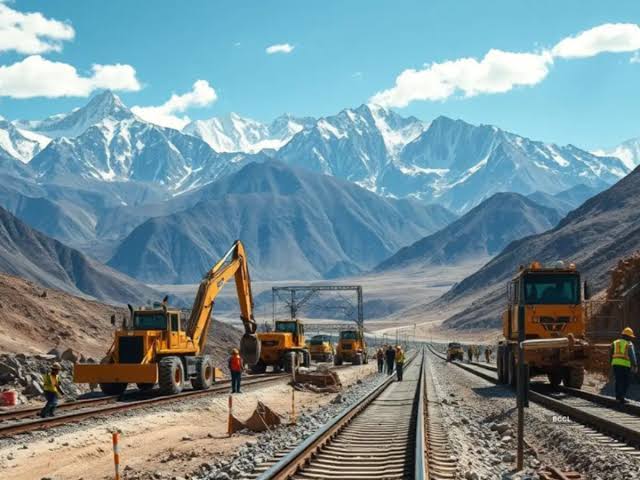
China has announced the start of construction on an ambitious railway line that will connect its Xinjiang province to Tibet. The project is a key part of China’s plan to build a 5,000-kilometer plateau rail network centered on Lhasa by 2035. However, the route’s proximity to the Line of Actual Control (LAC), the de facto border with India, has triggered significant strategic concerns in New Delhi.
The new line will link Hotan in Xinjiang with Lhasa in Tibet, with a portion of the track expected to run near the LAC, including through the disputed Aksai Chin region, which has been under Chinese occupation since 1962 but is claimed by India. This has raised alarms in India, with experts and media outlets highlighting the potential military and strategic implications of the project.
Reactions
- Indian Concerns: The news has been met with considerable apprehension in India. Analysts and media reports have pointed out that the railway line’s strategic location could allow China to rapidly deploy troops and military equipment to the border region, which remains a flashpoint for tensions between the two nuclear-armed neighbors. The railway’s construction through Aksai Chin is seen as a further assertion of China’s claim over the area and a parallel to the G219 highway, whose construction in the 1950s was a major factor leading to the 1962 Sino-Indian War. The new rail link, along with other Chinese infrastructure projects near the border, is viewed as part of a broader strategy to strengthen Beijing’s control over the region. While New Delhi has not issued an official statement, the project is expected to be a major point of discussion in diplomatic circles.
- Geopolitical Context: The railway project is being developed at a time when China and India have been in the process of normalizing relations after a four-year freeze following the military standoff in Eastern Ladakh. This development complicates those efforts and underscores the ongoing “infrastructure race” between the two nations along the Himalayan border. International defense analysts have noted that the “dual-use” nature of such infrastructure—serving both civilian and military purposes—is a significant factor contributing to regional instability.
- Chinese Perspective: From Beijing’s viewpoint, the new railway is an economic and developmental imperative. It is part of a plan to improve transportation infrastructure, boost economic integration, and promote tourism in the remote and challenging Tibetan Plateau. The project is a massive engineering undertaking, facing extreme conditions such as high altitudes, sub-zero temperatures, and permafrost, and is seen by China as a testament to its technological and infrastructural prowess. China maintains that such infrastructure projects are for the benefit of the region and will not negatively impact neighboring countries.