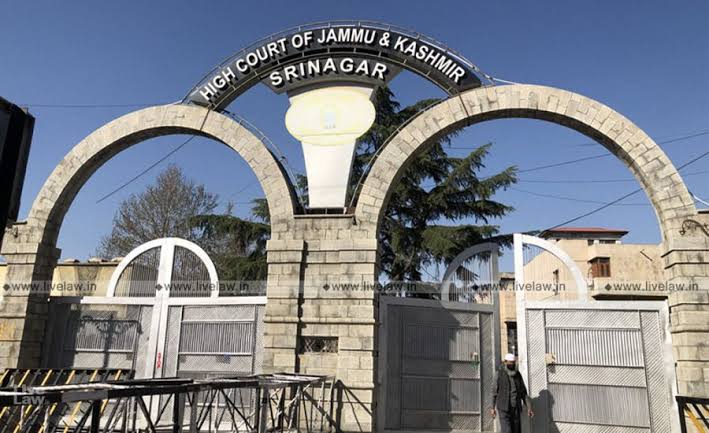
Srinagar, November 29, 2025 — A division bench of the Jammu & Kashmir and Ladakh High Court, headed by Sanjeev Kumar and Sanjay Parihar, has ruled that trade conducted across the Line of Control (LoC) between the Union Territory of Jammu & Kashmir (J&K) and Pakistan‑Occupied Kashmir (PoK) qualifies as intra-state supply under the Central Goods and Services Tax Act, 2017 (CGST Act), because PoK is legally part of the territory of the erstwhile state of J&K.
What happened
- The Court was hearing writ petitions filed by traders who had engaged in barter or supply transactions with persons across the LoC during 2017–2019. These traders challenged show-cause notices issued by tax authorities under the GST regime, which demanded tax on those cross-LoC transactions.
- The petitioners argued that cross-LoC trade should be treated as import/export (i.e. international trade) between two countries — India and Pakistan — and hence should not fall under intra-state GST rules.
What the Court decided
- The bench noted that “the area of the State presently under de facto control of Pakistan is part of the territories of the State of Jammu & Kashmir.”
- Because of that territorial identity, the Court held that both — the “supplier location” and the “place of supply” — lay within the same legal entity: J&K (as reorganised into a Union Territory). As a result, cross-LoC transactions under the 2008 Standard Operating Procedure (SOP) must be treated as intra-state trade.
- Consequently, the show-cause notices issued under Section 74(1) of the CGST Act were upheld as valid. The Court dismissed the batch of writ petitions, while noting that the petitioners have the statutory remedy of appeal under the GST regime if they wish to challenge demand orders.
Significance & Implications
- Legal / Tax Implication: The ruling clarifies that cross-LoC trade (when it existed) was not international commerce, but intra-state supply under Indian GST law. Traders are — or were — liable to pay CGST/SGST just like any other intra-state supply.
- Sovereign Assertion: By reaffirming that PoK remains legally part of J&K, the Court has reinforced the constitutional and legal position of India regarding the territorial status of PoK — at least for purposes of trade and taxation.
- Precedent for Territorial Ambiguity: The judgment may serve as a reference in future cases involving contested territories and supply classification under GST (or other laws), particularly in regions under de facto foreign control.
What this means for traders & policy
- Traders who had earlier received GST-related demands on cross-LoC barter trades may now need to approach the statutory adjudicating authorities / appeal process (rather than seeking writ-based relief).
- Even though cross-LoC trade has been suspended (since 2019), the ruling addresses historical transactions (2017–2019), meaning tax liability for that period stands on record and subject to adjudication under GST law.
- The decision provides clarity on how “location of supplier” and “place of supply” must be interpreted in contexts where territory is disputed, reducing legal uncertainty for future claims or disputes.