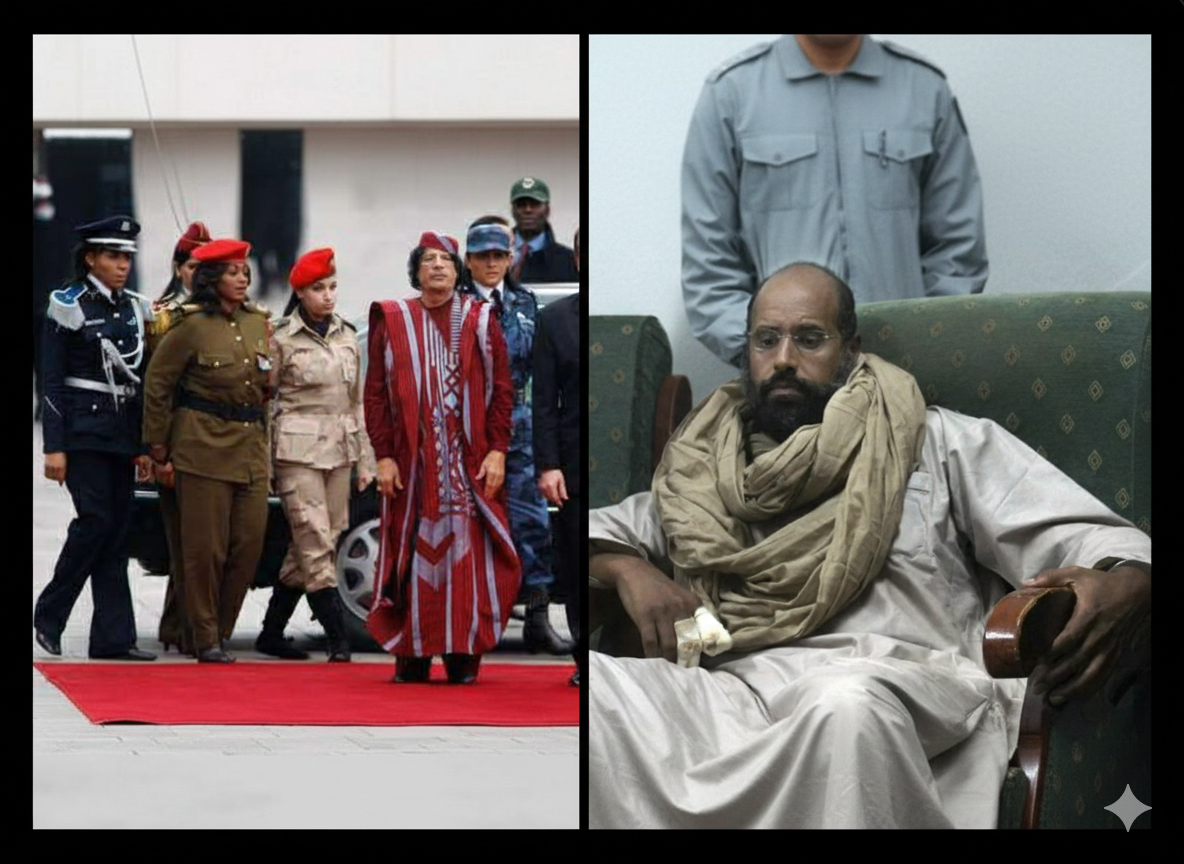
Zintan, Libya: Saif al-Islam Gaddafi — the influential son of former Libyan ruler Muammar Gaddafi — has been killed at the age of 53 after a confrontation with unidentified armed attackers, according to officials and his political circle.
Libyan authorities confirmed that the attack took place in the western city of Zintan, where he had been living for years following Libya’s civil conflict.
A statement from his political team said that “four masked assailants forcefully entered his house, disabled CCTV cameras, and shot him after a confrontation.” Authorities have launched an investigation, but responsibility for the killing remains unclear.
His French lawyer Marcel Ceccaldi told AFP: “For now, we don’t know who was behind the killing,” adding that he had recently been warned about security concerns.
A Once-Powerful Heir Turned Controversial Figure
Saif al-Islam was long viewed as the political successor to his father and had played a diplomatic role in Libya’s outreach to Western nations, including negotiations tied to disarmament and compensation for the Lockerbie bombing.
Educated in London and fluent in English, he was once seen by Western governments as a possible reform-minded leader.
However, during the 2011 uprising he backed the regime’s violent crackdown, leading to his capture by rebel fighters while trying to flee the country.
He was held by a militia for six years, sentenced to death in 2015 for war crimes, and remained wanted by the International Criminal Court even after his release in 2017.
Despite legal controversies, he attempted a political comeback by announcing a presidential bid in 2021 — a move that fueled tensions and contributed to the postponement of elections.
Analysts say his death could weaken pro-Gaddafi factions but might also remove “a key obstacle to future elections in Libya.”
Who Was Muammar Gaddafi? — The Full Historical Context
Rise to Power
Muammar al-Qaddafi (1942–2011) ruled Libya for more than four decades after seizing power in a 1969 military coup that overthrew King Idris I.
Born to a Bedouin farming family, he rose through the military while plotting the takeover with fellow officers.
Radical Policies and Rule
After consolidating authority, Gaddafi:
- Removed U.S. and British military bases from Libya.
- Nationalized foreign petroleum assets in 1973.
- Promoted his own ideology combining Arab nationalism and Islamic socialism.
His foreign policy was strongly anti-Western, and his government was repeatedly linked to militant activity abroad while supporting revolutionary movements in other countries.
Global Confrontations
Tensions with Western powers escalated dramatically in the 1980s — including U.S. airstrikes on Libya after it was blamed for attacks such as the Berlin disco bombing.
Fall and Death
Mass protests in early 2011 triggered a civil war that ultimately toppled his regime. After weeks in hiding, Gaddafi was captured and killed by rebel forces in October 2011.
Libya After Gaddafi — A Nation Still in Turmoil
Since the collapse of his rule, Libya has faced prolonged political fragmentation and conflict — conditions reflected again in the high-profile assassination of his son.
Saif al-Islam had remained a symbolic figure for loyalists even after withdrawing from active politics, highlighting the enduring legacy of the Gaddafi era in Libya’s unstable landscape.