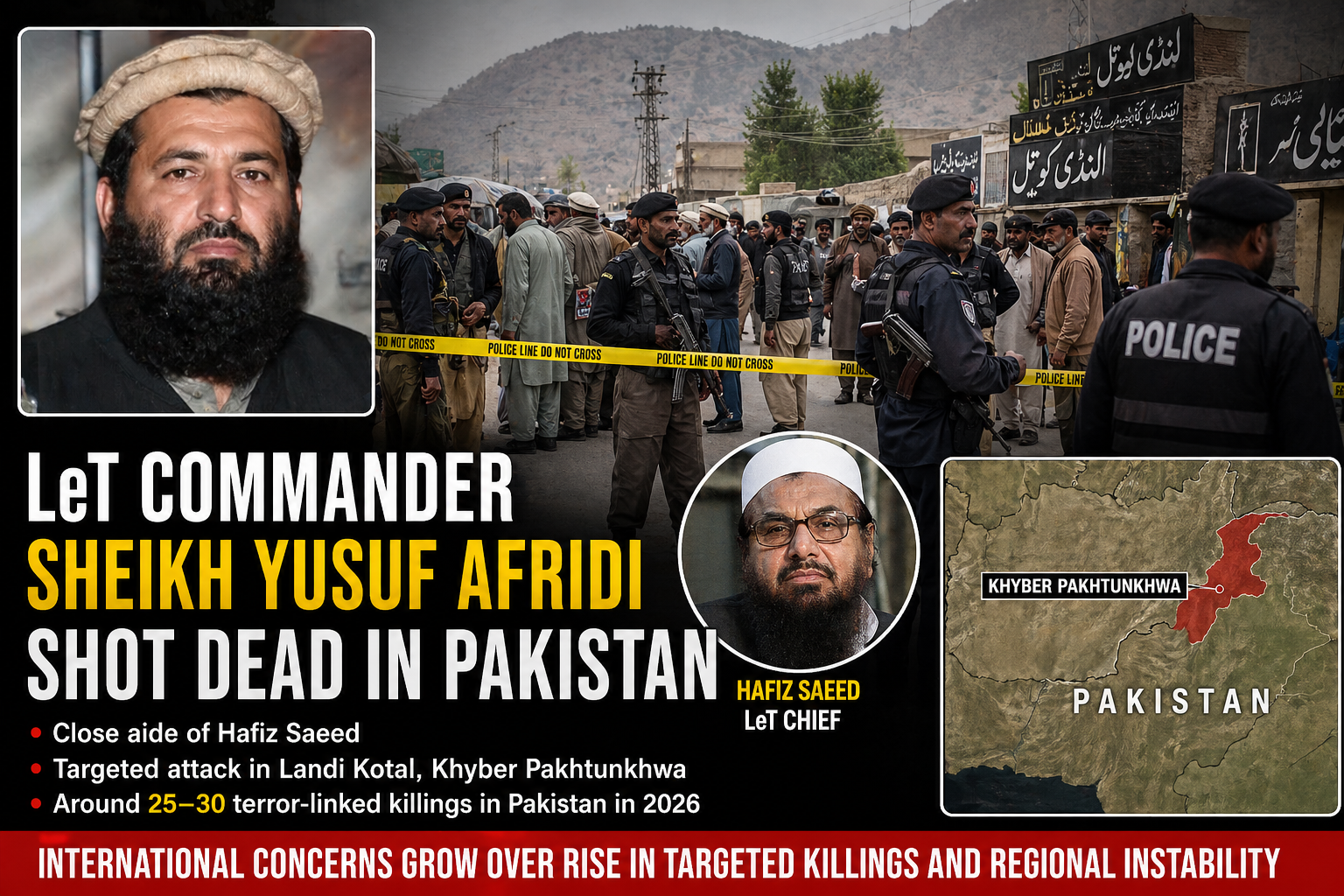
Peshawar: A senior figure linked to Lashkar-e-taiba (LeT), Sheikh Yusuf Afridi, was shot dead by unidentified gunmen in Pakistan’s Khyber Pakhtunkhwa province, according to multiple media reports. The incident, which took place in the Landi Kotal area of the Khyber region, is being seen as part of a growing pattern of targeted killings involving individuals associated with militant networks.
Afridi was reportedly a close aide of Hafiz Saeed and played a role in local coordination and recruitment activities linked to the outfit. Authorities have not yet identified the attackers or confirmed a motive.
What Happened
According to reports by NDTV ,Times of India, and ,The Indian Express Afridi was targeted in a swift shooting carried out by unknown assailants. The attackers reportedly fled the scene immediately, and no group has claimed responsibility so far.
A local police official, quoted in media reports, said:
“The attack appears to be a targeted killing. We are investigating all possible angles, but no suspects have been identified yet.”
Links to Lashkar-e-Taiba Leadership
Afridi was considered part of the inner circle of LeT’s leadership. Analysts say his role included:
- Coordinating regional activities
- Assisting recruitment efforts
- Supporting ideological outreach
A security analyst quoted by The Indian Express noted:
“Individuals like Afridi are important nodes in the operational network. His killing could disrupt certain local-level activities.”
Surge in Targeted Killings
The killing comes amid a reported rise in attacks on individuals linked to militant groups in Pakistan.
- Media estimates suggest around 25–30 such killings in 2026 alone
- Many incidents involve unknown gunmen and remain unsolved
- A significant number have occurred in Khyber Pakhtunkhwa
A senior regional security official told NDTV :
“There is a noticeable pattern. Several mid- and lower-tier operatives have been targeted in recent months.”
International Reactions
Global observers and counter-terror experts are closely watching the developments.
A South Asia security expert affiliated with the International Crisis Group commented:
“These incidents highlight internal vulnerabilities within militant ecosystems as well as possible external pressures. However, attribution remains unclear.”
Officials from the United Nations have not issued a direct statement on this specific case but have repeatedly emphasized the need for sustained counter-terror efforts in the region.
Who Is Behind the Killings?
Speculation has emerged in sections of the media about possible involvement of foreign intelligence agencies. However, no official confirmation or evidence has been provided.
A regional affairs analyst told Times of India:
“At this stage, it would be premature to attribute these killings to any particular country or agency.”
Conclusion
The killing of Sheikh Yusuf Afridi underscores a broader and increasingly complex security trend in Pakistan. Whether driven by internal rivalries, counter-terror operations, or other factors, the spike in targeted killings is adding new uncertainty to the region’s militant landscape.
With investigations ongoing and no group claiming responsibility, the incident raises more questions than answers—particularly about the forces shaping this emerging pattern of violence.