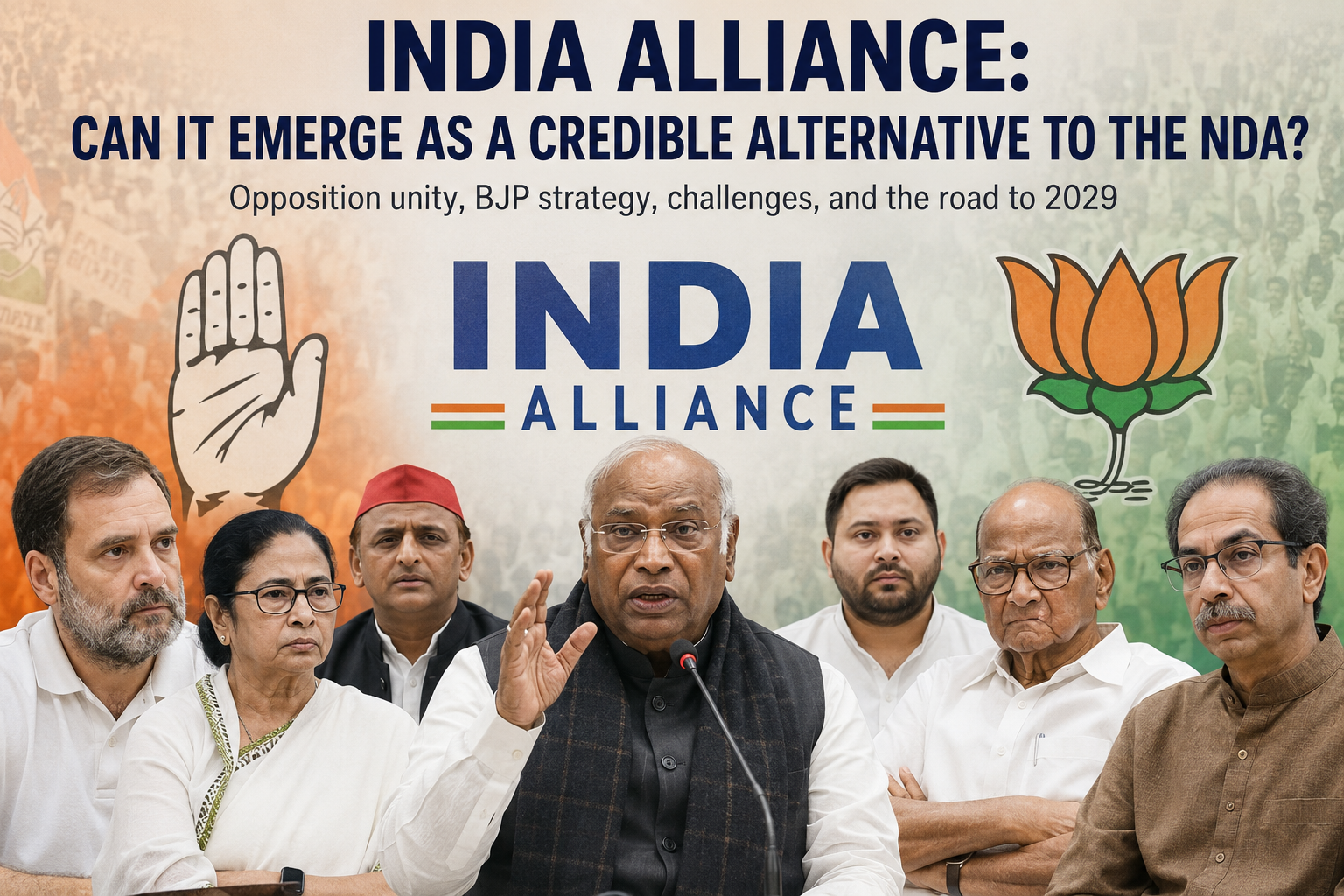
Despite the absence of key allies such as the DMK and the Aam Aadmi Party (AAP), leaders of 25 political parties attended the latest meeting of the INDIA (Indian National Developmental Inclusive Alliance) bloc in New Delhi, according to Congress president Mallikarjun Kharge. The meeting signaled that the opposition coalition remains active and committed to coordination against the ruling NDA, even as questions persist about its internal unity and long-term viability.
What Is the INDIA Alliance?
Formed in 2023, the INDIA alliance was created as a broad opposition platform aimed at challenging the BJP-led National Democratic Alliance (NDA) headed by Prime Minister Narendra Modi.
Major constituents of the alliance include:
- Indian National Congress
- All India Trinamool Congress
- Samajwadi Party
- Rashtriya Janata Dal
- Nationalist Congress Party (Sharad Pawar faction)
- Shiv Sena (UBT)
- National Conference
- Several Left parties and regional political forces
However, the absence of the DMK and AAP from recent meetings has raised concerns about cohesion within the alliance and highlighted the difficulties of maintaining unity among ideologically and regionally diverse partners.
BJP’s Expansion Strategy: More Than Electoral Competition
Over the past decade, the BJP has pursued a political strategy that extends beyond winning elections. The party has often sought to weaken opposition formations by capitalizing on internal dissent, leadership rivalries, and organizational fractures within rival parties.
The political developments in Maharashtra serve as notable examples. The split in the Shiv Sena and the subsequent division within the Nationalist Congress Party dramatically altered the state’s political landscape and reshaped alliance equations.
For many political observers, this approach has become a defining feature of contemporary Indian politics: strengthening one’s own organization while simultaneously exploiting vulnerabilities within competing parties.
West Bengal: Is Trinamool the Next Major Battleground?
West Bengal remains one of the few large states where the BJP has not yet succeeded in displacing the ruling Trinamool Congress.
Chief Minister Mamata Banerjee continues to command significant political influence. Yet challenges such as leadership succession debates, local factionalism, corruption allegations against some party figures, and pressure from central investigative agencies have periodically created political turbulence.
Some analysts argue that if internal tensions deepen, the BJP could attempt to capitalize on them, much as it did in Maharashtra. However, it is important to note that there is currently no confirmed split within the Trinamool Congress comparable to those witnessed in the Shiv Sena or NCP. Any prediction of such a development remains speculative.
Which Parties Could Become BJP’s Next Political Targets?
Political strategy is inherently fluid, making precise predictions difficult. Nevertheless, several opposition parties are often identified by analysts as key battlegrounds in the BJP’s future expansion efforts.
1. Trinamool Congress
West Bengal remains central to the BJP’s national ambitions. Any weakening of Trinamool’s organizational strength could significantly improve BJP’s prospects in the state.
2. Samajwadi Party
With Uttar Pradesh sending the largest number of MPs to Parliament, the Samajwadi Party remains one of the BJP’s principal rivals. Political contests in the state are likely to shape national politics in the coming years.
3. Rashtriya Janata Dal (RJD)
In Bihar, the growing prominence of Tejashwi Yadav has positioned the RJD as a major challenger. Bihar’s coalition dynamics could therefore become another area of intense political competition.
4. Regional Parties Across India
Many regional parties face leadership transitions, succession battles, and factional disputes. Such circumstances often create opportunities for rival parties to expand their influence.
Can the INDIA Alliance Resist BJP’s Political Advances?
For the INDIA bloc to emerge as a credible national alternative, it must address several structural weaknesses.
Develop a Common National Narrative
The alliance currently functions more as a coalition against the BJP than as a coalition united around a common vision. A shared agenda focused on employment, economic growth, federalism, social welfare, and institutional reforms could help strengthen its appeal.
Manage State-Level Rivalries
One of the alliance’s biggest challenges is that many of its partners compete directly against one another in state politics. Congress and Left parties clash in Kerala, while Congress and Trinamool have historically been rivals in West Bengal. Managing these contradictions remains crucial.
Embrace Collective Leadership
Unlike the NDA, which benefits from a nationally recognized leader in Narendra Modi, the INDIA alliance lacks a single dominant figure. A collective leadership model may therefore be its most practical approach.
Strengthen Internal Cohesion
Preventing defections and maintaining organizational unity will be essential. Internal democracy and effective conflict resolution mechanisms could help reduce vulnerabilities.
Elevate Emerging Leaders
Leaders such as Rahul Gandhi, Akhilesh Yadav, and Tejashwi Yadav represent a younger generation of opposition politics. Their growing prominence may help reshape the alliance’s public image.
Political Analysis: The Road to 2029
At present, the NDA retains a significant advantage. It benefits from a nationwide organizational network, a disciplined electoral machinery, and the leadership of Narendra Modi, who remains one of India’s most influential political figures.
Yet the INDIA alliance should not be underestimated. Collectively, its constituent parties maintain strong regional bases across West Bengal, Uttar Pradesh, Bihar, Maharashtra, Tamil Nadu, and several other states.
The alliance’s future will largely depend on three factors:
- Can it maintain unity among diverse regional parties?
- Can it present a coherent policy alternative to the NDA?
- Can it convince voters that it is a credible governing coalition rather than merely an anti-BJP platform?
Conclusion
The next phase of Indian politics is likely to be defined not only by electoral contests but also by battles over party organization, coalition management, and political narratives.
The BJP’s strategy will likely continue to focus on expanding its influence while exploiting divisions within opposition ranks. For the INDIA alliance, survival and success will depend on its ability to overcome internal contradictions and transform itself from a coalition of opposition parties into a cohesive political alternative.
The political developments unfolding in West Bengal, Bihar, Maharashtra, Uttar Pradesh, and other key states over the next few years may ultimately determine whether the INDIA alliance emerges as a genuine challenger to the NDA in 2029 or remains a loose coalition struggling to maintain unity.