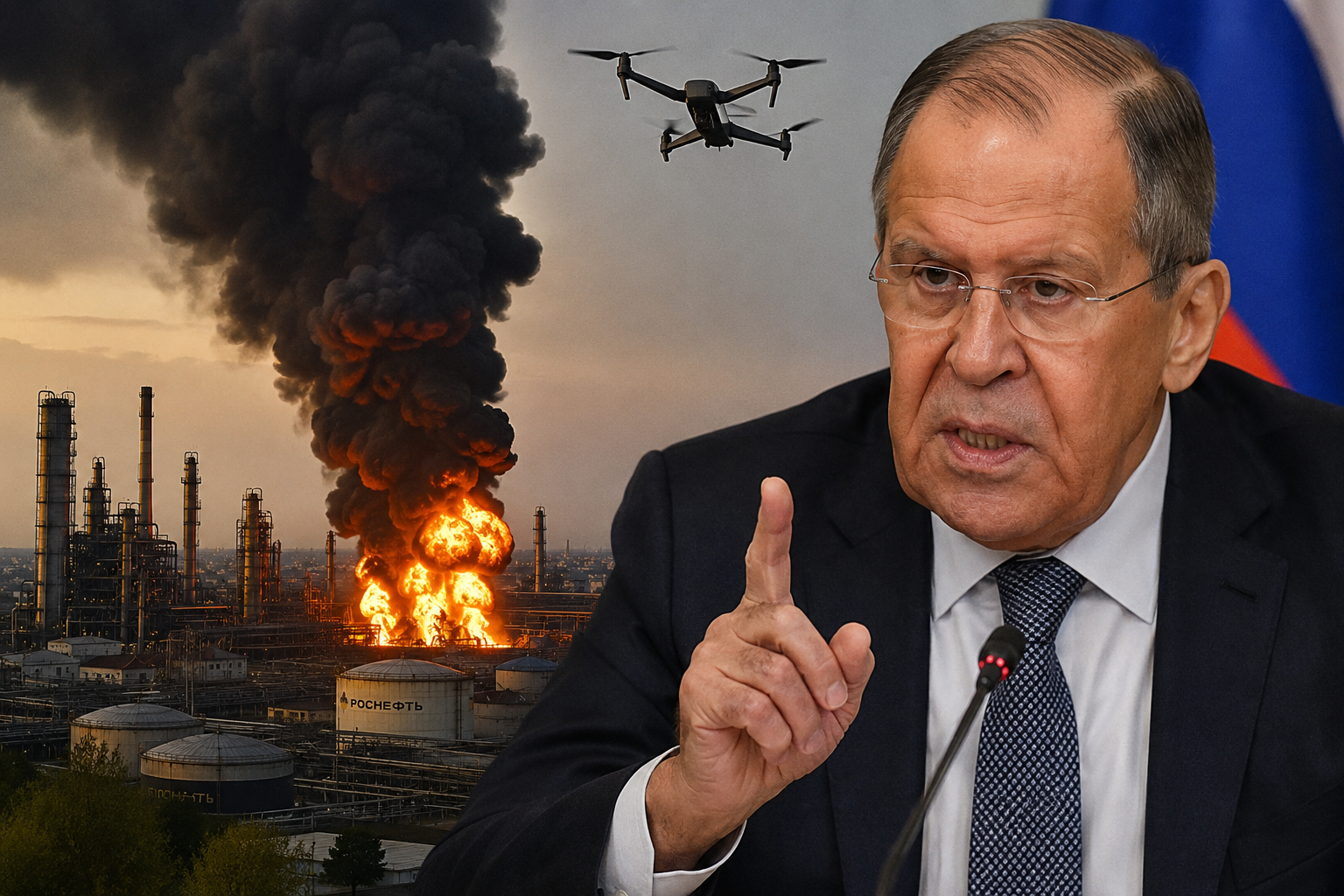
In the wake of a major Ukrainian drone attack targeting key oil refining facilities in Moscow, Russian Foreign Minister Sergey Lavrov has issued a stern warning that has raised concerns across the international community. As the Russia-Ukraine war enters its fifth year, renewed references to nuclear risks have once again brought global security into focus.
Escalation in the Heart of Russia
Ukraine has increasingly targeted Russia’s military and energy infrastructure deep inside Russian territory. The recent strike on the Kapotnya oil refinery, one of Moscow’s most important fuel-processing facilities, is being viewed as a significant blow to Russia’s energy network and wartime logistics.
According to international media reports, the attack triggered fires and temporarily disrupted operations, highlighting Ukraine’s growing ability to strike strategic targets far from the front lines.
Kyiv argues that Russian oil infrastructure is a legitimate military target because energy revenues continue to finance Moscow’s war effort. Russia, however, has condemned such attacks as acts of terrorism.
Lavrov’s Strong Response
Speaking during diplomatic engagements, Lavrov declared:
“Words are not enough.”
The statement was widely interpreted as a signal that Moscow intends to respond with stronger military measures rather than relying solely on diplomatic protests.
He further warned:
“Massive strikes will continue.”
The remarks suggest that Russia plans to intensify large-scale missile and drone attacks against Ukrainian targets in response to continued strikes on Russian territory.
Why Nuclear Concerns Are Back in the Headlines
Russia’s official nuclear doctrine allows the use of nuclear weapons if the state faces an existential threat. As Western nations continue supplying advanced weapons and military aid to Ukraine, some Russian officials have increasingly framed the conflict as a broader confrontation between Russia and NATO.
Lavrov has previously issued warnings about the dangers of escalation. In 2022, he stated:
“A third world war would be nuclear and destructive.”
His latest comments have prompted international observers to revisit concerns about the potential consequences of a prolonged and expanding conflict.
Russia–Ukraine War: Key Timeline
2014
• Russia annexed Crimea.
• Armed conflict began in Ukraine’s eastern Donbas region.
2021
• Russia massed troops along Ukraine’s borders.
• Western governments warned of a possible invasion.
February 24, 2022
• Russia launched its full-scale invasion of Ukraine.
• President Vladimir Putin described the offensive as a “special military operation.”
March–April 2022
• Russia’s attempt to capture Kyiv failed.
• Ukrainian forces pushed Russian troops away from the capital.
September 2022
• Ukraine launched a successful counteroffensive in the Kharkiv region.
• Large areas of occupied territory were recaptured.
November 2022
• Ukrainian forces retook the city of Kherson.
2023
• Ukraine began a major counteroffensive in southern and eastern regions.
• Heavy fighting continued along fortified Russian defensive lines.
2024
• Russia gained ground in parts of eastern Ukraine.
• Drone warfare became a defining feature of the conflict.
2025
• Ukraine intensified attacks on Russian oil refineries, air bases, and military facilities.
• Russia expanded missile and drone strikes against Ukrainian infrastructure.
2026
• Large-scale drone attacks targeted oil facilities in the Moscow region.
• Lavrov issued fresh warnings amid rising tensions.
• NATO and European governments expressed growing concern over regional security risks.
What International Analysts Say
Most security experts believe the likelihood of Russia using nuclear weapons remains low, despite increasingly aggressive rhetoric. Several factors continue to act as deterrents:
• NATO’s strong military posture.
• Opposition from major powers such as China and India to any nuclear escalation.
• The risk of severe international isolation for Russia.
• Moscow’s continued ability to respond through conventional military means.
However, analysts caution that the growing frequency of drone strikes, long-range attacks, and retaliatory operations increases the risk of miscalculation, which could lead to a broader and more dangerous confrontation.
Conclusion
The attack on Moscow’s oil refinery marks more than just another battlefield development; it symbolizes a new phase in the Russia-Ukraine war, where strategic infrastructure far from the front lines is increasingly becoming a target. While Lavrov’s warning does not indicate an imminent nuclear strike, it underscores the heightened tensions surrounding the conflict and the growing concerns about global security.
As the war continues, the world is once again confronting questions about deterrence, escalation, and the shadow of nuclear conflict. Whether the current crisis remains contained or develops into a wider geopolitical confrontation may depend on the decisions taken in Moscow, Kyiv, Washington, and European capitals in the months ahead.