By International Desk
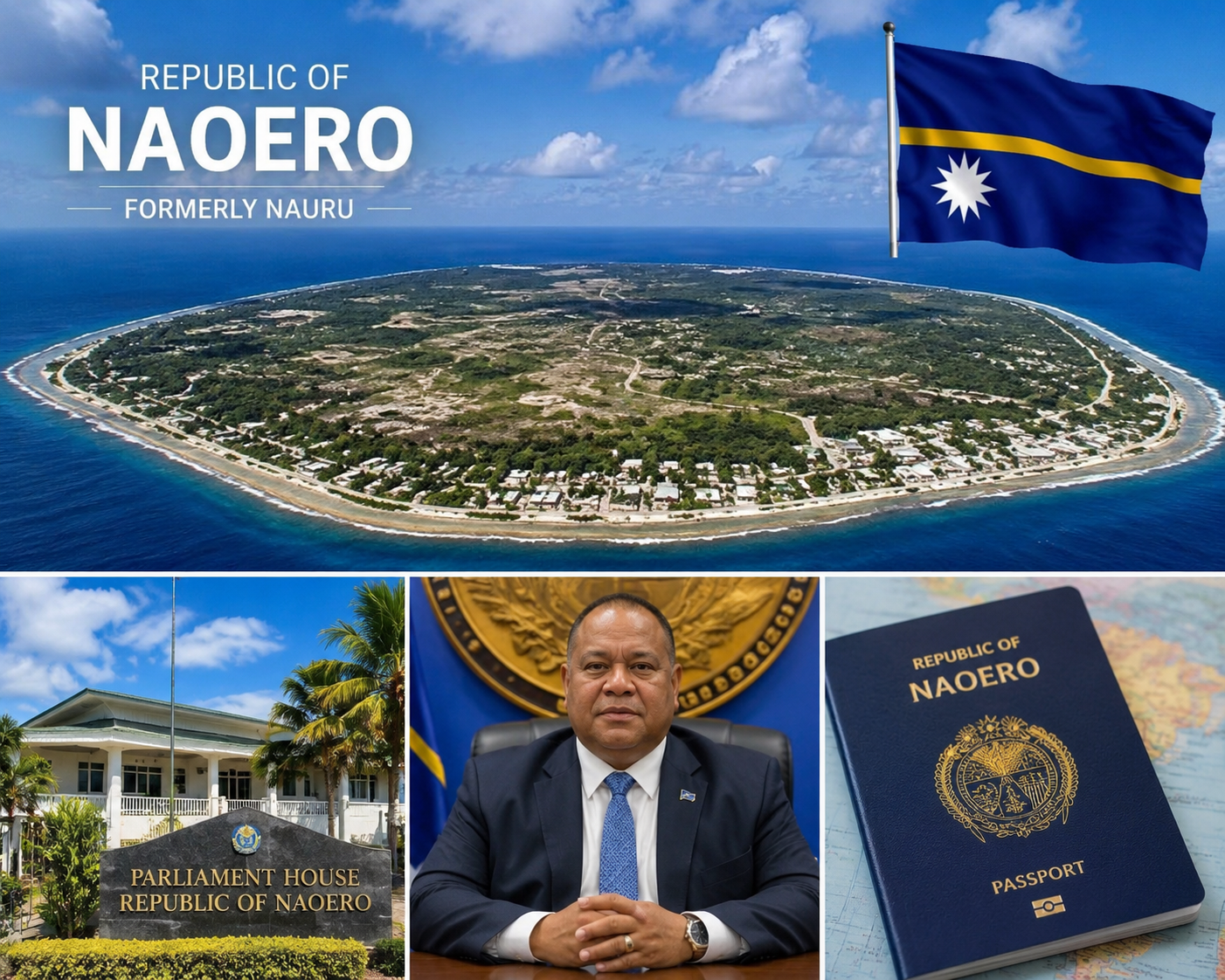
In a landmark move to restore its indigenous identity and cultural heritage, the South Pacific island nation of Nauru has officially changed its name to the Republic of Naoero. The constitutional amendment, introduced under President David W. R. Adeang, replaces the colonial-era name “Nauru” with the traditional name used by the island’s indigenous people for centuries.
Government officials said the change reflects the authentic pronunciation, spelling, and linguistic traditions of the Naoero language and marks an important step toward reclaiming the nation’s historical and cultural identity.
Official Changes
Under the constitutional amendment:
- The country’s official name is now Republic of Naoero.
- The international country abbreviation has changed from NRU to NRO.
- Citizens will officially be known as dei-Naoero instead of “Nauruans.”
- The country’s name will be pronounced “Naoero” rather than “Nauru.”
- Government aircraft, ships, official seals, passports, and state documents are being updated to reflect the new national identity.
Restoring a Traditional Name
According to the government, “Naoero” has always been the island’s traditional indigenous name. During German colonial rule in the late 19th century, European administrators adopted the easier-to-pronounce name “Nauru,” which continued under Australian administration and remained in use after independence.
President David Adeang described the renaming as “not merely a change of name, but the restoration of our people’s identity, language, and heritage.”
Parliamentary Approval
The constitutional amendment was approved unanimously in both required readings of Parliament.
Although the government initially considered holding a national referendum, lawmakers later concluded that public voting was unnecessary because “Naoero” had always existed in the country’s Constitution, national symbols, and cultural traditions.
Geography
Located in the central South Pacific Ocean, the Republic of Naoero covers only 21 square kilometres (8.1 square miles) and has a population of approximately 12,000 people.
It is:
- The world’s smallest independent republic.
- The third least-populated sovereign country after Vatican City and Tuvalu.
Historical Background
British navigator John Fearn first sighted the island in 1798 and named it Pleasant Island.
Key historical milestones include:
- 1888: Annexed by the German Empire.
- 1914: Occupied by Australia during World War I.
- 1920: Administered jointly by Australia, New Zealand, and the United Kingdom under a League of Nations mandate.
- 1942–1945: Occupied by Japan during World War II, with many islanders deported to Chuuk.
- 31 January 1968: Achieved full independence.
From Extraordinary Wealth to Economic Collapse
Naoero was once among the world’s wealthiest nations on a per-capita basis due to its enormous phosphate reserves.
During the 1970s and 1980s, phosphate mining generated billions of dollars in revenue. However, decades of intensive extraction left nearly 80 percent of the island environmentally devastated.
When phosphate reserves declined, the economy collapsed, leading to severe financial crises throughout the 1990s.
The government has since pursued economic diversification, including fisheries, offshore services, climate financing, and citizenship-by-investment programmes.
Culture and Language
The Naoero language, an Austronesian language spoken only on the island, remains a central element of national identity.
While English continues to serve as the primary language of government and international affairs, authorities are placing renewed emphasis on preserving and promoting the indigenous language.
Officials say the name change forms part of a broader cultural revival aimed at strengthening national identity for future generations.
Religion
Christianity is the dominant religion in the Republic of Naoero.
The principal denominations include:
- Nauru Congregational Church
- Roman Catholic Church
- Various Protestant churches
The Constitution guarantees freedom of religion.
Government
Naoero operates as a parliamentary republic.
- Head of State and Government: President David W. R. Adeang
- Legislature: A unicameral Parliament
- The President is elected by members of Parliament.
Defence and Security
Naoero has no standing military force.
National defence is supported through close security cooperation with Australia, while domestic law enforcement is handled by the Naoero Police Force and maritime security agencies.
Climate Change Threat
The Republic of Naoero is considered one of the countries most vulnerable to climate change.
Major challenges include:
- Rising sea levels
- Coastal erosion
- Saltwater intrusion
- Freshwater shortages
- Increasing threats to infrastructure and housing
To finance climate adaptation projects, the government has sought foreign investment through citizenship-by-investment initiatives and international climate partnerships.
International Recognition
The United Nations has updated its official records to reflect the country’s new name.
Governments including Australia, New Zealand, the United States, and China have also begun recognizing the new designation in official diplomatic communications.
International media organizations, including Reuters, Associated Press (AP), The Guardian, and People, have described the renaming as part of a broader global movement in which countries seek to replace colonial-era names with indigenous ones, similar to the transitions from Swaziland to Eswatini, Turkey to Türkiye, and the increasing international use of Czechia.
A Symbol of National Pride
For the people of the Republic of Naoero, the renaming represents far more than a constitutional amendment. It symbolizes the restoration of a national identity shaped by indigenous language, culture, and history after more than a century of colonial influence.
As one of the world’s smallest nations confronting some of the greatest challenges—from climate change to economic transformation—the adoption of its traditional name stands as a powerful affirmation of sovereignty, cultural resilience, and national pride.