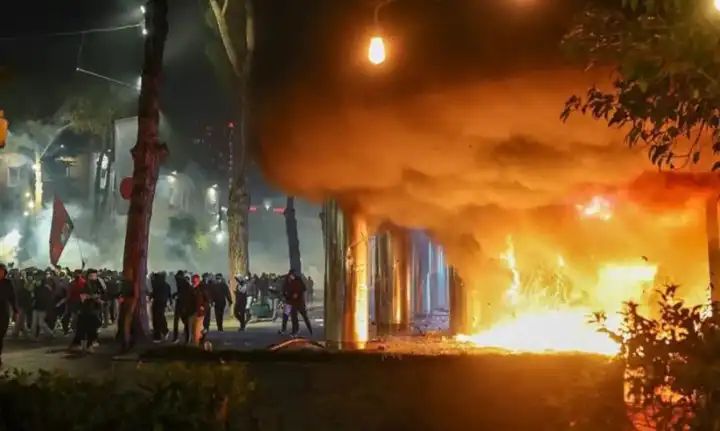
TIRANA: Student-led anti-government protests in Albania have escalated into violent clashes in the capital, Tirana, with demonstrators setting fire to the Ministry of Education and damaging nearby businesses. Police deployed tear gas and water cannons to disperse protesters as demonstrations over education costs, university conditions and alleged government corruption intensified.
According to reports by international media outlets, including Reuters, the Associated Press (AP), Al Jazeera and Deutsche Welle (DW), the unrest has become part of a broader anti-government movement demanding accountability and the resignation of Prime Minister Edi Rama. The latest violence marks a significant escalation in protests that have been challenging the government for months.
Education Ministry Set Ablaze During Clashes
The situation deteriorated on Tuesday and Wednesday, October 13 and 14, as hundreds of students and other demonstrators gathered outside the Ministry of Education in Tirana. Thousands joined the demonstrations as the protests intensified.
According to Reuters, the ministry caught fire on Wednesday during the second day of student protests. Some demonstrators threw bricks at the building, dismantled metal street barriers and overturned rubbish bins. A nearby Raiffeisen Bank branch also caught fire, according to a Reuters witness.
Al Jazeera, citing police and other reports, said demonstrators entered the ministry grounds and started a fire inside the building. Firefighters were called to extinguish the flames as clashes continued in the surrounding streets.
Protesters also damaged other government buildings and businesses. According to the Associated Press, the unrest involved attacks on government institutions, banks and commercial properties, with fires and vandalism reported in several locations.
The demonstrations have increasingly focused on both students’ grievances and wider public anger over alleged corruption within the government.
Police Deploy Tear Gas and Water Cannons
Police in riot gear moved to disperse the crowds after demonstrators threw stones, firecrackers and other objects during confrontations with security personnel.
Officers responded with tear gas and water cannons as protesters attempted to maintain their positions near government buildings. Police also made arrests during the clashes.
According to the Associated Press, authorities reported that 23 police officers and six civilians were injured, while 35 people were arrested in connection with the unrest. Al Jazeera separately reported that at least 16 additional protesters were arrested following clashes on Wednesday. The figures reflect reports at different stages of the demonstrations.
The European Union’s delegation to Albania expressed concern over the escalation and called for an investigation into allegations of excessive force against protesters and journalists.
In a statement reported by Anadolu Agency, the EU delegation stressed that police action must be proportionate and respect fundamental rights. It also called on all sides to reduce tensions and pursue constructive dialogue.
Why Are Albanian Students Protesting?
The immediate grievances include rising higher-education costs, inadequate university facilities, limited financial support for students and uncertainty about employment opportunities after graduation.
Student organisers have argued that young people need better educational conditions and greater opportunities to build their futures in Albania.
The protests have also become part of a wider movement against alleged corruption and a perceived lack of transparency in government decision-making.
Demonstrators have called for Prime Minister Edi Rama to resign, accusing his administration of failing to address public concerns. These are protesters’ demands and allegations; they do not, by themselves, establish wrongdoing by the government.
The ‘Flamingo Revolution’
The latest student demonstrations are connected to a broader protest movement known as the ‘Flamingo Revolution’, which began months earlier.
According to Al Jazeera, the movement initially emerged in opposition to a luxury resort development in a protected area of southern Albania. The project has been linked to Jared Kushner, the son-in-law of US President Donald Trump, and has fuelled concerns among protesters about alleged corruption and a lack of transparency.
The movement subsequently expanded to include broader demands for political accountability, better opportunities for young people and the resignation of Rama.
Besar Likmeta, editor of the Balkan Investigative Reporting Network in Albania, told Al Jazeera that the protests followed months of demonstrations in the capital and reflected growing frustration among younger Albanians over limited opportunities and corruption concerns.
Deputy Prime Minister Condemns Violence
Albanian Deputy Prime Minister Albana Koçiu condemned the violence while acknowledging the right of citizens to demonstrate peacefully.
In a statement published on Facebook and quoted by Al Jazeera, she said:
“Protesting is a legitimate right, but it cannot be used as an excuse for violence, city destruction or ugly fighting in the middle of the road.”
Koçiu urged students and other demonstrators to distance themselves from violence and vandalism.
Her response reflects the government’s position that the right to protest must not be used to justify attacks on public institutions, police officers or private property.
Government Under Growing Pressure
The latest unrest presents another challenge for Prime Minister Edi Rama’s government, which has faced months of anti-corruption demonstrations.
Although the student protests have highlighted education-related grievances, they have also become part of a wider debate about government accountability, economic opportunities and public trust.
Albania is seeking membership in the European Union, making concerns about corruption, institutional transparency and the protection of democratic rights particularly significant.
The European Union’s call for restraint and an investigation into allegations of excessive police force underscores the importance of protecting both the right to peaceful protest and public safety.
As demonstrations continue, the key questions are whether the government will respond to students’ demands, whether protesters will maintain peaceful demonstrations and whether the authorities will investigate the violence and allegations of police misconduct.
Sources: Reuters, Associated Press, Al Jazeera, Deutsche Welle and Anadolu Agency.