New Delhi | November 10, 2026
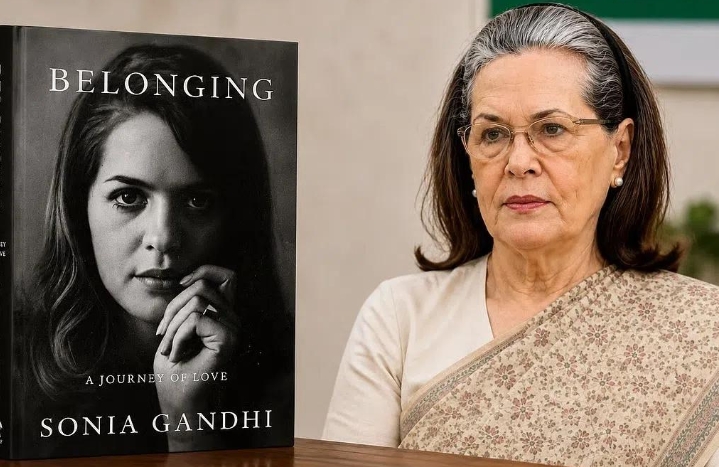
The publication of senior Congress leader Sonia Gandhi’s memoir, Belonging: A Journey of Love, has sparked a fresh political confrontation between the Congress and the Bharatiya Janata Party (BJP), bringing one of the most controversial chapters in India’s democratic history — the Emergency of 1975–77 — back into the national spotlight.
The memoir, which reflects on Sonia Gandhi’s personal journey, family relationships, political experiences and the evolution of Indian politics, has attracted considerable attention for its observations on former Prime Minister Indira Gandhi, the role of Sanjay Gandhi during the Emergency and the political developments that shaped the Congress party.
However, it is the book’s account of the Emergency that has triggered the sharpest political reaction. While Sonia Gandhi acknowledges that the decision to impose the Emergency was a mistake, the BJP has accused her of attempting to soften the historical record of the Congress government and avoid confronting the full extent of the period’s excesses.
The controversy has developed into a wider political debate over democratic accountability, historical responsibility and the legacy of the Nehru-Gandhi family.
Emergency remarks trigger BJP’s criticism
One of the most significant sections of the memoir deals with the Emergency, imposed by Prime Minister Indira Gandhi on June 25, 1975. The 21-month period witnessed the suspension of several civil liberties, the detention of opposition leaders, press censorship and restrictions on democratic institutions.
Reflecting on the decision, Sonia Gandhi describes the Emergency as a mistake and suggests that Indira Gandhi eventually recognised the consequences of her actions.
She also discusses the influence of Sanjay Gandhi during that period, arguing that keeping him under control could have prevented much of the damage associated with the Emergency.
The memoir reportedly revisits controversial episodes, including forced sterilisation programmes and demolitions in Delhi’s Turkman Gate area, which remain painful reminders of the excesses committed during the period.
The BJP, however, believes that such personal reflections do not adequately address the political and constitutional responsibility of the Congress leadership.
BJP calls memoir ‘Whitewashing’
The BJP launched a sharp attack on Sonia Gandhi following the book’s publication. Party spokesperson C. R. Kesavan criticised the memoir on social media, suggesting that it should have been titled Whitewashing rather than Belonging: A Journey of Love.
The BJP alleged that the book attempts to present a softer version of the Gandhi family’s political legacy while failing to fully acknowledge the consequences of controversial decisions taken during Congress rule.
The party also questioned the memoir’s treatment of other sensitive political episodes, including the 1984 anti-Sikh violence, the Babri Masjid demolition and the 2008 Batla House encounter.
The BJP argued that historical events involving questions of governance, public accountability and human suffering should not be examined merely through personal recollections.
The criticism has added another dimension to the ongoing political rivalry between the two national parties.
Congress and BJP clash over historical accountability
The controversy has once again exposed the sharp differences between the Congress and BJP over India’s political history.
The BJP has consistently highlighted the Emergency as evidence of the Congress party’s failure to uphold democratic principles. It argues that the suspension of civil liberties and the detention of political opponents remain among the darkest episodes in independent India’s history.
The Congress, meanwhile, has accused the BJP of repeatedly using historical controversies for political advantage rather than addressing contemporary national concerns.
The publication of Sonia Gandhi’s memoir has provided both parties with another opportunity to defend their respective political narratives.
At the centre of the debate is a larger question: how should political leaders acknowledge historical mistakes while explaining the circumstances and decisions that shaped their political journeys?
Sonia Gandhi recalls rejecting the Prime Minister’s post in 2004
Another important aspect of the memoir concerns Sonia Gandhi’s decision not to become Prime Minister following the Congress-led United Progressive Alliance’s electoral victory in 2004.
Her decision at the time surprised political observers, as she had played a crucial role in the Congress campaign and the formation of the coalition government.
Sonia Gandhi recalls that she had already decided against occupying the Prime Minister’s position and that the decision was personal.
She also addresses suggestions that then President A. P. J. Abdul Kalam had prevented her from becoming Prime Minister because of her foreign origin. According to her account, she never formally sought the position and instead supported Manmohan Singh as the leader of the government.
The episode remains an important chapter in contemporary Indian politics, particularly in discussions surrounding leadership, political authority and the influence of the Gandhi family within the Congress.
Concerns over democratic institutions and political environment
The memoir also offers Sonia Gandhi’s assessment of India’s changing political environment under Prime Minister Narendra Modi.
She expresses concern about the growing confrontational nature of political relationships, the treatment of opposition leaders and the functioning of democratic institutions.
She contrasts the political communication between rival leaders in earlier decades with what she describes as the increasingly difficult atmosphere in contemporary politics.
Her observations touch upon press freedom, political dissent and the role of constitutional institutions.
These comments are likely to attract further criticism from the BJP, which has repeatedly defended its governance record and rejected allegations that democratic institutions are being weakened.
Publication dispute adds to controversy
The memoir’s publication journey has also attracted attention.
The book was initially associated with Penguin Random House India before the publication arrangement changed, with HarperCollins eventually handling its Indian publication.
Reports surrounding the change raised questions about editorial independence and the treatment of politically sensitive passages concerning the Modi government.
Sonia Gandhi reportedly suggested that the earlier publisher was uncomfortable with criticism of the government. Penguin disputed the suggestion that it withdrew because she refused to make editorial changes.
The disagreement brought wider attention to the relationship between publishing houses, political criticism and freedom of expression.
A politically significant publication
Beyond the immediate exchange between the Congress and BJP, the memoir carries broader political significance.
The Emergency remains a defining episode in India’s democratic history, and its legacy continues to influence discussions about constitutional safeguards, civil liberties and executive power.
The book also provides a personal account of the political evolution of the Gandhi family, although its interpretations are likely to remain subject to public scrutiny and historical debate.
For the Congress, the memoir offers an opportunity to present Sonia Gandhi’s perspective on important political developments and defend aspects of the party’s historical legacy. For the BJP, the controversy provides another opportunity to highlight the Emergency and question the Congress leadership’s record on democracy.
Conclusion
Sonia Gandhi’s Belonging: A Journey of Love has emerged as more than a personal memoir. Its reflections on the Emergency, the Gandhi family’s political legacy, the 2004 Prime Ministerial decision and the present political environment have reopened several longstanding debates in Indian public life.
While the BJP has accused Sonia Gandhi of attempting to whitewash controversial chapters of Congress history, the Congress maintains that the memoir should be judged on the basis of its contents rather than political criticism.
As the debate continues, the book is likely to remain a subject of political discussion, particularly over how India’s major political parties interpret their past and address questions of democratic accountability.