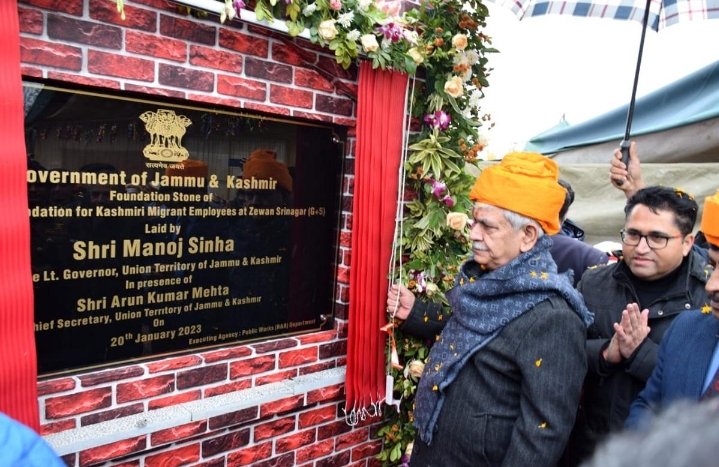
Srinagar, November 2, 2026: In a significant step towards the rehabilitation of displaced Kashmiri Pandits, Jammu and Kashmir Lieutenant Governor Manoj Sinha on Sunday handed over keys to newly constructed transit accommodation in Srinagar, providing 936 flats to employees appointed under the Prime Minister’s Rehabilitation Package.
The housing complex at Zewan, Srinagar, is part of a larger initiative aimed at facilitating the safe and dignified return of Kashmiri Pandit families to the Kashmir Valley.
Sinha also virtually inaugurated residential complexes at Kakan Maran in Budgam and Kulangam Bagh in Kupwara. Together, the three complexes comprise 1,416 flats.
Addressing the gathering, Sinha said Kashmir’s cultural and spiritual heritage would remain incomplete without the return of Kashmiri Pandits.
“Kashmir is incomplete without Kashmiri Pandits and is deprived of a precious part of its soul,” he said, emphasising that their return with dignity, security and confidence was essential to restoring the region’s historical heritage.
Details of the Housing Project
The Zewan complex, the largest under the project, consists of 936 flats across 39 blocks. All the flats have been allotted to eligible employees.
The other two complexes include:
- Kulangam Bagh, Kupwara: 288 flats across 18 blocks.
- Kakan Maran, Budgam: 192 flats across 12 blocks.
The overall transit accommodation project envisages the construction of 6,000 flats across 342 blocks at 20 locations in 10 districts of the Kashmir Valley.
The project was accelerated in 2020 under a mission-mode approach. Of the 6,000 sanctioned flats, more than 5,200 have been completed, while over 3,800 have already been allotted.
The administration has been directed to ensure uninterrupted electricity and water supply, adequate security, effective waste management and prompt grievance redressal for residents.
Historical Background: The Exodus of Kashmiri Pandits
Kashmiri Pandits are a Hindu community indigenous to the Kashmir Valley, with a rich cultural, literary and spiritual heritage.
In the late 1980s, the Valley witnessed a surge in militancy and targeted violence. Threats and killings of members of the Kashmiri Pandit community created widespread fear and insecurity.
The killings of prominent community figures, including Tika Lal Taploo in 1989 and former judge Neelkanth Ganjoo in 1989, intensified the sense of danger.
In January 1990, amid escalating violence and threats, large numbers of Kashmiri Pandit families began leaving the Valley. Many relocated to Jammu, Delhi and other parts of India.
The displacement became one of the most consequential episodes in Kashmir’s modern history, leaving thousands of families separated from their ancestral homes and communities.
Government Rehabilitation Efforts
Successive governments have introduced measures to support displaced Kashmiri Pandits.
In 2008, the Manmohan Singh-led UPA government announced a rehabilitation package that included housing assistance, financial support and employment opportunities.
In 2015, the Narendra Modi-led government announced an additional package providing 3,000 government jobs and 6,000 transit accommodation units for displaced Kashmiri Pandits returning to work in the Valley.
The newly inaugurated flats are part of this broader rehabilitation effort, intended to provide secure housing for employees serving in Kashmir.
A Step Towards Return
The handover of the flats marks an important milestone for employees and their families who have waited years for secure accommodation.
However, the broader challenge of the community’s return remains. Long-term rehabilitation also depends on security, restoration of property rights, employment opportunities and rebuilding trust.
The latest housing initiative represents a significant step towards enabling displaced Kashmiri Pandits to reconnect with their homeland and preserve the Valley’s shared cultural heritage.