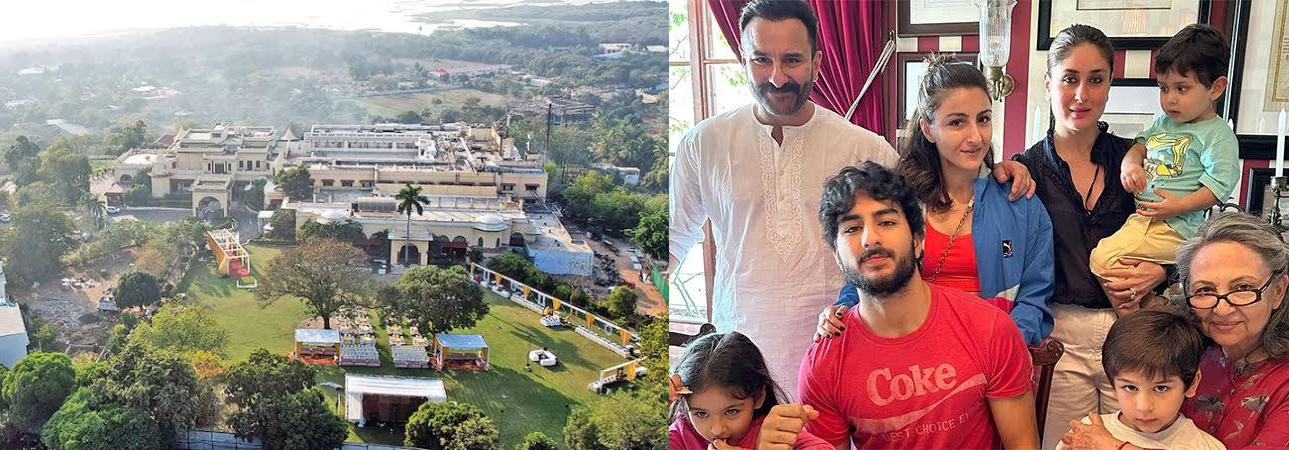
BHOPAL, India – Actor Saif Ali Khan’s long-standing petition challenging the government’s decision to label his ancestral properties in Madhya Pradesh, estimated to be worth ₹15,000 crore, as ‘enemy property’ has been dismissed.
The High Court has set aside a 2000 trial court order that had recognized Saif Ali Khan, his sisters Soha and Saba, and mother Sharmila Tagore as legal heirs to the ancestral properties. The High Court has now directed the trial court to rehear the property inheritance dispute and set a one-year deadline for its resolution.
The Pataudi family had laid claim to their properties in Bhopal and Raisen, which include the Flag House of Kohefiza, Ahmedabad Palace, Kothi, and forest in Chiklod, Raisen. They asserted ownership over properties including Noor-us-Sabah, Flag House, Dar-us-Salam, Four Quarters, New Quarters, Fars Khana, Kohefiza, and Ahmedabad Palace.
What is the Case? – A Deep Dive into the Historical Context.
The complex legal battle revolves around the legacy of the former princely state of Bhopal and the subsequent partition of India.
- Bhopal and the Last Nawab: In 1947, Bhopal was a princely state. Its last Nawab was Nawab Hamidullah Khan, who was the maternal grandfather of Mansoor Ali Khan Pataudi (Saif Ali Khan’s father).
- Partition and Succession: Nawab Hamidullah Khan had three daughters.
- His eldest daughter, Abida Sultan, migrated to Pakistan in 1950.
- His second daughter, Sajida Sultan, remained in India and married Nawab Iftikhar Ali Khan Pataudi, who was Saif Ali Khan’s paternal grandfather. Sajida Sultan thus became a legal heir to the properties.
- Merger Agreement and Succession Law: Nawab Hamidullah Khan passed away on February 4, 1960. Prior to this, on April 30, 1949, the State of Bhopal had merged with the Indian Union. According to a written agreement, the Nawab’s special privileges would continue even after the merger, and the full ownership of personal property would be governed by the Bhopal Throne Succession Law of 1947.
- Sajida Sultan as Nawab: Following Hamidullah Khan’s demise, Sajida Sultan was declared the Nawab. On January 10, 1962, the government issued a letter referring to ancestral property under Article 366 (22) of the Constitution.
- Initial Legal Proceedings: After Nawab Hamidullah Khan’s death, his private property was supposed to be divided between the plaintiff and the defendant as per Muslim Personal Law. An application seeking property inheritance was filed in the Bhopal District Court. However, the District Court dismissed their application based on a decision passed by the Allahabad High Court.
- High Court Intervention in 2000: In 2000, Begum Suraiya Rashid, Begum Mehar Taj, Sajida Sultan, Nawabzadi Qamar Taj Rabia Sultan, Nawab Mehar Taj Sajida Sultan – as successors of the Bhopal State – filed two appeals in the High Court against the order issued by the Bhopal District Court.
- Madhya Pradesh High Court’s Latest Ruling: The Madhya Pradesh High Court, in its latest order, noted that the trial court had dismissed the case based on an order issued by the Allahabad High Court. Crucially, the High Court stated that the trial court had failed to consider the fact that the Supreme Court had set aside the Throne Succession Law related to the merger.
- Parties Involved in the Appeals: The appeals had named Mansoor Ali Khan Pataudi, his wife Sharmila Tagore, their son Saif Ali Khan, and daughters Saba and Soha as respondents.
The ‘Enemy Property’ Angle:
The classification of these properties as ‘enemy property’ is a key aspect of the current dispute. - The ‘Enemy Property’ Ordinance/Act: This legislation deals with properties left behind by those who migrated to Pakistan or China after the partition of India or subsequent conflicts. The Custodian of Enemy Property for India (CEPI) is vested with such properties.
- 2015 Declaration: In 2015, the Mumbai-based Custodian of Enemy Property for India (CEPI) declared the Nawab of Bhopal’s land in Bhopal as government property. This declaration immediately led the Pataudi family to seek legal recourse.
- 2019 Developments: In 2019, a court had recognized Sajida Sultan as a legal heir and granted her grandson, Saif Ali Khan, a share of the properties. However, Abida Sultan’s migration to Pakistan remained the central reason for the Central Government’s claim over the properties as ‘enemy property.’ The government’s stance is that because the eldest daughter of the Nawab migrated to Pakistan, her share (or potentially the entire property) falls under the Enemy Property Act.
The High Court’s recent decision to quash the 2000 trial court order and send the matter back for re-hearing signifies that the Pataudi family must now present their case again to prove their rightful ownership and challenge the ‘enemy property’ classification on the grounds of valid succession and Indian citizenship of the primary heirs. The battle for the sprawling ancestral assets continues.