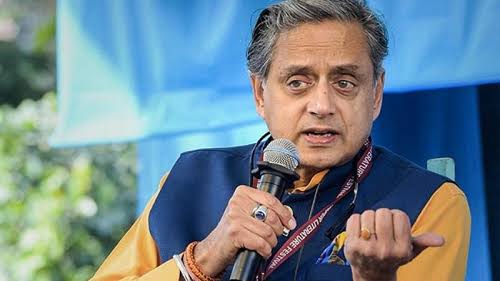
New Delhi, July 10: Senior Congress leader and Member of Parliament Shashi Tharoor has triggered a fresh round of political debate by publishing a strongly worded article marking the 50th anniversary of the Emergency declared by then Prime Minister Indira Gandhi in 1975.
In the essay, Tharoor describes the Emergency as a “dark chapter” in Indian history, criticizing the 21-month period (June 1975 to March 1977) for its “unspeakable cruelties,” including mass arrests, censorship of the press, and forced sterilizations. He laid particular blame on Sanjay Gandhi, Indira Gandhi’s son and close aide, calling his actions “arbitrary, violent, and deeply harmful to India’s democratic fabric.”
Tharoor wrote, “The Emergency offers a sobering reminder that civil liberties and democratic norms must never be taken for granted. When media is silenced, the public loses access to truth — and democracy begins to erode.”
He also criticized the Supreme Court’s role at the time, accusing it of upholding the revocation of fundamental rights. According to Tharoor, such actions left lasting scars on India’s political and legal institutions.
Internal Tensions in Congress
While Tharoor’s comments have been applauded by many intellectuals and civil society leaders for their candor, they have caused unease within his own party. The Congress leadership has so far remained silent on the issue, with no official response to Tharoor’s article.
Party sources suggest that some senior Congress leaders view the essay as an indirect critique of the Nehru-Gandhi family and a potential challenge to party unity. However, others argue that acknowledging past mistakes is necessary for political credibility.
In Kerala, where Tharoor recently published a survey projecting public support for his potential Chief Ministerial candidacy in 2026, party cadres appear divided. The “Kerala Vote Vibe Survey 2026,” conducted by a private firm, placed Tharoor as the most favored leader among the opposition ranks, further fueling speculation about his growing ambitions within the state.
Political Reactions and Commentary
Tharoor’s remarks have drawn mixed reactions from across the political spectrum. BJP leaders welcomed the article, using it to reinforce their long-standing criticism of the Congress for its handling of the Emergency. On social media, public opinion was split, with many praising Tharoor for his intellectual honesty, while others accused him of playing both sides for political gain.
Political analysts say Tharoor’s essay serves as both a historical reckoning and a carefully timed political statement. “He is positioning himself as a voice of conscience within the Congress, but it also puts him at odds with the traditionalist wing of the party,” said political commentator Rajdeep Sardesai in a panel discussion.
As India marks 50 years since the Emergency, Tharoor’s reflections have reignited a national conversation on the state of democracy, both past and present. Whether his bold stance strengthens his leadership image or alienates him from the Congress establishment remains to be seen.