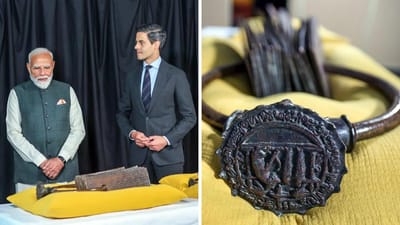
The Netherlands has officially returned the historic Anaimangalam Chola Copper Plates, also known as the Leiden Plates, to India during Prime Minister Narendra Modi’s official visit to the country.
The handover marks a major milestone in India’s ongoing efforts to recover cultural artefacts taken abroad during the colonial period. The copper plates, dating back to the 11th century CE, are considered among the most important surviving records of the Chola Empire and medieval South Indian maritime history.
What Are the Chola Copper Plates?
The returned artefacts are royal copper inscriptions issued during the reigns of:
- Rajaraja chola I
- Rajendra chola I
These plates were used to record official royal grants, land donations, tax exemptions, and administrative orders.
The collection includes:
- 21 large copper plates
- 3 smaller plates
- A bronze ring carrying the royal Chola seal
- Inscriptions written in both Tamil and Sanskrit
Historians say the inscriptions provide valuable insight into the Chola administration, economy, religion, and maritime trade networks.
Connection to the Chudamani Vihara
The inscriptions mainly document grants made to the Chudamani Vihara, a Buddhist monastery located at Nagapattinam in present-day Tamil Nadu.
This is historically significant because:
- The Cholas were Hindu rulers
- Yet they supported Buddhist institutions and international religious centers
The records demonstrate the religious tolerance and cosmopolitan culture of the Chola period.
Evidence of India’s Ancient Maritime Power
The copper plates also reveal strong diplomatic and trade relations between the Chola Empire and the Srivijaya Empire in Southeast Asia, covering parts of modern-day:
- Indonesia
- Malaysia
- Sumatra
According to historians, the inscriptions prove that:
- The Cholas possessed a powerful naval empire
- South India had active overseas trade routes
- Tamil merchants and Buddhist monks traveled extensively across the Indian Ocean
How Did the Plates Reach the Netherlands?
During the Dutch colonial presence on the Coromandel Coast several centuries ago, the copper plates were taken to Europe and eventually became part of the collection at Leiden University in the Netherlands.
Because of this, they became internationally known as the “Leiden Plates.”
India formally began efforts to reclaim the artefacts in 2012, and discussions gained momentum after international cultural restitution initiatives supported India’s claim.
PM Modi’s Statement
Prime Minister Modi described the return as:
“A joyous moment for every Indian.”
He also thanked the Dutch government and Leiden University for their cooperation in the repatriation process.
Why the Return Matters
Experts describe the return as important for several reasons:
Cultural Repatriation
It restores an important part of India’s lost cultural heritage.
Tamil Heritage Recognition
The return highlights the global importance of Tamil and Chola history.
Historical Research
The inscriptions are valuable sources for studying:
- Medieval Tamil society
- Land administration
- Tax systems
- Maritime trade
- South Asian diplomatic history
Historians regard the plates as one of the most significant documentary records from medieval South India.