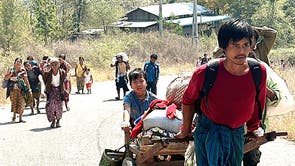
Aizawl, Mizoram – July 17: Close to 3,000 refugees from Myanmar, who had recently sought shelter in India’s northeastern state of Mizoram, have begun returning to their villages in Myanmar’s Chin state. This mass repatriation follows a temporary ceasefire between warring Chin rebel factions, a senior police official in Mizoram confirmed on Thursday.
The exodus into Mizoram occurred in early July when intensified armed conflict between the Chin National Defence Force (CNDF) and the Chinland Defence Force (CDF-Hualngoram), both reportedly backed by the Chin National Army (CNA), forced over 4,500 civilians to flee across the porous international border into Mizoram’s Champhai district.
The refugees had taken refuge in the border villages of Zokhawthar, Saikhumphai, and Vaiphai. Officials reported that as of Wednesday, 2,923 people had returned from Zokhawthar, and an additional 39 from Vaiphai. The return movement began on July 7 and significantly accelerated from July 12, following the implementation of the ceasefire agreement between the rival Chin factions.
A police officer indicated that the situation along the Indo-Myanmar border has now stabilized, and more refugees are expected to return in the coming days. Mizoram shares a 510-km border with Myanmar and has been a primary sanctuary for over 32,000 refugees since the military coup in the neighboring country in February 2021.
The recent conflict erupted when CNDF and CDF, both pro-democracy forces, clashed with the CNA over territorial control in Chin State. Retaliatory attacks by the CNA on a CNDF camp at Rihli village in Chin state subsequently led to a further influx of over 700 refugees into other border villages of Mizoram.
In a related development, the Mizoram government is preparing to commence the collection of biometric and demographic data of all Myanmar refugees by the end of July. This initiative aims to aid in their formal identification and better manage the refugee population.
Most of the refugees belong to the Chin ethnic group, who share deep cultural, linguistic, and familial ties with the majority Mizo population of Mizoram, a factor that has heavily influenced the state’s compassionate approach to providing shelter despite a more stringent stance from the central government regarding undocumented migrants. The biometric exercise, funded by the Union Home Ministry, will be conducted across all 11 districts of Mizoram using the Foreigner Identification Portal.