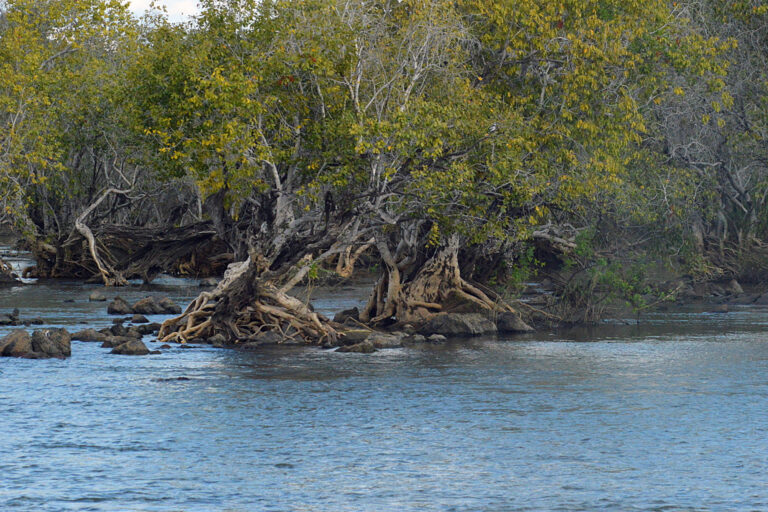
KAFUE NATIONAL PARK, Zambia — New research has revealed that the bicolored waterberry tree (Syzygium guineense subsp. barotsense), a once-overlooked species lining the Kafue River, plays a critical role in supporting biodiversity and stabilizing the riverbanks of Zambia’s vast Kafue National Park.
The findings emerged from a recent 300-kilometer expedition conducted by The Wilderness Project (TWP), a conservation research group specializing in Africa’s river systems. Accompanied by journalists from Mongabay, researchers documented the ecological interactions between the waterberry trees and various animal species, highlighting the tree’s key position in the riparian ecosystem.
“These trees are strictly riverine and their roots bind to soft sediment, extending into the water to provide shelter for fish and crabs,” said Christine Coppinger, a Zambian pollination ecologist not affiliated with the expedition but conducting parallel research along Zambia’s Kabompo River. “Without them, you would definitely have a lot more scouring and a lot more erosion.”
Ecological Hotspot
Along the Kafue River, the fluted trunks of the bicolored waterberry frequently bear signs of wildlife, such as the tracks of African clawless otters (Aonyx capensis). Dozens of white-breasted cormorants (Phalacrocorax lucidus) were observed nesting directly in the tree canopies, often perched above the current itself.
The tree’s distinctive fruits — half-white, half-purple — appear throughout the upper Zambezi basin, including in the Zambezi, Lunga, and Kabompo rivers across Zambia, and also in parts of Botswana, Zimbabwe, and northern South Africa.
Coppinger’s research suggests that while the trees are capable of self-pollination, cross-pollination is essential to maintain their genetic diversity. Her studies have found the tree’s nectar-rich flowers attract a vast range of daytime and nocturnal pollinators, including western honeybees (Apis mellifera adansonii), butterflies, wasps, hawk moths, sunbirds, and northern yellow white-eyes.
“The waterberry canopy is a whole ecosystem in itself,” she said. “They’re also bee trees — they offer real potential for conservation through sustainable honey production.”
Local Threats and Conservation Potential
Although the species is not currently considered threatened, its future is uncertain due to local pressures such as the clearing of riparian vegetation for agriculture. Coppinger and other experts argue that educating farmers about the economic value of waterberry trees — particularly for honey production — could encourage local protection efforts.
The TWP team, which has surveyed the entire Kafue River over the past two years, also flagged several ecological threats in the region. These include the spread of invasive crayfish, heavy plastic pollution, discarded fishing nets, and water extraction facilities, particularly in the upper stretches of the river.
In many parts of the river, especially outside protected areas, researchers observed declining populations of hippos and other large aquatic species. Meanwhile, human activity continues to grow in Game Management Areas (GMAs) surrounding the park, despite their intended purpose as ecological buffer zones.
Informing Policy
All data collected during the expedition is being shared with Zambia’s wildlife and fisheries departments, as well as local and international conservation organizations, to inform long-term policy planning and management strategies.
“The waterberry trees may not be famous, but their roots literally hold the riverbank together,” one TWP researcher remarked. “Understanding and protecting them is crucial not just for wildlife, but also for the millions of people who depend on the Kafue River.”
Source:
- Truscott, R. (2025, July 16). Bicolored waterberry: The overlooked tree shaping Zambia’s rivers. Mongabay.