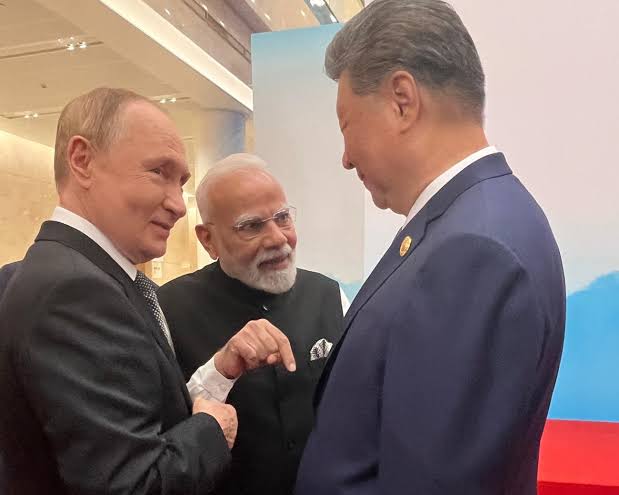
TIANJIN, CHINA — The trilateral meeting of Indian Prime Minister Narendra Modi, Chinese President Xi Jinping, and Russian President Vladimir Putin on the sidelines of the Shanghai Cooperation Organisation (SCO) summit has been lauded by international media as a pivotal event in global geopolitics. The convergence of these three powerful leaders is widely seen as a significant challenge to the unipolar world order and a strong display of emerging multipolarity.
The leaders’ discussion reportedly centered on a range of issues, from economic collaboration and energy security to the broader principles of international relations. A key takeaway was President Xi Jinping’s statement that “India and China are not adversaries but partners,” a phrase that has resonated across the world as a signal of intent to de-escalate tensions.
Quotes from Leading Media Outlets:
- Associated Press (AP): “The SCO summit has served as a platform for a powerful display of non-Western unity. The trilateral between Modi, Xi, and Putin is a clear signal that these nations are charting their own course on the global stage, independent of US-led pressure.”
- Reuters: “Modi’s assertive stance on continuing oil trade with Russia, even in the face of sanctions, demonstrates India’s growing confidence as a major global player. The meeting with both Xi and Putin cements India’s role as a crucial bridge between East and West.”
- The Washington Post: “The meeting is a stark reminder of the shifting geopolitical landscape. While the West remains focused on isolating Russia and containing China, New Delhi is actively engaging with both, showcasing its strategic autonomy and highlighting the limitations of a unipolar world.”
Diverse Perspectives from Around the World: - Chinese Media: State-run outlets, such as Xinhua, framed the meeting as a triumph of multilateralism and a testament to the “shared commitment to resisting unilateralism and external interference.” They emphasized the leaders’ joint vision for a more “just and fair” international order.
- Russian Media (TASS): The Kremlin’s official news agency, TASS, presented the meeting as proof that Russia is not isolated on the global stage. One report highlighted the “warm and friendly” interactions, stating, “The meeting in Tianjin is a testament to the fact that Russia’s partnerships with major global powers like India and China are stronger than ever.”
- UK Media (The Guardian): A report in The Guardian noted the pragmatic nature of the alliance, highlighting the potential for economic and strategic gains for each country. “This is a marriage of convenience, not one of ideological alignment. But it is a powerful one, driven by a shared desire to counter Western dominance,” a correspondent wrote.
- French Media (Le Monde): France’s leading daily, Le Monde, analyzed the meeting as a symptom of a broader “rejection of the Eurocentric view of global affairs.”
- Arab Media (Al Jazeera): Al Jazeera provided a perspective from the “Global South,” emphasizing the SCO as a platform for developing nations to assert their interests. One of their analyses stated, “The strong bond on display between India, China, and Russia will resonate widely, as many countries in the Global South seek to move away from Western-led international forums and find common ground on issues of sovereignty and development.”
- Indian Media (The Times of India): Indian media, including The Times of India, highlighted the diplomatic maneuver of PM Modi. One article described the meeting as a “Reverse Nixon” moment, suggesting that Putin, with the help of Modi, has turned the tables on Western efforts to create a wedge between Moscow and Beijing.
- German Media (Der Spiegel): Der Spiegel, a German news magazine, viewed the meeting with a cautious lens. A report suggested that while the optics are significant, the ability of the group to effect real change is “limited by a lack of cohesive vision and internal frictions.”
- Pakistani Media: Pakistani news outlets noted the increasing complexity of their own foreign policy in the wake of the meeting, acknowledging the need to balance relations with both China and Russia in a shifting regional landscape.The trilateral meeting has thus not only reshaped the narrative surrounding the SCO but has also sent a clear message that the world’s power dynamics are in a state of flux, with these three nations at the forefront of a new geopolitical realignment.