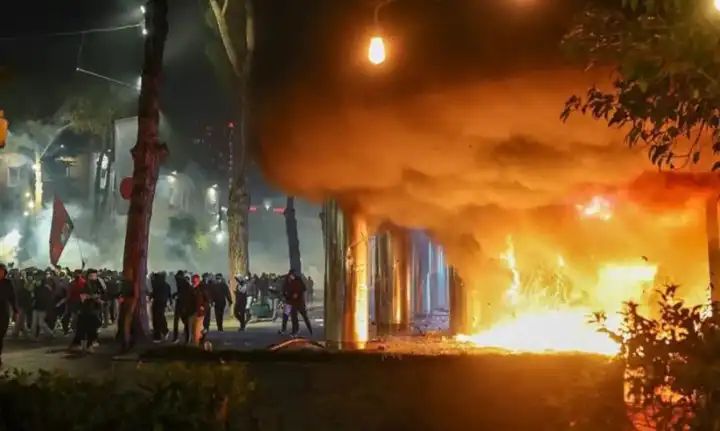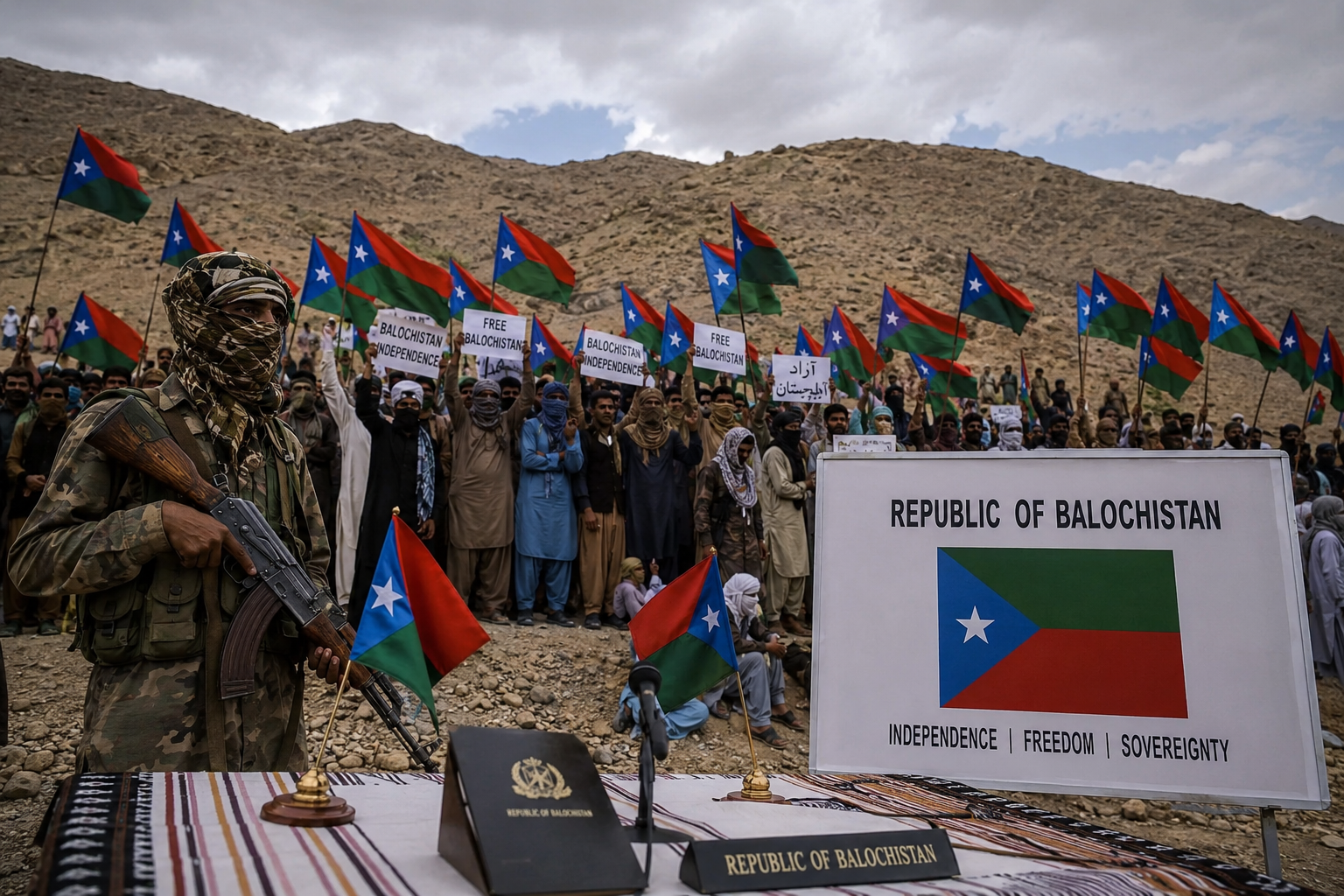
Quetta/Islamabad: Baloch separatists have claimed that Pakistan’s largest province, Balochistan, has declared itself an independent nation under the name “Republic of Balochistan.” According to a statement widely circulated on social media, the new administration has assumed control over nearly 85 percent of Balochistan’s territory and has established its own national flag, national anthem, currency, and governing institutions.
The statement also appealed to the international community and the United Nations to recognize Balochistan as a sovereign state.
“We are an independent nation. We urge the United Nations and democratic countries around the world to recognize the Republic of Balochistan,” the statement said.
However, these claims have not been independently verified. The Government of Pakistan has not officially acknowledged any declaration of independence, and no country has recognized Balochistan as a sovereign state.
The announcement surfaced amid rising protests in western Balochistan and Pakistan-administered Kashmir. For decades, Baloch nationalist and separatist groups have demanded either greater provincial autonomy or complete independence from Pakistan.
A Land of Ancient Civilizations
Balochistan is among the oldest continuously inhabited regions in the world. The Mehrgarh Civilization, dating back to around 7000 BCE, is regarded as one of South Asia’s earliest agricultural settlements and a precursor to the Indus Valley Civilization.
The region later witnessed the march of Alexander the Great, who crossed the harsh Gedrosian Desert while returning from India.
Following centuries of Islamic rule, the Khanate of Kalat emerged as the principal Baloch polity. During British colonial rule, Balochistan became a strategically important frontier. The incorporation of Kalat into Pakistan in 1948 remains at the heart of today’s political dispute. Pakistan maintains that the accession was legal, while Baloch nationalists argue that it was carried out under coercion.
Rich in Resources, Poor in Stability
Covering nearly 44 percent of Pakistan’s land area, Balochistan is rich in natural gas, gold, copper, coal, and chromite. It is also home to the strategically significant Gwadar Port, a key component of the China-Pakistan Economic Corridor (CPEC), making the province one of South Asia’s most geopolitically important regions.
Culture and Identity
The Baloch people are known for their strong tribal traditions, hospitality, folk music, epic poetry, embroidery, camel culture, and the Balochi and Brahui languages. The overwhelming majority of the population follows Sunni Islam.
Baloch Liberation Army and the Armed Insurgency
Armed resistance has persisted in Balochistan since 1948 through multiple phases. The Baloch Liberation Army (BLA) is currently the most prominent separatist militant organization seeking an independent Balochistan. The BLA has been designated as a terrorist organization by Pakistan, the United States, the United Kingdom, and several other countries.
In recent years, the BLA, the Balochistan Liberation Front (BLF), and the Baloch Republican Guards (BRG) have intensified attacks against Pakistani security forces, government installations, railway infrastructure, gas pipelines, and Chinese-linked projects under CPEC. Several of these groups have claimed responsibility for specific attacks.
Pakistan has responded with extensive military operations and counterinsurgency campaigns across the province.
Human Rights Concerns
Baloch human rights groups and several international organizations have repeatedly alleged enforced disappearances, arbitrary detentions, and other human rights violations in the province. Pakistan rejects these allegations, maintaining that its security operations are aimed at combating militancy and protecting national security.
Leaders of the Baloch Movement
Several prominent figures have shaped the Baloch nationalist movement over the decades. Nawab Akbar Bugti, one of the strongest advocates of Baloch rights and autonomy, was killed during a Pakistani military operation in 2006, an event widely viewed as a turning point in the insurgency.
Other influential figures include Hyrbyair Marri, Brahamdagh Bugti, and Dr. Allah Nazar Baloch, some of whom currently live in exile while continuing to advocate for the Baloch cause.
Pakistan’s Allegations Against India
Pakistan has long accused India of providing financial and intelligence support to Baloch separatist groups. Islamabad has frequently cited the 2016 arrest of former Indian naval officer Kulbhushan Jadhav as evidence supporting its claims.
India has consistently denied these allegations, describing Balochistan as Pakistan’s internal matter. To date, no publicly available independent evidence has conclusively established that India provides military or financial assistance to Baloch separatist organizations.
A Region of Strategic Importance
With its access to the Arabian Sea, the Gwadar deep-sea port, abundant mineral wealth, and its central role in CPEC, Balochistan remains one of the most strategically significant regions in South and Central Asia. As a result, developments in the province continue to influence the security and foreign policy calculations of Pakistan, China, India, Iran, and Afghanistan.
The Current Situation
The social media announcement proclaiming the “Republic of Balochistan” has generated widespread international attention. Nevertheless, under current international law, Balochistan continues to be recognized as a province of Pakistan. Until the separatists’ claims are independently verified and receive diplomatic recognition, they remain unverified claims rather than established facts.