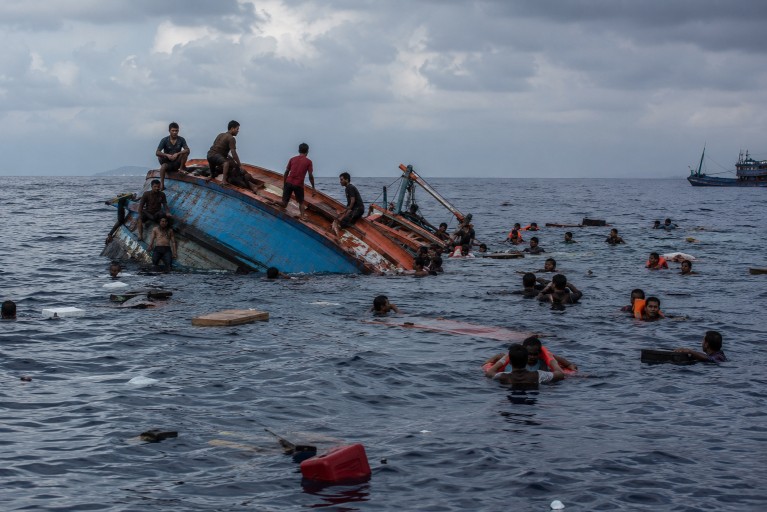
More than 500 people, mostly Rohingya refugees, are feared dead after two boats carrying refugees reportedly sank in the Bay of Bengal off Myanmar’s coast, according to the United Nations High Commissioner for Refugees (UNHCR) and the International Organization for Migration (IOM).
According to the UN agencies, the two boats departed from Myanmar’s conflict-hit Rakhine State in late June. Although the exact death toll has not been officially confirmed, the UN has warned that the tragedy could be one of the deadliest maritime disasters involving Rohingya refugees in recent years.
What happened?
Preliminary reports indicate:
- One boat carrying around 250 people lost contact shortly after departing.
- A second boat, with approximately 280 passengers, is believed to have capsized near Myanmar’s Ayeyarwady coast around July 8.
- Many of those on board had previously been living in Rohingya refugee camps in Bangladesh.
Who are the Rohingya?
The Rohingya are a predominantly Muslim ethnic minority who have lived for generations in Myanmar’s Rakhine State.
Under Myanmar’s 1982 Citizenship Law, most Rohingya were denied citizenship, making them one of the world’s largest stateless populations. For decades, they have faced severe restrictions on freedom of movement, education, healthcare, employment, and other basic rights.
The 2017 Mass Exodus
In 2017, Myanmar’s military launched a large-scale security operation in Rakhine State following attacks on security posts by the Arakan Rohingya Salvation Army (ARSA), an armed Rohingya insurgent group.
The military crackdown forced more than 740,000 Rohingya to flee to neighboring Bangladesh. The United Nations and several international human rights organizations have described the military operation as involving widespread human rights violations, while Myanmar has maintained that it was conducting counter-insurgency operations.
Rohingya Refugee Camps in Bangladesh
Bangladesh hosts the world’s largest refugee settlement in the Cox’s Bazar district.
Key facts:
- Around 1 to 1.2 million Rohingya refugees currently live in the camps.
- Major camps include:
- Kutupalong
- Balukhali
- Several camps in the Ukhiya and Teknaf areas.
The camps face overcrowding, food shortages, inadequate healthcare, limited educational opportunities, security concerns, and human trafficking. International aid agencies have also warned that reductions in humanitarian funding have led to cuts in food assistance.
Why are Rohingya risking dangerous sea journeys?
With no safe conditions for return to Myanmar and limited opportunities in Bangladesh’s refugee camps, many Rohingya attempt dangerous sea crossings in search of safety or employment in countries such as:
- Malaysia
- Indonesia
- Thailand
These journeys are often organized by human trafficking networks using overcrowded and poorly equipped boats. Monsoon weather further increases the risk of maritime disasters.
According to UN agencies, more than 6,500 Rohingya attempted sea journeys in 2025, with nearly 900 reported dead or missing, making it one of the deadliest years for Rohingya maritime migration.
Arakan Rohingya Salvation Army (ARSA)
The Arakan Rohingya Salvation Army (ARSA) is an armed Rohingya insurgent group that emerged in Myanmar’s Rakhine State.
- ARSA claimed responsibility for attacks on Myanmar security posts in 2016 and 2017.
- Those attacks triggered the military operations that led to the mass displacement of Rohingya civilians.
- Myanmar has designated ARSA as a terrorist organization.
- ARSA has denied having operational links with international jihadist groups such as ISIS or Al-Qaeda. While some regional security agencies have alleged links with militant networks, such claims remain disputed and have not been conclusively established in the public domain.
It is important to distinguish ARSA, an armed militant group, from the wider Rohingya population. The overwhelming majority of Rohingya are civilians who have fled conflict and persecution.
Rohingya Presence and Illegal Entry into India
Some Rohingya refugees have entered India through different routes over the years.
According to Indian security agencies:
- Illegal crossings have been detected mainly through the Bangladesh–India border, and in some cases through the Myanmar–Mizoram and Myanmar–Manipur borders.
- Some Rohingya residing in India possess UNHCR registration cards, but these do not confer Indian citizenship or legal permanent residency.
- The Government of India has repeatedly stated that illegal Rohingya immigration poses national security concerns, leading to arrests, detention, and deportation proceedings in certain cases.
Human rights organizations, however, argue that each asylum seeker’s case should be assessed individually in accordance with international refugee protection principles. As a result, the issue continues to involve both humanitarian and national security considerations.
Sources
- UN High Commissioner for Refugees (UNHCR) and International Organization for Migration (IOM)
- Associated Press (AP)
- The Guardian
- Human Rights Watch (HRW)