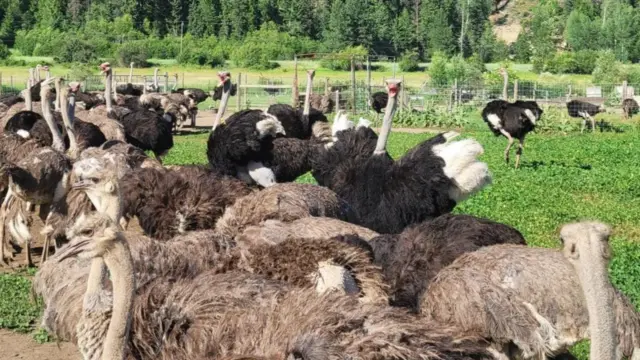
Edgewood, British Columbia, November , 2025: A protracted legal and political struggle came to a grim conclusion this week as the Canadian Food Inspection Agency (CFIA) executed a controversial order to cull more than 300 ostriches at the Universal Ostrich Farms in Edgewood, British Columbia, following an outbreak of H5N1 avian influenza.
The decision marked the end of nearly 11 months of court battles, public protests, and international appeals to spare the birds, whose owners argued that many had developed immunity to the virus.
The Outbreak and Government Action
The crisis began in December 2024, when 69 ostriches at the farm died following confirmation of the highly pathogenic H5N1 strain of avian influenza. In line with its “stamping out” biosecurity policy, the CFIA issued a Notice to Dispose order for the remaining flock—estimated at between 300 and 330 birds—to prevent further transmission of the virus to commercial poultry farms and wild birds.
Despite the owners’ repeated appeals, the CFIA stood firm on the cull, stating that ostriches can act as silent carriers, potentially spreading or mutating the virus.
The Legal Battle
The farm’s owners, Karen Espersen and Dave Bilinski, launched a determined legal campaign to halt the cull, arguing that:
- The surviving birds were healthy and exhibited signs of herd immunity, which could offer valuable insights for avian disease research.
- The CFIA had refused to conduct additional testing, despite requests from independent veterinarians.
- The policy of mass culling was scientifically outdated and ethically indefensible for large, long-lived birds like ostriches.
Their case reached all levels of Canada’s judicial system, including the Federal Court, the Federal Court of Appeal, and finally the Supreme Court of Canada.
On November 6, 2025, the Supreme Court dismissed the final appeal, siding with the CFIA and effectively clearing the way for the destruction of the flock.
CFIA’s Position
In a public statement, the CFIA reaffirmed its commitment to protecting public health, animal welfare, and the integrity of the national poultry sector:
“While these decisions are never easy, they are guided by established science and international disease control standards. The cull was conducted humanely and under veterinary oversight.”
Officials emphasized that the H5N1 strain poses not only a risk to poultry exports but also potential zoonotic dangers to humans.
International Attention and Public Outcry
The Edgewood ostrich case attracted global media attention, drawing sympathy from both animal rights activists and political figures.
Among the supporters were Robert F. Kennedy Jr., former U.S. Health Secretary, and television personality Dr. Mehmet Oz, both of whom offered to relocate the birds to sanctuaries in the United States.
Protests were held outside CFIA offices in Vancouver and Ottawa, where demonstrators denounced the cull as “government overreach” and a “failure of compassion.”
Farm owner Karen Espersen, speaking after the cull, said:
“We were willing to comply with all health measures, to test and isolate, but not to destroy what we knew were healthy animals. They silenced science and empathy for the sake of bureaucracy.”
The Cull and Its Aftermath
Following the Supreme Court ruling, CFIA teams moved into the farm on Thursday evening, assisted by marksmen and veterinarians. The ostriches were corralled into pens and euthanized under what officials described as “controlled and humane procedures.”
Local residents reported scenes of grief and anger as the operation took place, with supporters lighting candles at the farm gate in memory of the birds.
The CFIA later confirmed that disposal and disinfection measures were completed according to international biosecurity standards.
Broader Implications
The case has reignited debate over Canada’s disease control policies, particularly the mandatory culling of healthy animals during outbreaks. Critics argue that newer containment methods and vaccination programs should replace blanket destruction orders, especially for species like ostriches that are not part of the mainstream poultry trade.
Experts predict that the Edgewood ostrich cull will likely become a defining precedent in future legal and ethical discussions surrounding animal health policy and biosecurity law in Canada.