Thiruvananthapuram, January 5, 2026:
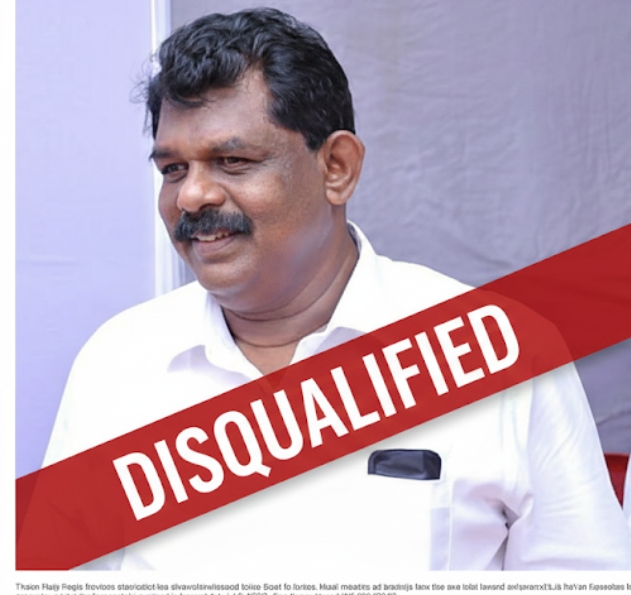
The Kerala Legislative Assembly Secretariat on Monday issued an official notification disqualifying Thiruvananthapuram MLA and former state minister Antony Raju following his conviction in a decades-old case involving the tampering of court evidence.
The order was issued on the evening of January 5, a day after a trial court sentenced Raju to three years of imprisonment, triggering his immediate disqualification under the Representation of the People Act.
Conviction and Legal Basis for Disqualification
Antony Raju was found guilty by the Nedumangad Judicial First Class Magistrate Court in a 34-year-old “thondimuthal” (material evidence) tampering case. The court sentenced him to three years of rigorous imprisonment, along with fines, after holding him responsible for conspiring to manipulate key evidence in a criminal case dating back to 1990.
Under Section 8(3) of the Representation of the People Act, any elected representative sentenced to two years or more of imprisonment stands disqualified from the moment of conviction. This legal position was further strengthened by the Supreme Court’s landmark 2013 judgment in the Lily Thomas vs Union of India case, which abolished the earlier provision that allowed convicted legislators a three-month window to appeal before disqualification took effect.
In line with these provisions, the Assembly Secretariat declared Raju disqualified with immediate effect.
Background of the Case
The case pertains to an incident in 1990 at Thiruvananthapuram International Airport, where an Australian national, Andrew Salvador Servalli, was arrested for possessing 61.5 grams of hashish. Prosecutors alleged that Antony Raju, then a practicing lawyer, colluded with a court employee named Jose to tamper with the seized evidence.
According to the prosecution, the innerwear in which the contraband was concealed was deliberately cut and altered to render it unusable as material evidence. This manipulation ultimately weakened the prosecution case and led to the accused being acquitted at the time.
The court held Raju guilty of criminal conspiracy, destruction of evidence, fabrication of false evidence, and forgery.
Sentence Details
Raju was convicted under multiple sections of the Indian Penal Code, including:
| Major Charges | Sentence |
|---|---|
| Destruction of evidence (Section 201) | 3 years’ imprisonment, ₹10,000 fine |
| Fabrication of false evidence (Section 193) | 3 years’ imprisonment |
| Criminal conspiracy (Section 120B) | 6 months’ imprisonment |
| Forgery (Section 465) | 2 years’ imprisonment |
All sentences are to run concurrently, making the effective prison term three years.
Appeal, Bail, and Future Legal Course
The trial court granted Antony Raju bail for one month to enable him to file an appeal before the High Court. As a result, he is not required to be taken into custody immediately.
However, legal experts point out that merely staying the execution of the sentence will not restore his MLA status. Only a stay on the conviction itself (stay of conviction) by the High Court can reverse the disqualification. If the conviction is not stayed, Raju will remain disqualified even while out on bail.
In addition, the prosecution has indicated that it may approach the High Court seeking enhancement of the sentence, arguing that more serious provisions—such as Section 409 of the IPC (criminal breach of trust by a public servant), which can attract life imprisonment—were applicable and that the punishment awarded was inadequate.
Political Impact and By-Election Likely
Antony Raju’s disqualification has formally rendered the Thiruvananthapuram Assembly seat vacant. With a significant portion of the Assembly’s term still remaining, the Election Commission is expected to announce a by-election in the constituency in the coming months.
The development is seen as a major setback for the ruling Left Democratic Front (LDF), particularly in the politically sensitive Thiruvananthapuram segment, where Raju had emerged as a prominent leader.
If the conviction stands, Antony Raju will not only serve the three-year sentence but will also be barred from contesting elections for an additional six years after his release—effectively keeping him out of electoral politics for up to nine years.