Caracas/Washington:
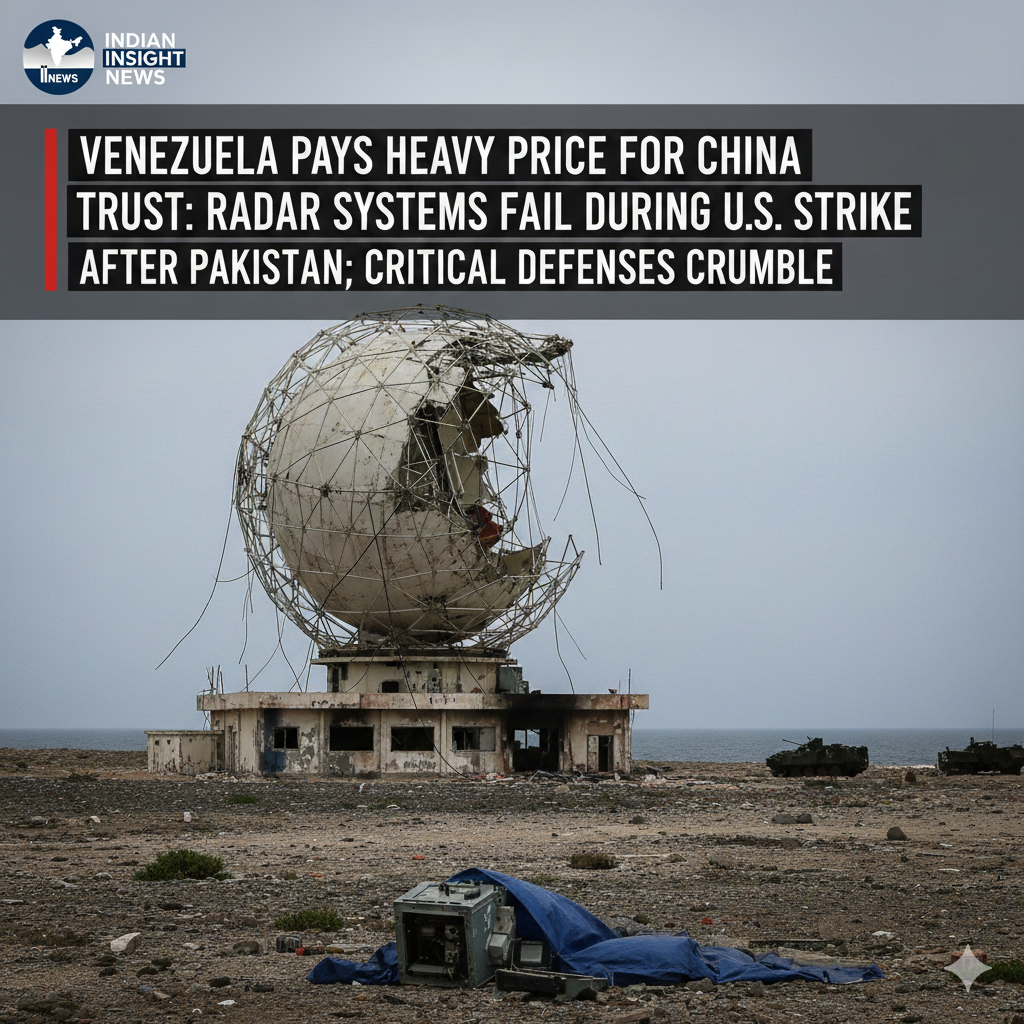
Venezuela has reportedly suffered major strategic and military setbacks after placing heavy reliance on Chinese defence technology, drawing parallels with Pakistan’s long-standing experience of technical vulnerabilities linked to Chinese systems. During the recent U.S. military operation targeting key installations near Caracas and surrounding regions, Venezuela’s radar and air-defence monitoring systems allegedly failed at a critical moment, raising serious questions about the reliability of its imported military hardware.
According to defence analysts and regional security observers, Venezuela had upgraded much of its surveillance and radar infrastructure over the past decade with Chinese-made systems, viewing Beijing as a dependable counterweight to U.S. influence. However, during the latest U.S. assault—reported by international media to have involved precision strikes on strategic facilities—these radar systems either went offline or failed to detect incoming aerial threats in time, severely limiting Venezuela’s defensive response.
Security experts note that similar concerns have been raised earlier by Pakistan, China’s closest defence partner, where issues related to interoperability, software reliability, and real-time battlefield performance of certain Chinese platforms have been debated within military circles. Venezuela’s experience now appears to reinforce those concerns, with critics arguing that over-dependence on a single foreign supplier—particularly in sensitive areas such as air defence—can prove costly during high-intensity conflicts.
Sources familiar with the developments claim that the radar failure allowed U.S. forces to conduct strikes with minimal resistance, undermining Venezuela’s deterrence posture and exposing key assets. While Venezuelan authorities have not officially acknowledged a system-wide breakdown, government-aligned media have spoken vaguely about “electronic warfare interference,” a term analysts interpret as an attempt to deflect attention from deeper technological shortcomings.
The incident is also being viewed through a broader geopolitical lens. China has invested heavily in Venezuela through loans, energy projects, and military cooperation, positioning itself as a strategic partner against Western pressure. However, critics argue that Beijing has often prioritized economic leverage and arms exports over long-term operational support, leaving client states exposed in moments of crisis.
For Venezuela, already grappling with economic collapse, sanctions, and political instability, the reported radar failure represents more than a technical issue—it is a strategic blow. Military analysts warn that the episode may force Caracas to reassess its defence partnerships and diversify its security architecture, even as its options remain limited under international sanctions.
The developments have reignited debates across the Global South about the risks of choosing geopolitical alliances based primarily on opposition to the United States rather than on proven military effectiveness. As one regional defence expert put it, “Pakistan learned this lesson over decades. Venezuela appears to be learning it the hard way—under fire.”