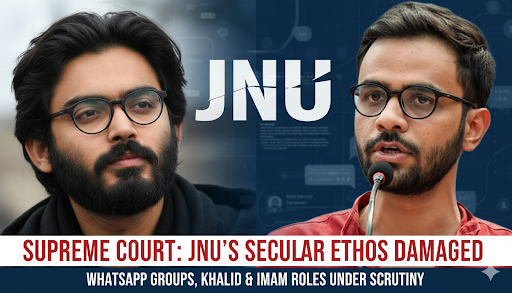
New Delhi: The Supreme Court of India has delivered a detailed ruling in the 2020 Delhi riots conspiracy case, highlighting serious concerns over actions that, according to the prosecution, undermined the secular character of institutions like Jawaharlal Nehru University (JNU) and allegedly involved religiously-oriented communication on WhatsApp. The order also discussed the evidence against Muslim student activists Umar Khalid and Sharjeel Imam, without granting them bail, and raised broader questions about social cohesion and the rule of law.
Court Denies Bail, Cites Role in Conspiracy
The Supreme Court denied bail to Khalid and Imam, noting that they were alleged to have played a central role in planning and mobilisation linked to the deadly February 2020 Delhi riots, in which at least 53 people were killed and hundreds injured. Although bail was granted to some co-accused, the court agreed with the prosecution that the material before it suggested substantial involvement in the alleged conspiracy.
WhatsApp Groups and Allegation of Communal Mobilisation
A key focus of the prosecution’s argument—and noted by the court—was the formation and use of WhatsApp groups that allegedly organised and mobilised students on communal lines. One such group, named “Muslim Students of JNU”, was cited as evidence of what lawyers for the state described as a breach of the university’s secular character.
During court proceedings, Additional Solicitor General (ASG) argued that WhatsApp groups such as Muslim Students of JNU, Jamia Coordination Committee, and others were used to communicate orders and coordinate activities that later escalated into violent protests across Delhi, including chakka jaam blockades aimed at disrupting daily life and essential services.
Prosecution’s Assertions on Secularism and Institutional Damage
The prosecution contended that Khalid and Imam “broke the secular fabric of JNU” by steering student mobilisation in a communal direction, rather than in the non-violent and secular context traditionally expected of academic campuses. These claims were supported by forensic analysis of WhatsApp chats and witness statements presented to the court.
In its submissions, the state also described the alleged plot as part of a broader attempt to disrupt national unity and challenge constitutional values, framing it as more than ordinary dissent.
Defence Arguments Cited by Court
Defence counsel for Khalid has previously argued in court—during separate hearings—that mere membership of a WhatsApp group does not establish criminal liability unless there is evidence of direct wrongdoing attributable to the individual. Counsel pointed out that Khalid had not sent inflammatory messages in these groups and was not an administrator of some of them.
Supreme Court’s Position
While the Supreme Court did not explicitly label the WhatsApp groups as unlawful in principle, it agreed with the prosecution that the context and content of the communication, combined with other evidence, justified continued detention without bail. The court took into account the severity of the allegations, the societal impact of the 2020 riots, and the prosecution’s assertion that the accused had significant involvement in planning, not just spontaneous protest.
Reactions and Broader Implications
The court’s decision has sparked debate among legal experts, civil society, and political commentators. Critics argue that extended pre-trial detention raises questions about civil liberties and the right to dissent, while supporters of the ruling emphasize the need to maintain secular harmony and public order. International observers have also weighed in, noting India’s secular constitutional guarantee and the balance between national security and individual rights.