Jammu | January 6, 2026
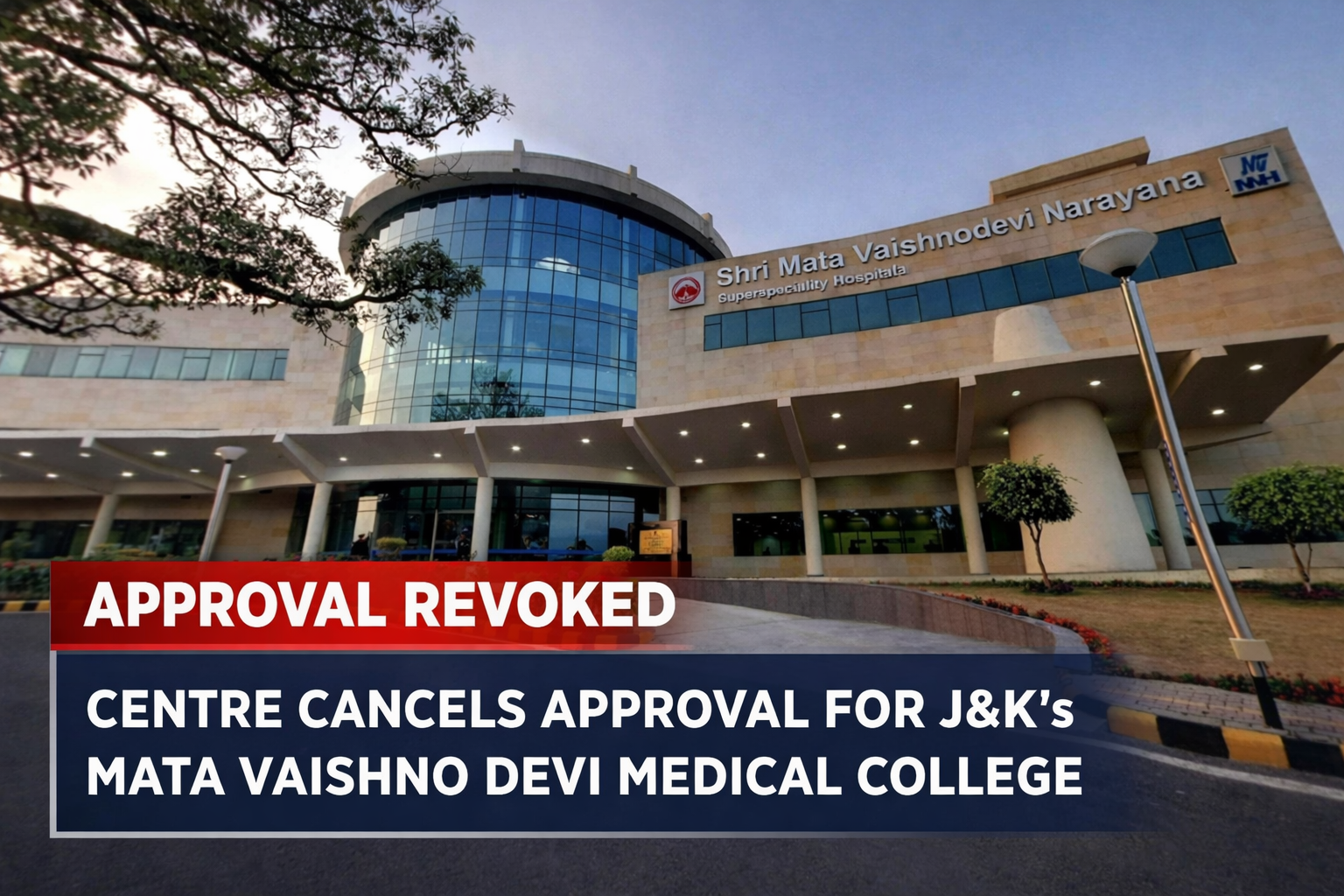
The Union government, acting through the National Medical Commission (NMC), has withdrawn approval for the MBBS programme at the Shri Mata Vaishno Devi Institute of Medical Excellence (SMVDIME) in Jammu, citing serious deficiencies in infrastructure, faculty strength, and clinical facilities. The decision has triggered political reactions across Jammu and Kashmir and renewed debate over medical education standards in the Union Territory.
Centre Government’s Stand
According to officials in the National Medical Commission, the decision was taken following inspections conducted by the Medical Assessment and Rating Board (MARB), the statutory body responsible for evaluating medical colleges.
The NMC had earlier granted a Letter of Permission (LoP) for 50 MBBS seats for the 2025–26 academic session. However, during subsequent compliance verification inspections, multiple violations of mandatory norms were identified.
An NMC official, speaking on condition of anonymity, said:
“The institute failed to meet minimum standards prescribed under the Undergraduate Medical Education Regulations, 2023. These include inadequate physical infrastructure, shortage of qualified teaching faculty and resident doctors, and insufficient clinical material for training undergraduate students.”
The Centre maintains that the decision is purely regulatory and academic, stressing that quality of medical education cannot be compromised. Officials clarified that the action was taken strictly in accordance with NMC rules and is not linked to any political or social considerations.
To safeguard students, the NMC has directed that the 50 admitted MBBS students be relocated to other government medical colleges in Jammu and Kashmir under supernumerary seats, ensuring their academic year is not affected.
Jammu and Kashmir Government Response
The Jammu and Kashmir administration has acknowledged the NMC’s decision and stated that it will fully cooperate with the regulatory process.
Sources in the Health and Medical Education Department said the UT government is examining the inspection report and will decide on corrective measures, including infrastructure upgrades and faculty appointments, if the institution seeks reapproval in the future.
Former Chief Minister and National Conference leader Omar Abdullah commented on the controversy, cautioning against politicisation of educational institutions.
“Medical education and student safety must not be dragged into religious or political debates. The focus should remain on compliance with standards and protecting students’ futures,” he said.
Political and Local Reactions
The decision has evoked mixed reactions from political parties and local organisations in Jammu.
BJP MLA R.S. Pathania supported the NMC’s move, stating:
“Medical education demands uncompromising standards. Quantity without quality will only produce undertrained doctors, which is unacceptable.”
Meanwhile, the Shri Mata Vaishno Devi Sangharsh Samiti, a local organisation, welcomed the cancellation but reiterated its long-standing demand for greater transparency in admissions and administration. The group has also demanded a comprehensive audit of the institution, which was established using funds linked to the Shri Mata Vaishno Devi Shrine Board.
The controversy had earlier intensified after admission data showed that a majority of students in the first MBBS batch belonged to minority communities, prompting protests by some local groups. However, NMC officials have categorically denied that student composition had any bearing on the regulatory action.
Regulatory Framework and Financial Implications
Under NMC norms, medical colleges must demonstrate full compliance with requirements related to infrastructure, faculty, hospital facilities, and patient load before and after commencement of courses. As part of the approval process, institutions are also required to submit a Performance Bank Guarantee, estimated at around ₹15 crore, which may now be subject to regulatory review.
Conclusion
The revocation of approval for SMVDIME highlights the Centre’s increasingly strict approach toward enforcing medical education standards. While political and social narratives continue to surround the issue, authorities insist the decision rests solely on regulatory compliance.
Experts believe the episode underscores the need for robust planning and sustained investment before launching new medical colleges, particularly in sensitive regions like Jammu and Kashmir, where education policy often intersects with politics.