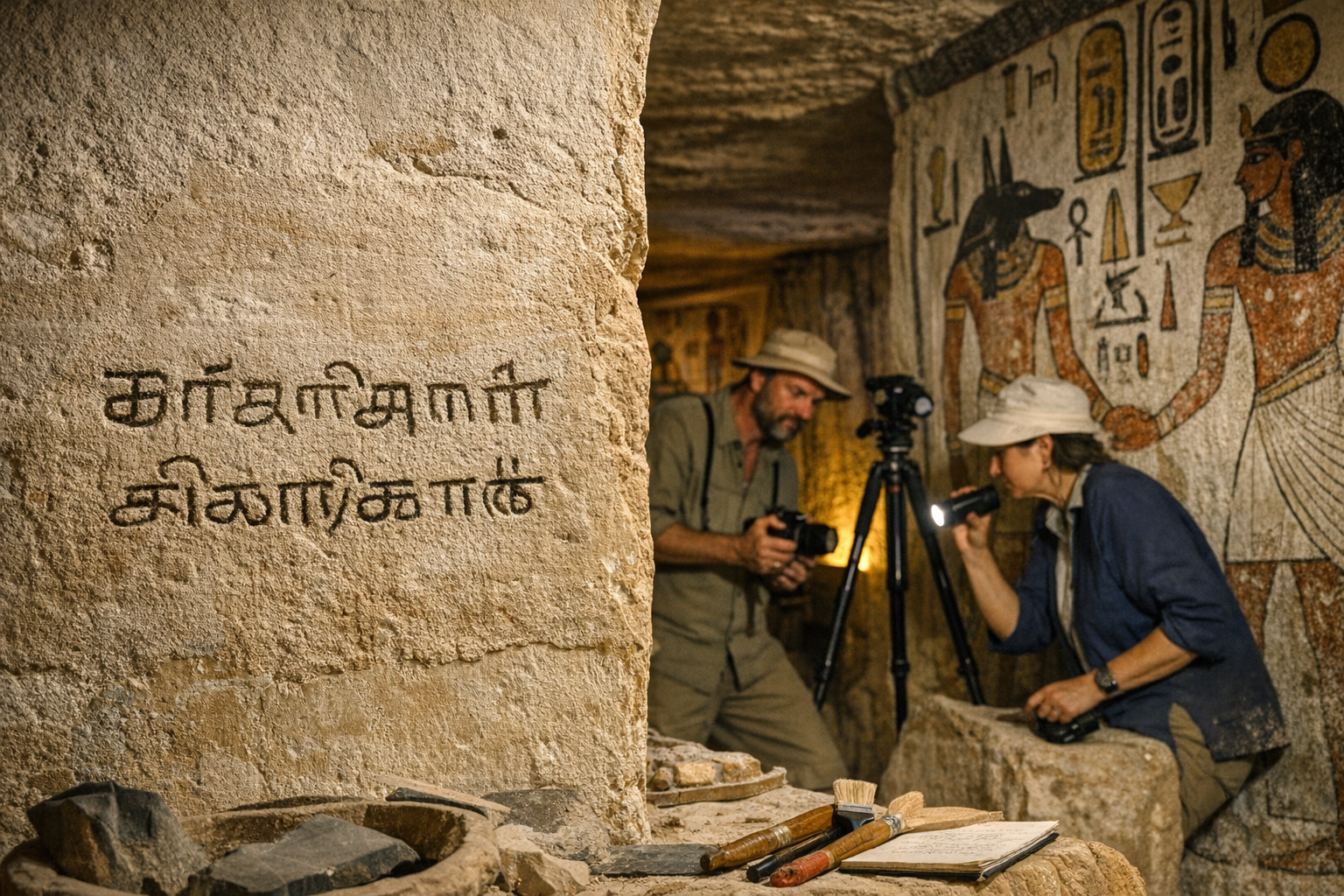
Chennai: In a discovery that could reshape the history of ancient Indian maritime trade, researchers have identified nearly 2,000-year-old Tamil-Brahmi inscriptions inside the heavily secured royal tombs in Egypt’s Valley of the Kings.
The findings were presented by Professor Ingo Strauch of the University of Lausanne, Switzerland, at the four-day International Conference on Tamil Epigraphy that began in Chennai on February 11.
Key Details of the Discovery
Professor Ingo Strauch, along with Professor Charlotte Schmid of the French School of Asian Studies in Paris, documented around 30 inscriptions across six rock-cut tombs.
One of the tombs belongs to Pharaoh Ramesses VI.
The name “Cikai Korran” was found repeated at eight different locations.
A notable phrase — “Cikai Korran vara kanta” — translates to “Cikai Korran came and saw,” resembling the style of graffiti left by ancient Greek visitors.
Researchers suggest that “Cikai” may mean “crest” or “topknot,” while “Korran” could signify “leader,” indicating that the individual may have held an important position within a merchant guild.
Historical Significance and Egyptian Evidence
Until now, evidence of Tamil presence in Egypt had largely been limited to port cities such as Berenike. The newly discovered inscriptions indicate that Indian traders traveled deep into Egypt’s interior.
“Merchants did not simply arrive by ship and leave; they stayed longer and visited heritage sites far from the coast,” Prof. Strauch noted.
Although thousands of Greek graffiti inscriptions exist inside these tombs, researcher Charlotte Schmid pointed out that very few foreign traders are known to have traveled such distances, highlighting the significance of the Tamil presence.
Proof of Two-Way Trade Links
Roman writers such as Ptolemy and Pliny documented trade with India, but whether Indian merchants traveled to Egypt had remained unclear.
“This new evidence proves that trade during the Roman period was not one-way but reciprocal,” said senior epigraphist Y. Subbarayalu.
Maritime historians also emphasize that the Nile corridor and the Red Sea served as major trade routes connecting Rome and India.
Influence of Ancient Tamil Traders
The inscriptions suggest that Tamil merchants were more than just cargo traders:
- They lived abroad for extended periods.
- They explored foreign regions.
- They engaged in early forms of cultural tourism.
According to researchers, the discovery demonstrates that links between India and the Western world were not limited to commercial exchanges but involved long-distance travel and sustained interaction.
Conclusion
The Tamil-Brahmi inscriptions discovered inside Egypt’s royal tombs are being regarded as powerful archaeological evidence that Tamil traders were part of a global trade network as early as two millennia ago. The finding is expected to open new avenues for research into the depth and scale of ancient India–Egypt relations.