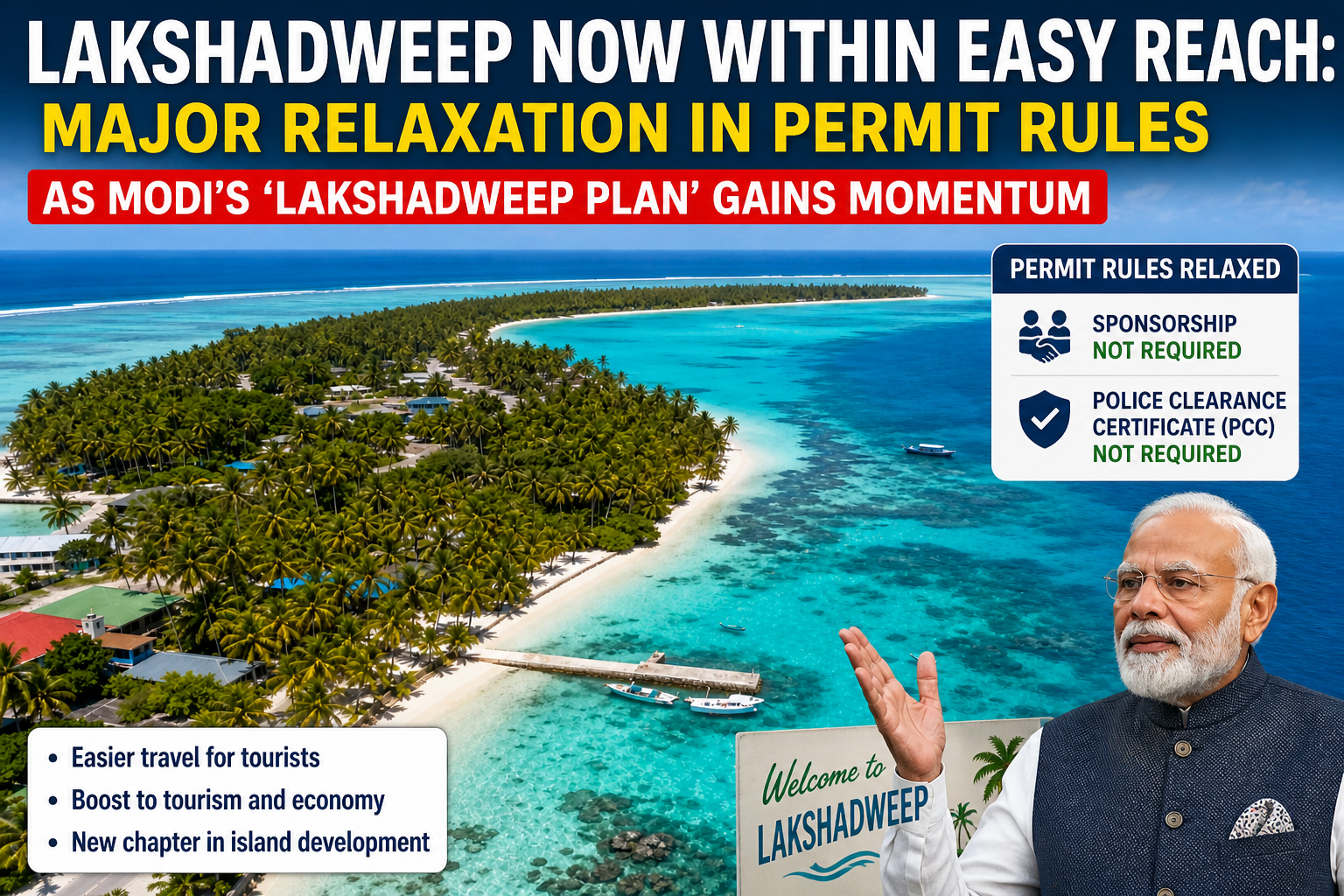
India’s picturesque island territory of Lakshadweep is becoming far more accessible to tourists after authorities significantly relaxed travel permit regulations. The administration has removed two major requirements for visitors — the mandatory Police Clearance Certificate (PCC) and local sponsorship requirement — making travel to the islands much easier than before.
The move is being viewed as part of Prime Minister Narendra Modi’s broader push to develop Lakshadweep as a major tourism destination following diplomatic tensions involving the Maldives in 2024.
According to the official Lakshadweep ePermit portal:
“Sponsorship is no longer required for Tourist category applications. Police Clearance Certificate (PCC) is no longer required.”
However, an Entry Permit remains mandatory for all visitors.
What Was the Previous Situation?
Earlier, tourists traveling to Lakshadweep had to :
- Obtain a Police Clearance Certificate (PCC)
- Arrange sponsorship from a local resident or resort
- Undergo strict security verification
- Wait several weeks for permit approvals
Travel agencies and tourism operators often described the process as lengthy and difficult, discouraging many travelers from visiting the islands.
With the new rules, ordinary tourists can now apply more easily through the online ePermit system.
Does Lakshadweep Have Special Constitutional Status?
Yes .Lakshadweep is a Union Territory directly governed by the Central Government of India under Article 239 of the Indian Constitution.
Key Constitutional Features
- No separate legislative assembly
- Governed by an Administrator appointed by the Centre
- Falls under the jurisdiction of the Kerala High Court
- Has one representative in the Lok Sabha
Despite easier tourism access, special entry regulations continue in order to protect the islands’ fragile ecology, indigenous culture, and security interests.
Ancient History of Lakshadweep
Lakshadweep is India’s smallest Union Territory and consists of 36 coral islands, of which only 10 are inhabited.
Historians believe the earliest settlers arrived from the Malabar Coast of present-day Kerala. Over time, Arab traders established strong maritime links with the islands, turning them into an important stop along Indian Ocean trade routes.
Ancient Greek navigators are also believed to have mentioned the islands in maritime records.
Where Did the People of Lakshadweep Come From?
Historical and cultural studies suggest:
- Most islanders migrated from Kerala’s Malabar region
- The population shares cultural links with the Mappila Muslim community of Kerala
- Residents of Minicoy Island have ethnic and linguistic similarities with Maldivian Mahl communities
Several genetic and historical studies support the long-standing Kerala–Arab maritime connection in the region.
How Did Islam Reach Lakshadweep?
According to local tradition, Islam was introduced to the islands in the 7th century by Arab missionary Sheikh Ubaidullah.
Historians note that Arab traders maintained extensive trade relations with the Malabar Coast, which gradually spread Islamic influence to the islands. Over time, most residents embraced Islam.
Today, nearly 96% of Lakshadweep’s population is Muslim, primarily belonging to the Sunni community.
Portuguese, Tipu Sultan and British Rule
Historically, Lakshadweep came under the influence of:
- Portuguese colonial powers
- The Arakkal Kingdom of Kannur
- Tipu sultan
- Later, British colonial administration
Historical records also mention a revolt by islanders against Portuguese rule in the 16th century.
Why Lakshadweep Is Strategically Important
Lakshadweep occupies a highly strategic position in the Arabian Sea near important international shipping lanes.
The islands are considered crucial for:
- India’s maritime security
- Naval operations
- Fisheries and marine resources
- High-end tourism development
The Indian government is now actively promoting the islands as an alternative luxury tourism destination in the Indian Ocean region.
Sources
- Lakshadweep ePermit Portal
- Historical and demographic records on Lakshadweep
- Publicly available constitutional and census data