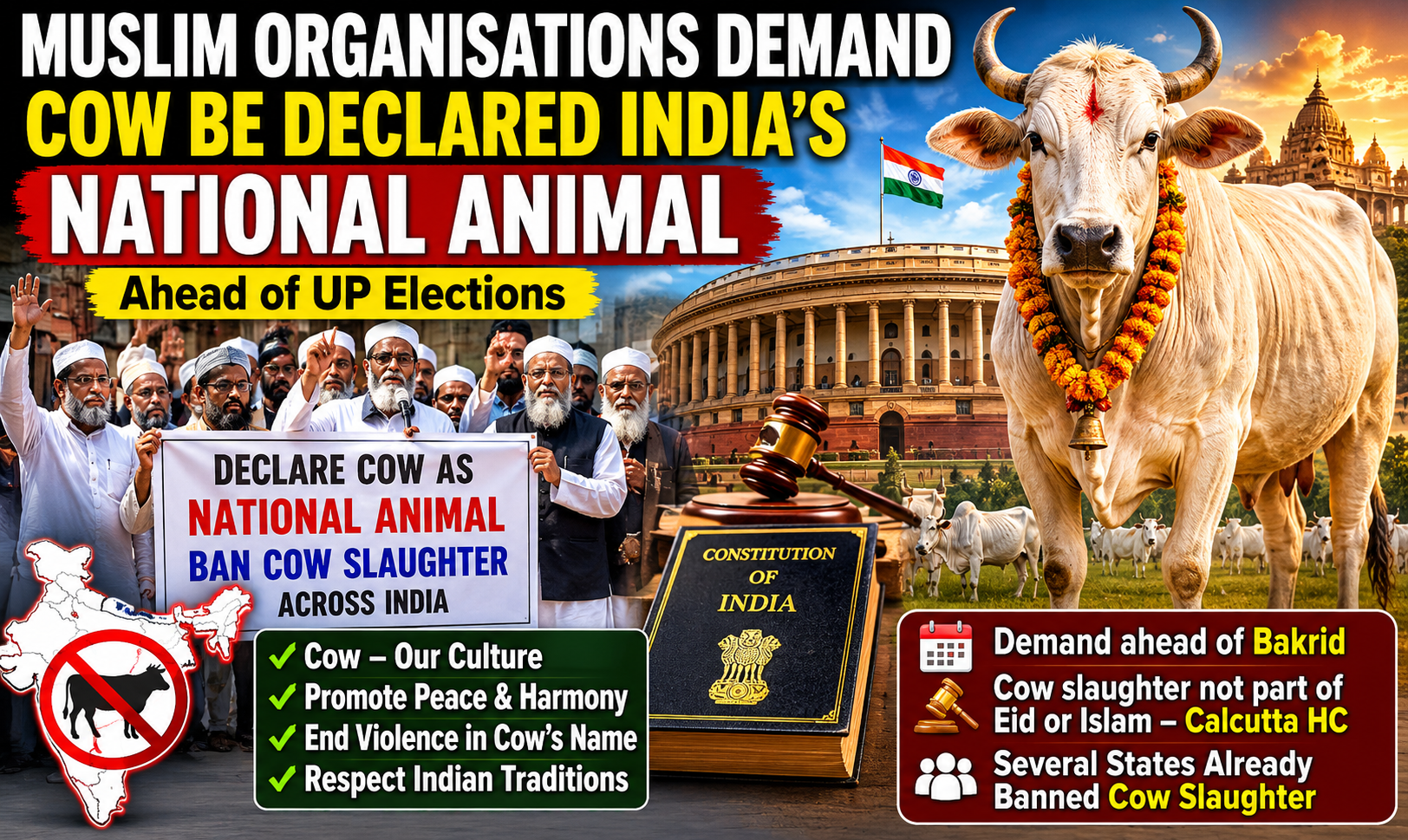
In a significant development ahead of the politically sensitive period in Uttar Pradesh, several Muslim organisations and clerics have reportedly demanded that the cow be declared India’s “National Animal” and that cow slaughter be completely banned across the country.
The move has drawn nationwide attention because the cow remains one of the most emotionally and politically charged symbols in India, deeply connected with religion, agriculture, constitutional debates, and electoral politics.
According to reports, the organisations argued that granting national animal status to the cow could help promote communal harmony, prevent violence in the name of cow protection, and strengthen respect for Indian cultural traditions.
The demand surfaced ahead of Bakrid (Eid al-Adha), a period during which debates over cattle slaughter often intensify in several northern states.
Cow and Indian Civilization: A Historical Relationship
The relationship between the cow and Indian civilization dates back thousands of years.
In Hindu traditions, the cow has long been revered as:
- a symbol of motherhood,
- prosperity,
- non-violence,
- and agrarian sustainability.
Ancient Indian society depended heavily on cattle for:
- agriculture,
- dairy production,
- transport,
- and organic farming.
Even today, cow-related symbolism plays a major role in Indian religious and political discourse.
Constitutional Protection of Cows
India’s Constitution indirectly supports cow protection through Article 48, a Directive Principle of State Policy, which states that the government should take steps to prohibit the slaughter of cows and calves and improve cattle breeds.
This constitutional provision became the basis for various state-level anti-cow slaughter laws after Independence.
States That Banned Cow Slaughter — Timeline and Political Background
| State | Law / Year | Political Party / Government |
|---|---|---|
| Uttar Pradesh | UP Prevention of Cow Slaughter Act, 1955 | Indian National Congress |
| Bihar | Bihar Preservation and Improvement of Animals Act, 1955 | Congress |
| Madhya Pradesh | Anti-cow slaughter laws, 1959 | Congress |
| Maharashtra | Animal Preservation Act, 1976; expanded in 2015 | Congress initially; BJP amendment in 2015 |
| Gujarat | Stronger amendments in 2011 & 2017 | BJP |
| Haryana | Gauvansh Sanrakshan Act, 2015 | BJP |
| Karnataka | Prevention of Slaughter Act, 2020 | BJP |
| Assam | Assam Cattle Preservation Act, 2021 | BJP |
| Rajasthan | Bovine Animal Act, 1995 | BJP-era political influence |
Several northeastern and southern states, including Kerala, West Bengal, Meghalaya, Nagaland, Mizoram, and Tripura, do not impose a total ban on cattle slaughter.
Rise of “Cow Politics” in India
The cow became a major political issue especially after the 1966 nationwide anti-cow slaughter protests in Delhi, led by Hindu religious groups and organisations such as:
- RSS,
- Jana Sangh,
- Hindu Mahasabha,
- and Vishwa Hindu Parishad.
Over the decades, “cow protection” evolved into a major ideological and electoral issue, particularly in northern India.
Interestingly, many of the earliest anti-cow slaughter laws were enacted during Congress governments, while later BJP governments strengthened penalties and enforcement mechanisms.
Social and Legal Controversies
Cow protection laws have also triggered major controversies in recent years, including:
- mob lynching incidents,
- allegations of vigilante violence,
- communal tensions,
- and debates over food rights and minority protections.
Indian courts, however, have repeatedly upheld the constitutional validity of state cow protection laws.
Recently, the Calcutta High Court observed that:
“Cow slaughter is not an essential part of Eid or Islam.”