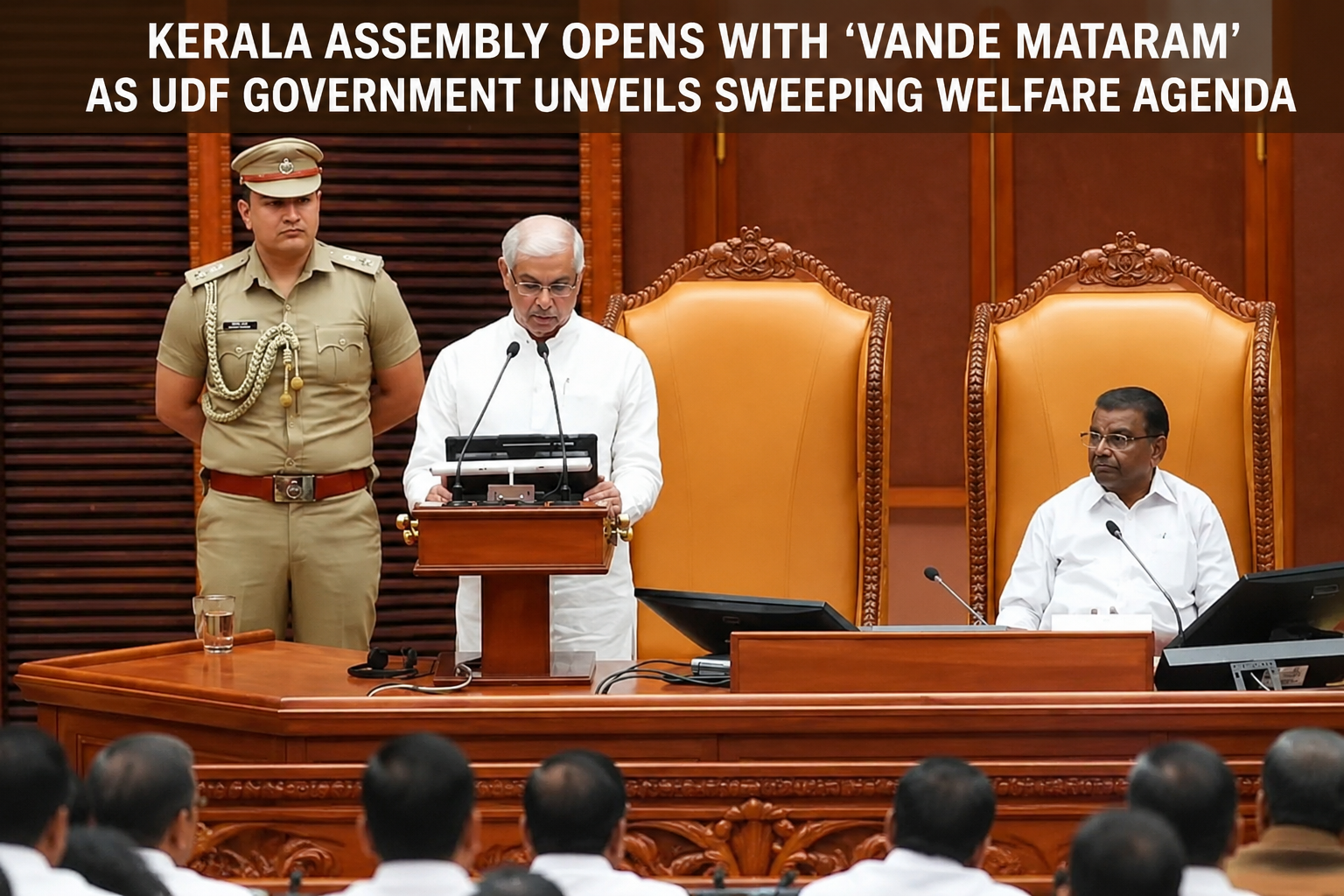
Thiruvananthapuram, Kerala — The first session of the 16th Kerala Legislative Assembly began on Friday with the singing of “Vande Mataram,” marking the first time in the Assembly’s history that proceedings opened with the national song instead of the customary national anthem, “Jana Gana Mana.”
The inaugural session of the new United Democratic Front (UDF) government formally commenced with Governor Rajendra Arlekar. delivering the policy address. The governor was received at the Assembly by Speaker Thiruvanchoor Radhakrishnan , Chief Minister V D Satheesan , and Parliamentary Affairs Minister Sunny Joseph.
Debate Over “Vande Mataram”
Traditionally, Kerala Assembly proceedings begin and conclude with the national anthem. This time, however, the opening featured an instrumental rendition of the first two stanzas of “Vande Mataram” performed by the Kerala Police Band.
The move comes amid continuing political debate over the song. During the UDF government’s swearing-in ceremony earlier this year, the complete version of “Vande Mataram” was played, drawing criticism from opposition groups and sections of civil society.
India’s Congress Working Committee had resolved in 1937 that only selected portions of the song should be used in official contexts, citing concerns that later verses may not reflect the country’s pluralistic character. The Constituent Assembly in 1950 also clarified that only the opening lines of the song would be accorded official national-song status.
The Kerala government’s decision to restrict the Assembly rendition to the opening verses appeared aimed at avoiding renewed controversy.
Major Welfare and Development Announcements
In his policy address, Governor Arlekar outlined an ambitious welfare and development agenda for the new government.
Among the key announcements was a proposal to release a white paper detailing Kerala’s actual financial condition. The government also pledged to raise welfare pensions to ₹3,000 per month.
Female college students will receive a monthly educational assistance grant of ₹1,000, while women will be allowed free travel on Kerala State Road Transport Corporation (KSRTC) buses.
The government said it would expand its “Indira Guarantee” social welfare initiative and launch the “Oommen Chandy Health Insurance Scheme,” promising free medical coverage of up to ₹2.5 million annually for every family.
To encourage entrepreneurship among young people, the administration announced interest-free loans of up to ₹500,000 for start-ups and self-employment ventures. A dedicated department for senior citizens will also be established.
Agriculture, Tourism and Infrastructure Push
The policy statement placed strong emphasis on agriculture and infrastructure development.
The government plans to reduce cultivation costs, expand mechanisation in farming, and encourage women farmers. Measures to strengthen Kerala’s spice export sector and improve soil conservation were also announced.
Officials said cooperative societies would receive additional institutional support, while Kerala would pursue plans to emerge as a major port and logistics hub.
The government also proposed expanding pilgrimage tourism by linking major temples through dedicated tourism circuits. The network of mobile Maveli stores operated through the state’s public distribution system will also be expanded.
Film Industry and Cultural Initiatives
The UDF government announced plans for a comprehensive film policy aimed at transforming Kerala into an internationally recognised film production destination.
The proposal includes the development of a Media City and Creative Industries Hub with advanced facilities for animation and visual effects production.
Cultural workers above the age of 60 will receive pensions and health insurance coverage. The government also pledged to establish permanent theatres across the state, expand the International Film Festival of Kerala to more cities, and create digital art museums.
Anti-Drug Measures and Education Reforms
The government pledged a “zero tolerance” approach to narcotics and substance abuse, promising major reforms in the excise department and intensified crackdowns on drug networks.
Schools and college campuses will be declared drug-free zones under the proposed initiative.
In education, the administration announced plans to increase Plus One seats in all districts and establish globally benchmarked higher education institutions. A new Jawaharlal Nehru Scientific Centre will also be set up to promote science education.
Additionally, the government unveiled a proposed academic tourism initiative titled “Semester in Kerala,” aimed at attracting students and researchers from across India and abroad.