Muhammad Zeeshan Ali becomes first Pakistani to enter orbit aboard China’s Shenzhou-24; mission highlights Beijing’s growing space diplomacy as India advances its indigenous Gaganyaan programme
NEW DELHI | November 25, 2026
Pakistan has entered a new chapter in its space exploration journey, with its first astronaut, Muhammad Zeeshan Ali, successfully travelling into orbit aboard China’s Shenzhou-24 spacecraft on Wednesday. The mission, launched from northwest China, marks a significant development in the growing space partnership between Beijing and Islamabad.
However, from an Indian perspective, the development also brings renewed attention to South Asia’s history of human spaceflight. India sent its first citizen into space more than four decades ago, when Wing Commander Rakesh Sharma travelled aboard the Soviet Soyuz T-11 spacecraft in April 1984.
Pakistan’s latest achievement is therefore a milestone for its own space programme, but it does not make the country the first South Asian nation to send a citizen into space. India achieved that distinction in 1984.
The Chinese mission also highlights the different approaches adopted by the two neighbouring countries. While Pakistan has entered human spaceflight through cooperation with China, India is working towards developing its own independent human spaceflight capabilities through the Indian Space Research Organisation (ISRO).
China’s Shenzhou-24 Rocket Successfully Launches
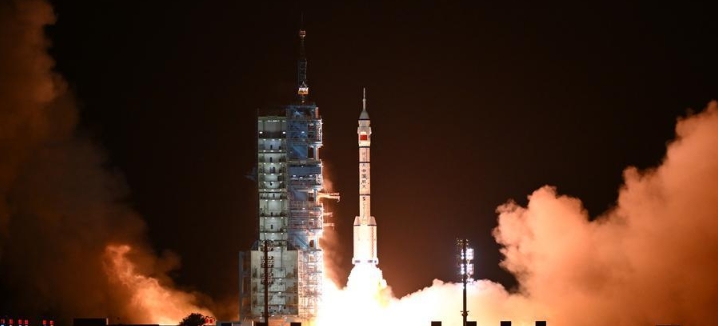
China’s Shenzhou-24 spacecraft lifted off successfully at 8:18 a.m. Beijing time (5:48 a.m. Indian Standard Time) on November 25 from the Jiuquan Satellite Launch Centre in northwest China.
The spacecraft was carried by a Long March-2F rocket and entered its planned orbit.
The three-member crew consists of Chinese astronaut Tang Hongbo, Chinese flight engineer Wu Yi and Pakistani astronaut Muhammad Zeeshan Ali.
The mission represents the first time a foreign astronaut has joined China’s crewed spaceflight programme and travelled towards its Tiangong space station.
According to international reports, the astronauts were in good condition following the launch.
Ali, a 40-year-old pilot, is expected to spend approximately five to ten days aboard the Chinese space station, participating in scientific experiments and research activities.
Who Is Muhammad Zeeshan Ali?
Muhammad Zeeshan Ali is a Pakistani pilot selected to participate in China’s human spaceflight programme.
He underwent approximately seven months of specialised astronaut training in Beijing before being selected for the historic mission.
His preparation included spacecraft operations, emergency procedures, physical conditioning, scientific research training and intensive Chinese-language instruction.
Ali has been appointed as a payload specialist, meaning his primary responsibilities include assisting with scientific experiments and research conducted aboard the space station.
His selection marks Pakistan’s entry into a government-sponsored orbital human spaceflight mission.
Before this achievement, Pakistani adventurer Namira Salim travelled on a Virgin Galactic suborbital space tourism flight in 2023. However, that was a commercial suborbital journey and was fundamentally different from an orbital mission involving a space station.
The Shenzhou-24 mission represents a new milestone because Ali is travelling to an orbital laboratory where he is expected to live and work alongside professional astronauts.
India Was the First South Asian Nation to Send a Citizen into Space
The development inevitably recalls India’s historic achievement in April 1984.
Wing Commander Rakesh Sharma became the first Indian citizen to travel into space when he flew aboard the Soviet Soyuz T-11 spacecraft as part of a joint Indo-Soviet space mission.
Sharma spent approximately eight days aboard the Salyut 7 space station, conducting scientific experiments and participating in research activities.
His historic mission remains an important landmark in India’s scientific and technological history.
During a conversation with then Prime Minister Indira Gandhi from space, Sharma was asked how India looked from above. His famous response was:
“Saare Jahan Se Achha.”
The words became part of India’s national memory and continue to symbolise the country’s achievements in space exploration.
Unlike Pakistan’s latest mission, which relies on China’s spacecraft, rocket and orbital infrastructure, India’s 1984 mission was conducted through cooperation with the Soviet Union.
India has since developed one of the world’s established national space programmes through ISRO, with achievements spanning satellite technology, lunar exploration, solar research and interplanetary missions.
India’s Gaganyaan Programme: The Next Major Milestone
India is now preparing for a much larger step in human space exploration through its ambitious Gaganyaan programme.
Developed by ISRO, Gaganyaan aims to demonstrate India’s ability to independently send Indian astronauts into low Earth orbit and safely return them to Earth.
Under the programme, India plans to send a crew of three astronauts into an orbit approximately 400 kilometres above Earth for a three-day mission.
According to information provided by the Department of Space to Parliament in August 2026:
- The first uncrewed experimental Gaganyaan mission is targeted for the fourth quarter of 2026.
- Two additional uncrewed missions are planned as part of the preparation programme.
- The first crewed mission is targeted for 2027.
- The Human Rated Launch Vehicle and several critical spacecraft systems have undergone development and qualification testing.
The programme is designed to establish India’s independent capability in launching, supporting and recovering human spaceflight missions.
The distinction is significant. Pakistan’s current achievement has been made possible through Chinese technological and operational support, whereas Gaganyaan aims to demonstrate India’s indigenous human spaceflight capabilities.
India Plans Its Own Space Station by 2035
India’s ambitions extend well beyond sending astronauts into orbit.
The government has approved the development of the Bharatiya Antariksh Station, India’s proposed indigenous space station.
The planned station will consist of five modules and is intended to support long-duration human spaceflight, scientific research and advanced experiments in microgravity.
The first module, BAS-01, is targeted for launch by 2028, while the station is planned to become operational by 2035.
India has also announced a long-term ambition to send Indian astronauts to the Moon by 2040.
These objectives demonstrate that India’s space strategy is not limited to individual astronaut missions. It involves developing a complete ecosystem covering launch vehicles, spacecraft, orbital infrastructure, scientific research and deep-space exploration.
China–Pakistan Space Cooperation: A Strategic Partnership
The Shenzhou-24 mission is also an important diplomatic development between China and Pakistan.
The two countries signed an agreement in February 2025 to facilitate Pakistani participation in China’s human spaceflight programme.
Their space cooperation extends beyond astronaut training.
Over the years, China and Pakistan have collaborated in areas including:
- Satellite development and launches.
- Telecommunications and remote sensing.
- Earth observation.
- Space research and technology.
- Lunar exploration initiatives.
- Human spaceflight training.
China has provided Pakistan with access to its astronaut training facilities, launch infrastructure and Tiangong space station.
The mission also gives Beijing an opportunity to demonstrate that its independently developed space station can accommodate international astronauts.
For Pakistan, the partnership provides access to sophisticated human spaceflight capabilities without having to develop an independent crewed spacecraft and orbital launch system.
For China, it strengthens its international space diplomacy and expands the potential role of Tiangong as a platform for international scientific cooperation.
The Tiangong Space Station and China’s Global Space Ambitions
China’s Tiangong space station, whose name translates as Heavenly Palace, is a major component of Beijing’s independent human spaceflight programme.
The station became fully operational in 2022 and supports long-duration astronaut missions, scientific experiments and technology demonstrations.
China developed its own space station after being excluded from participation in the International Space Station programme.
By sending the first foreign astronaut to Tiangong, Beijing has taken another step towards positioning the station as an international destination for scientific research and astronaut cooperation.
China has also announced an ambition to conduct a crewed lunar landing by 2030 and establish a lunar research base in cooperation with Russia by 2035.
The United States is pursuing its own lunar exploration objectives through the Artemis programme.
The growing competition between major space powers is expected to shape the future of human space exploration.
What Does Pakistan’s Achievement Mean for India?
Pakistan’s successful participation in an orbital space mission is an important development in the South Asian space landscape.
However, the achievement should be understood in its proper context.
India’s human spaceflight history began in 1984, while Pakistan’s first orbital astronaut mission has taken place in 2026.
The two countries are following different technological paths.
Pakistan is currently relying on Chinese infrastructure and expertise to participate in human spaceflight.
India, meanwhile, is developing its own crewed launch vehicle, spacecraft, astronaut training infrastructure and recovery systems through ISRO.
India’s future space programme also includes the development of its own orbital space station and plans for human lunar exploration.
The comparison is therefore not simply about which country has sent an astronaut into space. It is also about the technological infrastructure, scientific capabilities and long-term objectives each country is developing.
At the same time, international cooperation remains an important part of modern space exploration. India’s own human spaceflight programme also involves cooperation with international space agencies, including Russia, France, the European Space Agency and Australia.
A New Phase in the Asian Space Race
Asia is emerging as an increasingly important centre of global space exploration.
China has established an operational space station and is preparing for future lunar missions.
India is developing its human spaceflight capabilities and pursuing an ambitious programme involving a national space station and lunar exploration.
Japan, South Korea and other Asian countries are also expanding their space research and technological capabilities.
Pakistan’s participation in the Shenzhou-24 mission adds another dimension to this changing regional landscape.
The coming years will show how effectively these countries translate individual achievements into long-term scientific, technological and economic capabilities.
CONCLUSION: Pakistan Reaches Orbit Through China, India Prepares for Indigenous Human Spaceflight
The successful launch of Shenzhou-24 carrying Pakistani astronaut Muhammad Zeeshan Ali is an important milestone for Pakistan and a significant achievement for China’s international space cooperation programme.
For Pakistan, it represents the beginning of participation in orbital human spaceflight.
For China, it demonstrates the international potential of its Tiangong space station.
For India, the development is a reminder of the country’s historic position in human spaceflight and the importance of continuing to strengthen indigenous technological capabilities.
India sent Rakesh Sharma into space in 1984. More than four decades later, the country is preparing to take the next step through Gaganyaan, followed by the Bharatiya Antariksh Station and future lunar missions.
The central difference lies in the long-term technological objectives.
Pakistan has entered orbital human spaceflight through a partnership with China. India is working towards establishing the independent capability to send its own astronauts into space, operate its own space infrastructure and eventually undertake human missions beyond Earth orbit.
The launch of Shenzhou-24 is a historic moment for Pakistan. But for India, the larger challenge and opportunity lie in advancing its own space programme and maintaining its position as a major force in the future of global space exploration.