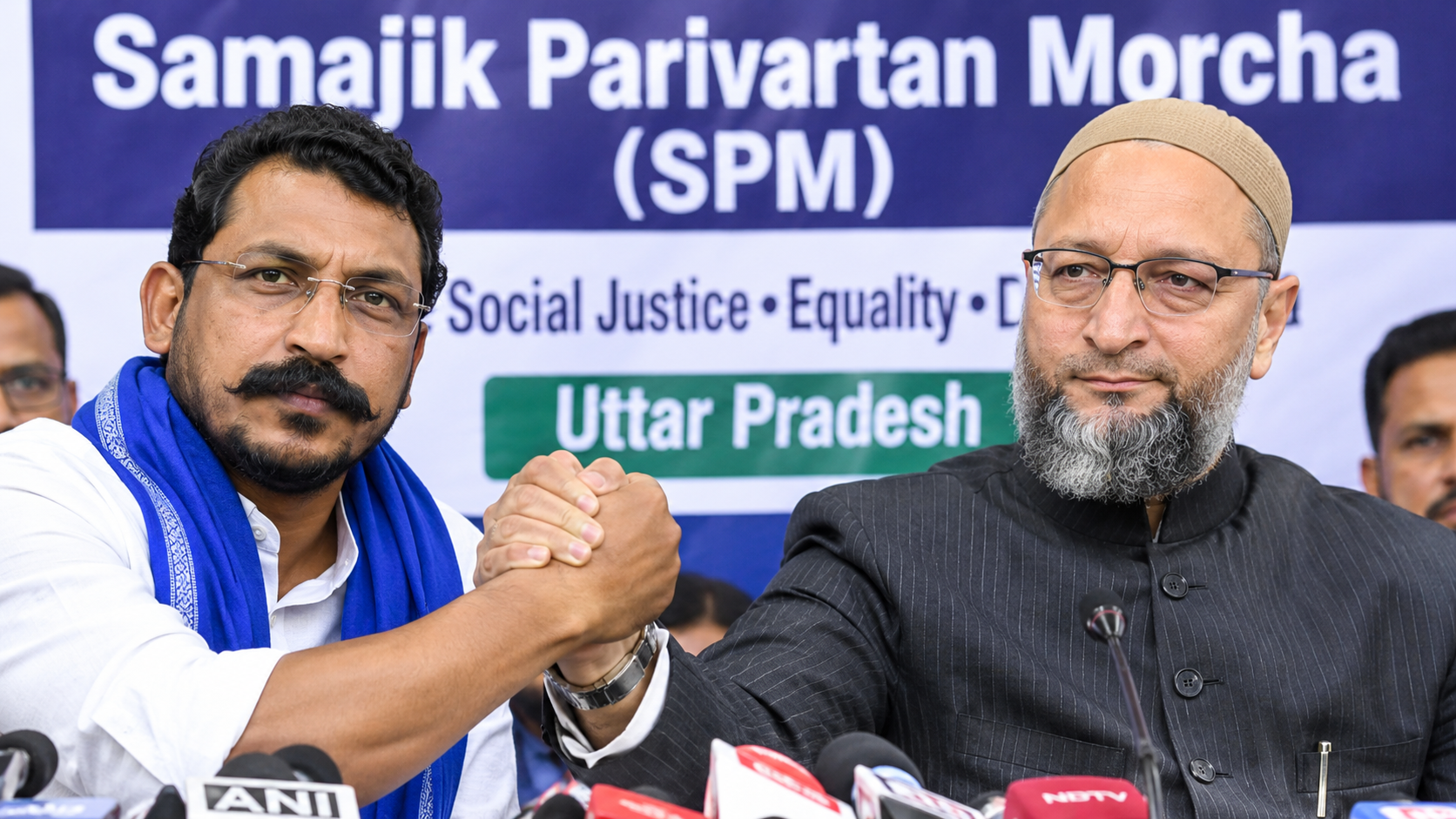
LUCKNOW: In a significant political development ahead of the 2027 Uttar Pradesh Assembly elections, Chandrashekhar Azad and Asaduddin Owaisi have joined hands to form a new political alliance, potentially reshaping the state’s electoral landscape. The alliance, named the Samajik Parivartan Morcha (SPM), brings together Azad’s Azad Samaj Party (Kanshi Ram) and Owaisi’s All India Majlis-e-Ittehadul Muslimeen (AIMIM). Chandrashekhar Azad has been named as the alliance’s chief ministerial candidate.
The announcement was made at a joint press conference in Lucknow, where the two leaders outlined their political agenda ahead of the crucial Assembly elections. The alliance aims to emerge as an alternative political force in the state, with a stated focus on social justice and the representation of Dalits, Muslims, backward communities, minorities, farmers and young people.
The leaders have also announced plans to organise a public rally on November 26 as part of their efforts to strengthen the alliance and mobilise support across the state.
The partnership is built around the idea of Dalit-Muslim political unity, with both parties seeking to consolidate support among communities that have significant demographic and electoral presence in Uttar Pradesh. Muslims constitute approximately 19–20 per cent of the state’s population, while Scheduled Castes account for around 21 per cent.
However, translating demographic strength into electoral support remains a major challenge, as voting patterns in Uttar Pradesh are influenced by caste identities, regional factors, local leadership, candidate selection and political affiliations.
Chandrashekhar Azad, founder of the Azad Samaj Party and a prominent Dalit leader, rose to national prominence through the Bhim Army, an organisation associated with the movement for Dalit rights and social justice. His political activities have largely focused on fighting caste discrimination, promoting educational opportunities and strengthening the political representation of marginalised communities.
Azad subsequently entered electoral politics by establishing the Azad Samaj Party. In the 2022 Uttar Pradesh Assembly elections, he contested against Chief Minister Yogi Adityanath from the Gorakhpur Urban constituency but failed to win. However, his victory from the Nagina Lok Sabha constituency in the 2024 general elections marked a significant milestone in his political career and strengthened his position in national politics.
Asaduddin Owaisi, president of the AIMIM and Member of Parliament from Hyderabad, is one of the prominent voices in India’s minority politics. His political campaigns have consistently highlighted minority representation, constitutional rights and the socio-economic concerns of Muslim communities.
Although AIMIM has struggled to establish a substantial electoral presence in Uttar Pradesh, the party has contested elections in several constituencies in the state. The alliance with Azad is seen as an effort to expand its political footprint and strengthen its organisational presence ahead of the 2027 elections.
The new political arrangement is also likely to attract attention because of its potential implications for the Samajwadi Party, led by Akhilesh Yadav. The Samajwadi Party has been pursuing its PDA (Pichhde, Dalit, Alpsankhyak) political strategy, aimed at bringing together backward communities, Dalits and minorities.
The party emerged as a major political force in Uttar Pradesh during the 2024 Lok Sabha elections, winning 37 of the state’s 80 parliamentary constituencies. Against this backdrop, the formation of a separate Dalit-Muslim political alliance introduces another dimension to the state’s opposition politics.
Political observers are likely to focus on whether a section of Muslim voters could gravitate towards AIMIM and whether Azad’s influence among Dalit youth could translate into broader electoral support for the new alliance. The position of the Bahujan Samaj Party (BSP), led by Mayawati, will also be significant, given its longstanding political base among Dalit communities.
The alliance has already triggered reactions from other political parties. Samajwadi Party MP Awadhesh Prasad has maintained that Akhilesh Yadav is the leader capable of defeating the BJP in Uttar Pradesh. Congress MP Imran Masood, meanwhile, said that political parties were free to form alliances in a democracy and that the Congress would decide its own political course.
Chandrashekhar Azad has rejected allegations describing his party or the new alliance as the BJP’s ‘B-team’. He has defended the decision to join hands with AIMIM, pointing to the broader political context in which different parties are forming alliances ahead of the elections.
Despite the political significance of the announcement, the new front faces several challenges. Seat-sharing arrangements across the state’s 403 Assembly constituencies, candidate selection, coordination between the two parties and the development of a strong grassroots organisation will be crucial.
The alliance will also have to demonstrate that its appeal extends beyond specific pockets of western Uttar Pradesh and reaches voters in eastern Uttar Pradesh and the Awadh region.
The electoral record of the two parties in the 2022 Assembly elections highlights the scale of the challenge. AIMIM contested numerous constituencies but secured only a limited share of the overall vote. The Azad Samaj Party also failed to make a substantial electoral breakthrough at the state level. However, Azad’s victory in the 2024 Lok Sabha elections has given the party a renewed political platform.
The idea of Dalit-Muslim unity is not new to Uttar Pradesh politics. However, bringing the two political streams together under a common electoral platform represents a significant development ahead of the 2027 Assembly elections.
The emergence of the Samajik Parivartan Morcha adds another player to an already competitive political landscape dominated by the BJP, Samajwadi Party, BSP and Congress.
Several questions remain unanswered, including how many constituencies the alliance intends to contest, how seats will be distributed between its partners, and whether it will explore electoral cooperation with other opposition parties.
Ultimately, the success of the alliance will depend on its ability to convert its political messaging into organisational strength and electoral support across different regions of Uttar Pradesh.
The coming months will reveal whether Chandrashekhar Azad’s Dalit political base and Asaduddin Owaisi’s minority-focused political platform can be effectively brought together to create a new force in Uttar Pradesh politics. With the 2027 Assembly elections approaching, the Samajik Parivartan Morcha is set to become an important development to watch in the state’s evolving political landscape.