Adinath
SRIHARIKOTA:In a groundbreaking achievement for space science, the European Space Agency’s (ESA) Proba‑3 mission has successfully created the first artificial solar eclipse in space, enabling scientists to observe the Sun’s corona with unprecedented clarity and duration.
Launch and Background
The Proba‑3 mission was launched on December 5, 2024, aboard India’s PSLV‑XL rocket from the Satish Dhawan Space Centre in Sriharikota. The mission represents a landmark collaboration in space exploration, combining European engineering with Indian launch capabilities.
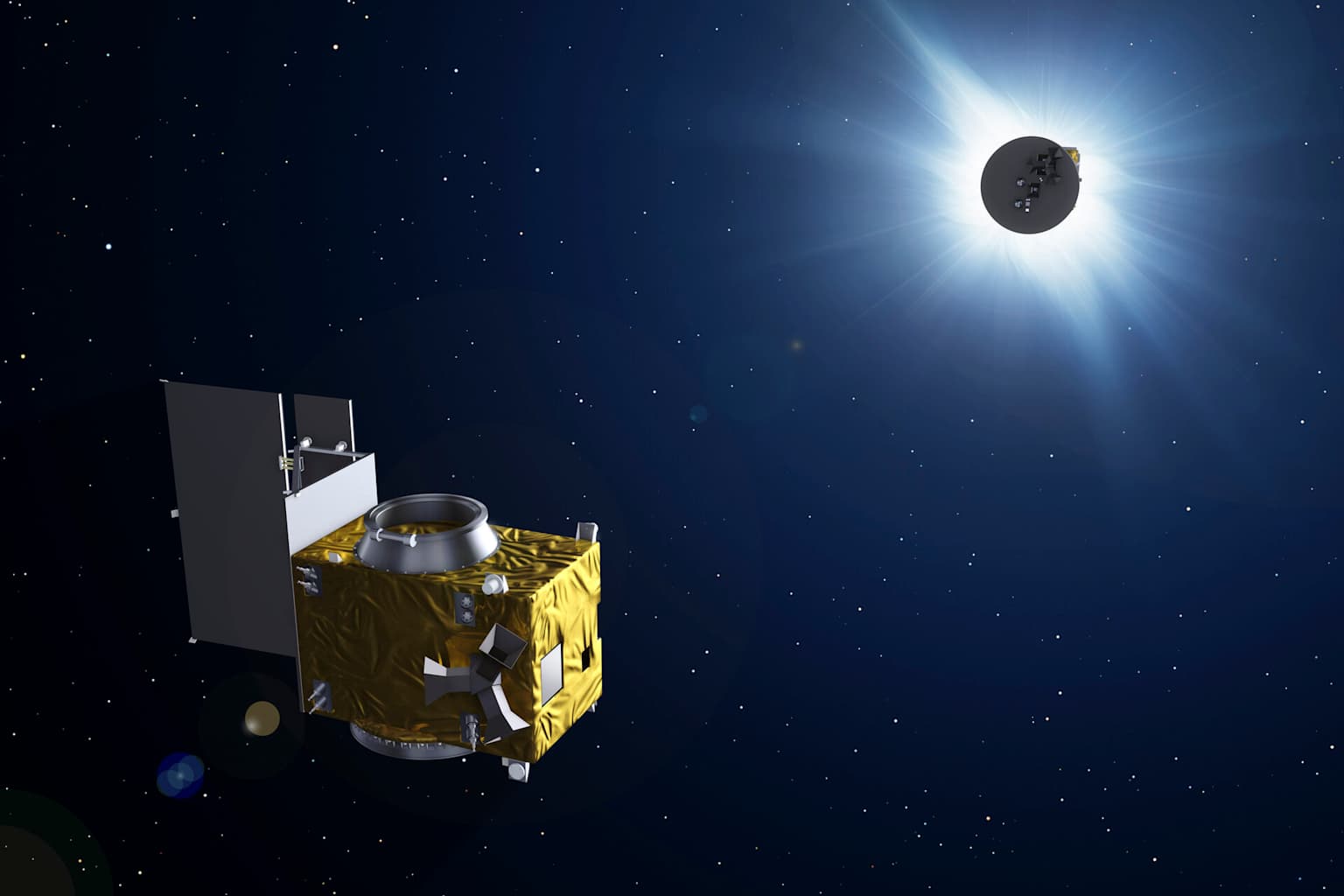
The mission comprises two satellites—the Occulter and the Coronagraph—flying in ultra-precise formation about 150 meters apart. These spacecraft operate together to simulate total solar eclipses in orbit.
Artificial Eclipse: A Technological Feat
In March 2025, the satellites achieved millimetre-level alignment, where the Occulter spacecraft blocked the Sun’s bright disk, allowing the Coronagraph spacecraft to capture detailed images of the Sun’s outer atmosphere, or corona. The alignment is so precise that the satellites maintain formation with errors of less than a few millimetres, thanks to advanced systems including GPS, star trackers, lasers, and inter-satellite radio links.
Since May 2025, the mission has performed ten artificial eclipses, with the longest lasting up to five hours—a dramatic improvement over the typical few minutes of natural eclipses.
Scientific Insights
The ASPIICS coronagraph, aboard the Coronagraph satellite, has already delivered the most detailed images yet of the inner solar corona, revealing complex structures such as solar prominences, previously difficult or impossible to study during brief natural eclipses.
Proba‑3 is expected to provide up to 1,000 hours of eclipse observations over its two-year mission, offering an extraordinary opportunity to study coronal heating, solar wind formation, and coronal mass ejections—phenomena that directly impact space weather and Earth’s communication and power systems.
Additional Instruments and Innovations
In addition to ASPIICS, Proba‑3 is equipped with other advanced instruments:
DARA (Digital Absolute Radiometer) – Measures solar irradiance.
3DEES (3D Energetic Electron Spectrometer) – Monitors charged particles in Earth’s radiation belts.
These tools not only support solar physics but also contribute valuable data for Earth’s space environment studies.
Expert Reactions
“I was absolutely thrilled to see the images, especially since we got them on the first try,” said Dr. Andrei Zhukov, principal investigator for ASPIICS at Belgium’s Royal Observatory.
“Having two spacecraft form one giant coronagraph in space allowed us to capture the inner corona with very low levels of stray light,” added Damien Galano, ESA’s Proba‑3 mission manager.
Broader Impact and Future Prospects
Beyond solar science, Proba‑3 sets a technological precedent in autonomous precision flying in space. The success of this formation-flying mission paves the way for future large-scale missions, including:
Exoplanet detection systems
Space-based gravitational wave observatories
Next-generation telescopes with modular spacecraft
As the mission concludes its commissioning phase, Proba‑3 is scheduled to perform two artificial eclipses per week, ultimately generating data from nearly 200 events over its operational lifespan.