Adinath
Bunker Buster bombs are a class of powerful conventional munitions designed to penetrate fortified military structures such as underground bunkers, tunnels, and heavily reinforced enemy shelters. Used primarily by advanced air forces like that of the United States and Israel, these bombs are engineered for deep penetration before detonation, making them critical in targeting high-value underground facilities—including nuclear sites, command bunkers, and missile silos. Their significance in strategic warfare has increased notably in conflicts involving nations like Iran, North Korea, and Russia, where vital military infrastructure is deliberately buried deep underground.
What is a Bunker Buster Bomb?
A Bunker Buster is a type of bomb specifically designed to destroy hardened or deeply buried targets. Unlike standard bombs that explode on impact or shortly after, bunker busters use hardened casings and sometimes rocket assistance to burrow deep into the ground or concrete before detonating.
Key Characteristics:
Heavy Casing: Made of reinforced steel to withstand high-speed impact.
Delayed Fuse: Detonates after penetration for maximum internal damage.
High Penetration: Capable of burrowing through meters of concrete or dozens of meters of soil.
Types of Bunker Buster Bombs
- GBU-28 (U.S.)
Developed during the Gulf War to penetrate Iraqi underground command centers.
Weighs 5,000 pounds (2,268 kg).
Can penetrate 30 meters (100 ft) of earth or 6 meters (20 ft) of reinforced concrete.
Delivered by aircraft like the F-15E Strike Eagle or B-2 bomber.
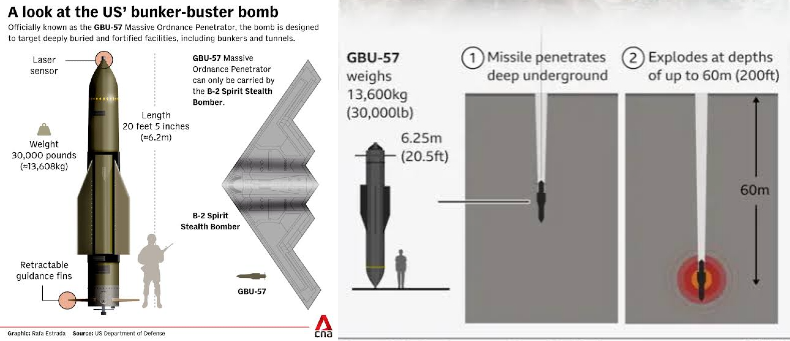
- GBU-57A/B MOP (Massive Ordnance Penetrator)
The most powerful non-nuclear bunker buster in the U.S. arsenal.
Weighs approximately 30,000 pounds (13,600 kg).
Designed to destroy deeply buried nuclear facilities.
Exclusively used by the B-2 Spirit stealth bomber.
- BLU-109 and BLU-116
Used by NATO and allies.
2,000-pound-class bombs with deep penetration capabilities.
Often fitted to JDAM (Joint Direct Attack Munition) kits for GPS guidance.
Technology Behind Bunker Busters
Kinetic Energy: The immense weight and high velocity at impact generate massive kinetic force, driving the bomb deep underground.
Hard-target Smart Fuses (HTSF): Specialized fuses that detect layers of earth or concrete before detonation.
Precision Guidance: GPS/INS and laser guidance systems ensure pinpoint accuracy, even against concealed or moving targets.
Military Use and Strategic Importance
Bunker Busters play a crucial role in:
Neutralizing Underground Command Centers
Destroying Weapons Storage Facilities
Targeting Hardened Missile Silos or Nuclear Labs
They have been considered essential in U.S. contingency plans against Iran’s underground nuclear facilities like Fordow, which is buried beneath a mountain.
Expert Opinion:
Dr. James Acton, a nuclear policy expert at the Carnegie Endowment, says:
“Bunker busters serve as a non-nuclear means of counterproliferation. Their existence alone can be a strategic deterrent, especially when adversaries know their underground shelters are not beyond reach.”
Lt. Gen. David Deptula (Ret.), U.S. Air Force, adds:
“These bombs enable us to achieve strategic effects with conventional munitions that were once thought only possible with nuclear weapons.”
Ethical and Strategic Concerns
Collateral Damage: Deep strikes can cause subterranean shockwaves, risking nearby civilian infrastructure.
Escalation: Use of bunker busters can be seen as a step toward nuclear conflict, especially when targeting nuclear sites.
Secrecy: Many such bombs are used in secretive operations, raising concerns over transparency and legality in international law.
Bunker Buster bombs have transformed the way militaries engage hardened targets. They bridge the gap between conventional warfare and nuclear deterrence by offering high-impact, precision-strike capability. As military technology evolves, these deep-penetration weapons will likely remain central in strategies against nations with heavily fortified underground infrastructures.