Washington, D.C. – June 28, 2025 —
In a significant development aimed at ending one of Africa’s most protracted and complex conflicts, Rwanda and the Democratic Republic of the Congo (DRC) signed a peace agreement in Washington on Friday. The deal seeks to end the violent clashes in eastern DRC that have killed thousands and displaced hundreds of thousands this year alone.
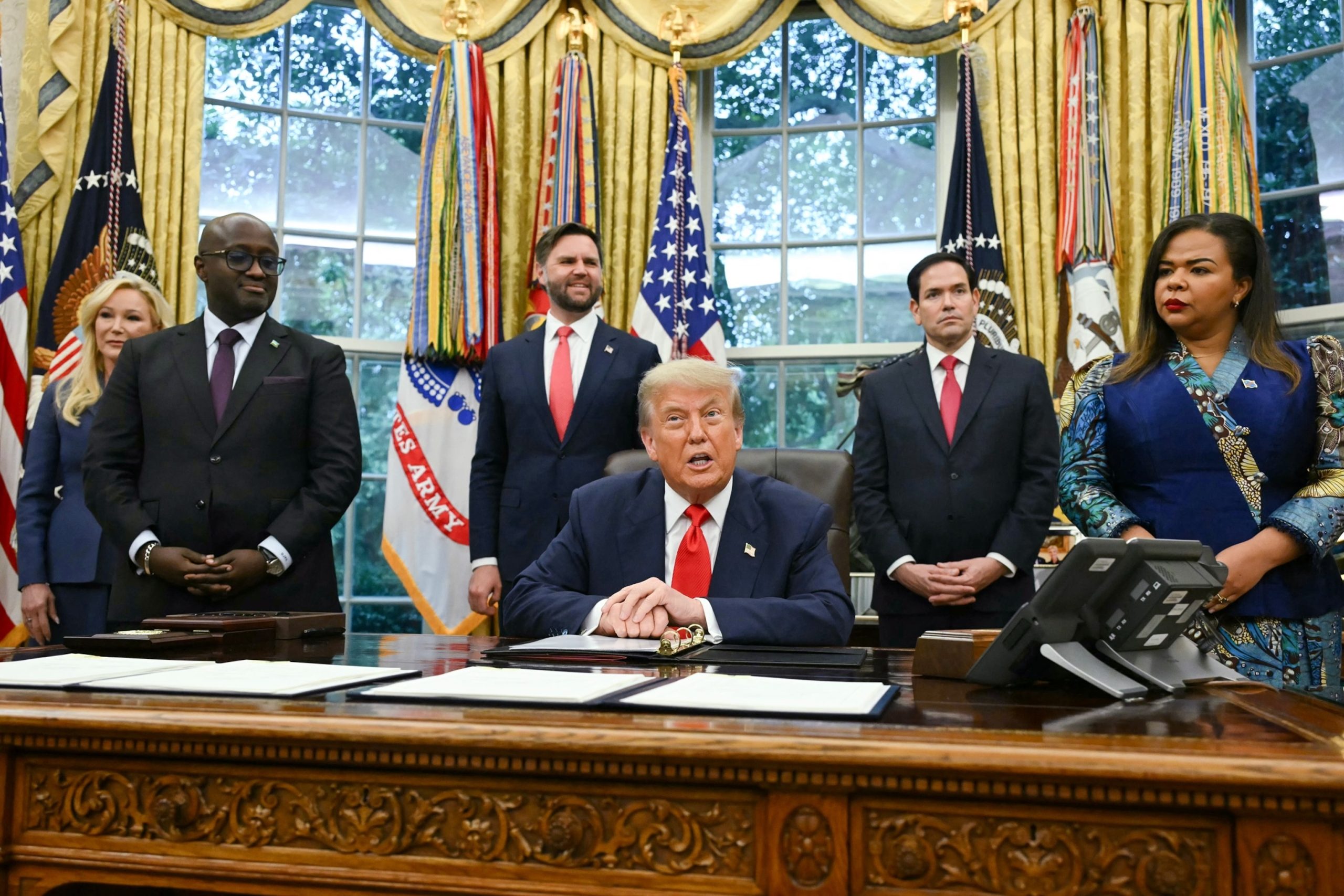
The ceremony was hosted by US Secretary of State Marco Rubio and was attended by the foreign ministers of both nations—Vincent Biruta of Rwanda and Thérèse Kayikwamba Wagner of the DRC. The peace deal builds upon a 2024 framework agreement and includes two major commitments: Rwanda will withdraw all its troops from eastern Congo within 90 days, and both nations will work toward launching a regional economic integration framework within the same period.
“This is not just a diplomatic document—it’s a lifeline for millions who have been caught in the crossfire of war,” Rubio said. “There is more work to be done, but this is a moment when people can start to dream of peace again.”
Decades of Conflict and a Fragile Peace
The deal aims to address one of the root causes of ongoing instability in eastern Congo: the presence of numerous armed groups operating in the mineral-rich region. Chief among them is the M23 rebel group, a Tutsi-led militia that has made significant territorial gains in recent months. The DRC government, United Nations, and international observers accuse Rwanda of supporting M23 to exploit mineral wealth—a charge Kigali has consistently denied.
Rwanda, in turn, accuses Congo of harboring the Democratic Forces for the Liberation of Rwanda (FDLR), an armed group founded by Hutu extremists involved in the 1994 Rwandan genocide. The newly signed agreement explicitly calls for the “neutralisation” of the FDLR, addressing a longstanding Rwandan demand.
Congo’s Foreign Minister Wagner emphasized the agreement’s commitment to national sovereignty and legal norms:
“By signing this agreement, we reaffirm a simple truth: peace is a choice, but also a responsibility. A responsibility to respect international law, to uphold human rights, and to protect the sovereignty of states.”
Trump’s Comments Spark Controversy
The ceremony took a controversial turn when former US President Donald Trump, who played a behind-the-scenes role in facilitating the deal, used the occasion to highlight what he described as America’s economic gains.
“We’re getting, for the United States, a lot of the mineral rights from the Congo as part of it,” Trump said. “They’re so honoured to be here. They never thought they’d be coming.”
His comments drew criticism from human rights groups and policy analysts, who warned that such statements could cast doubt on the neutrality of the US role in the mediation process. While the exact nature of any mineral agreements has not been disclosed publicly, observers fear the remarks could undermine local trust in the peace process.
Trump also made a dramatic reference to the region’s violent past:
“They were going at it for many years, and with machetes—it is one of the worst wars anyone has ever seen,” he said.
International Reactions and Skepticism
The agreement, mediated with support from Qatar, has been welcomed cautiously by international organizations and regional analysts. The United Nations praised the diplomatic effort but noted that the real test will be implementation, particularly the withdrawal of Rwandan troops and the disbanding of armed groups like M23 and the FDLR.
There are concerns about enforcement, especially given the number of armed factions operating in eastern DRC—more than 100 by most estimates. Many of these militias profit from the illegal extraction and trade of valuable resources such as gold, tin, and coltan.
Analysts also noted that the success of the economic integration framework, planned for launch within 90 days, would depend heavily on political will, regional cooperation, and international investment.
A Tentative Step Toward Peace
Despite the controversies and complexities, Friday’s signing is being viewed as a hopeful moment in a region long plagued by cycles of violence and foreign interference. Whether it marks a turning point or merely another diplomatic gesture remains to be seen.
Still, for millions in eastern Congo—many of whom have been displaced multiple times over the years—the promise of peace, however fragile, offers a rare glimmer of hope.