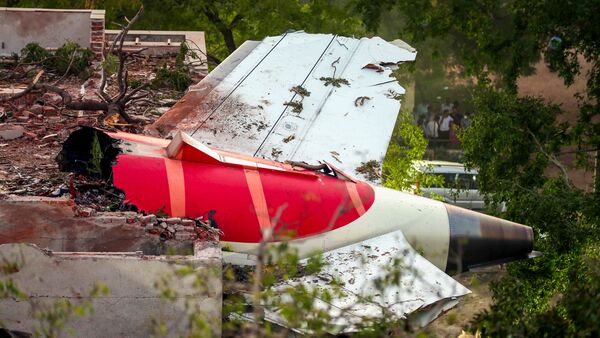
AHMEDABAD– July 12:The Aircraft Accident Investigation Bureau (AAIB) of India has released a 15-page preliminary report concerning the Air India Boeing 787-8 crash in Ahmedabad on June 12, which tragically claimed 260 lives. The report reveals that both engines of the aircraft shut down within moments of takeoff, with Engine 1 and Engine 2 fuel switches moving from “RUN” to “CUTOFF” within a second of each other.
According to the AAIB’s findings, both engines of the crashed aircraft experienced a temporary recovery after the initial thrust loss but ultimately failed to stabilize. The accident resulted in the loss of 260 lives, including 241 passengers and crew on board and 19 individuals on the ground, when the Air India Boeing 787 Dreamliner, bound for London, crashed into the BJ Medical College Hostel building in Ahmedabad shortly after takeoff.
The AAIB stated that on-site operations, including drone photography and videography, have been completed, and debris has been moved to a secure location near the airport. “Both engines have been recovered from the wreckage site and quarantined in a hangar at the airport. Components of interest for further examination have been identified and quarantined,” the report stated.
The report highlights that the aircraft reached a maximum indicated airspeed (IAS) of 180 knots at 08:08:42 UTC, just before the Engine 1 and Engine 2 fuel cutoff switches moved from “RUN” to “CUTOFF.” This effectively de-activated both engines within the aircraft.
It was further revealed that both engines disengaged within a second of each other immediately after takeoff. The Engine 1 and Engine 2 fuel cutoff switches sequentially moved from the RUN position to the CUTOFF position, with a one-second interval, leading to a reduction in engine N1 and N2 speeds due to loss of fuel supply.
The Cockpit Voice Recording (CVR) provided critical insight into the moments leading up to the crash. One pilot can be heard asking the other, “Why did you cut off?”, to which the second pilot responded that they had not. This exchange raises concerns about possible miscommunication or a technical malfunction in the crucial moments before both engines shut down.
The report acknowledged that CCTV footage from the airport clearly showed the Ram Air Turbine (RAT) deploying immediately after liftoff, as the aircraft initially gained altitude. However, the aircraft began to lose height before it could even clear the airport’s perimeter wall. The investigation report added that significant bird activity was not found near the flight path, making a bird strike an unlikely cause at this stage.
India’s Aircraft Accident Investigation Bureau stated, “At this stage of the investigation, no action has been recommended against Boeing BA.N 787-8 and/or GE GE.N GEnx-1B engine operators and manufacturers.”
The investigation is still ongoing, with several key components identified and quarantined for further analysis. The AAIB noted that the aircraft’s extended airframe flight recorder (EAFR) at the rear suffered significant damage and could not be accessed using conventional methods.