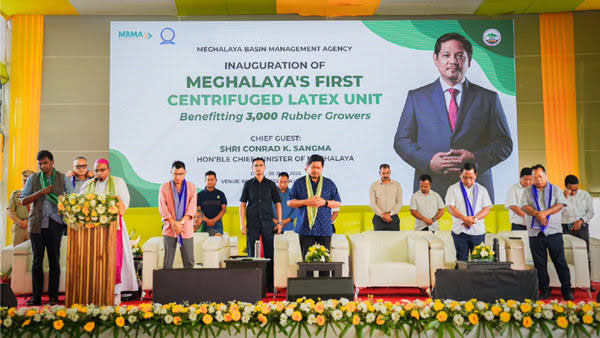
SHILLONG, Meghalaya – In a significant boost to its burgeoning rubber industry, Meghalaya has inaugurated its first centrifuged latex manufacturing unit in the East Garo Hills. This pioneering facility, launched on Monday, July 28, 2025, by Chief Minister Conrad K Sangma, is set to directly benefit over 3,000 rubber farmers in the region by enabling the local processing of raw rubber.
The ₹18.8-crore project at Koksi Nengsat under Songsak C&RD Block was funded by the state government through the Meghalaya Basin Management Agency (MBMA) and implemented by Sr. Rose, founder of Mendipathar Multipurpose Cooperative Society (MMCS). This unit marks a major milestone for Meghalaya’s efforts to support rural livelihoods and promote agri-based entrepreneurship.
Chief Minister Sangma highlighted that the new processing unit will transform the local rubber sheet industry, which has long suffered due to exploitation by middlemen from outside the region. It is expected to offer competitive prices and reduce the transportation burden for farmers, encouraging them to sell their produce directly to the facility. This is only vthe second such centrifuged latex unit in the entire Northeast.
Kerala’s Enduring Footprint in India’s Rubber Story
The development in Meghalaya, while a localized initiative, inherently connects to the larger narrative of India’s rubber industry, a story largely dominated by Kerala. Kerala holds a paramount position in India’s natural rubber production, historically contributing over 70% to 90% of the country’s total output.
Rubber cultivation was first introduced to India on a commercial scale in 1902 at Thattekad in Kerala. The state’s unique agro-climatic conditions – high humidity and abundant rainfall – proved ideal for the growth of Hevea brasiliensis, the primary source of natural rubber. Over the decades, rubber farming in Kerala transitioned from large colonial estates to predominantly smallholdings, which now account for over 80% of the area under rubber cultivation in the state.
Kerala has also been the hub for rubber research and development. The Rubber Research Institute of India (RRII), a pioneering institution dedicated to advancing rubber research, technology, and sustainable practices, is headquartered in Kottayam, Kerala.
Established in 1929, RRII has been instrumental in developing high-yielding and disease-resistant rubber plants, improving tapping methods, and innovating processing techniques that have significantly benefited rubber farmers across India. The Rubber Board of India, the statutory organization regulating the Indian rubber industry, also has its headquarters in Kottayam.
The growth of rubber cultivation in other Northeastern states like Meghalaya signifies a geographical diversification of India’s rubber production. However, the expertise, research, and historical groundwork laid by Kerala, through its extensive farming practices and institutions like RRII, continue to serve as a foundational model and source of knowledge for emerging rubber-growing regions across the country. The success of units like the one in Garo Hills will undoubtedly draw upon the collective experience garnered over a century of rubber cultivation and processing in India, much of which originated from Kerala.