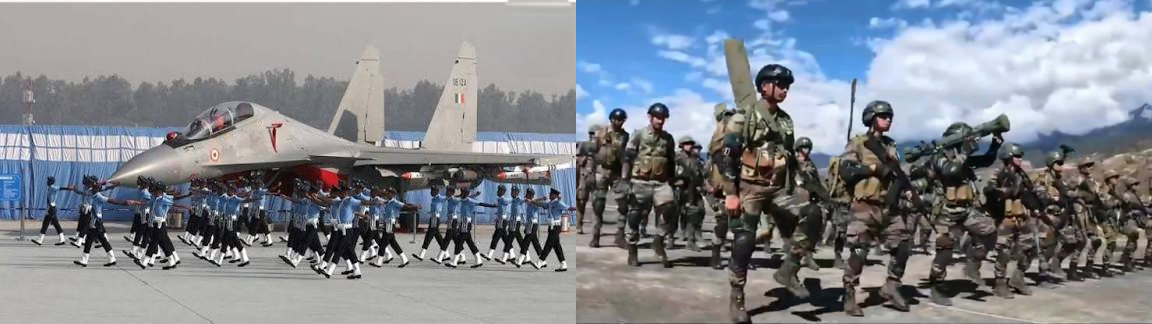
NEW DELHI: In a powerful demonstration of military readiness and joint operational capability, India has launched a large-scale tri-service exercise named ‘Exercise Trishul’ along its western border with Pakistan, focusing on the strategically sensitive Sir Creek and Kutch region in Gujarat. The operation, involving the Indian Army, Navy, and Air Force, underscores India’s evolving doctrine of integrated defence operations and rapid-response capability in potential conflict zones.
Integrated Exercise on the Western Front
‘Exercise Trishul,’ named after the trident symbolizing the combined might of India’s three armed services, aims to test and refine interoperability between land, sea, and air forces. Conducted across Gujarat and Rajasthan, the exercise involves over 20,000 personnel and an extensive array of advanced weapon systems, including T-90 and Arjun battle tanks, BrahMos missile batteries, Rafale and Su-30MKI fighter aircraft, attack helicopters, and frontline naval frigates and destroyers.
According to defence officials, the exercise is designed to evaluate multi-domain operations, joint logistics, and real-time battlefield coordination in a simulated high-intensity conflict environment. It comes at a time of heightened tension following intelligence reports and public warnings from India’s Defence Ministry regarding Pakistan’s recent military infrastructure buildup near the Sir Creek area—a region long disputed between the two countries.
The Sir Creek sector, a 110-kilometre tidal estuary separating India’s Gujarat coast from Pakistan’s Sindh province, is strategically vital for both nations due to its proximity to key oil reserves and maritime routes. The exercise’s choice of location reinforces India’s commitment to defending its coastal and maritime frontiers.
Simultaneous IAF Exercise in the Northeast
In parallel with ‘Trishul,’ the Indian Air Force has launched a major air combat and logistics drill named ‘Exercise Gajraj’ across the Northeastern frontier, encompassing areas bordering China, Bhutan, Myanmar, and Bangladesh.
This simultaneous deployment on both western and eastern fronts reflects India’s growing emphasis on dual-front preparedness—a strategy to maintain operational superiority against both of its principal adversaries, Pakistan and China, under the emerging integrated theatre command framework.
IAF officials described ‘Gajraj’ as one of the largest air readiness exercises in the region, focusing on air dominance, logistical mobility, and combat operations in high-altitude and complex terrain. The exercise involves the deployment of fighter squadrons, transport aircraft, and aerial refuelling platforms, aimed at enhancing quick reaction capabilities in the event of a border contingency.
Strategic Context and International Reactions
The dual exercises mark a new phase in India’s defence posture, aligning with its push to operationalize joint theatre commands—a concept designed to unify command structures and optimize cross-service coordination.
Pakistan has responded with visible unease, issuing NOTAMs (Notice to Airmen) restricting airspace over parts of its central and southern regions, and deploying its navy to forward posts near Sir Creek. Pakistani naval leadership publicly vowed to defend their maritime boundaries amid the heightened Indian activity.
China, though maintaining official silence, is closely monitoring the developments. Defence analysts suggest that Beijing views such exercises as indicative of India’s resolve to match Chinese military assertiveness along the Line of Actual Control (LAC).
A Message of Strength and Readiness
‘Exercise Trishul’ and ‘Exercise Gajraj’ together showcase India’s expanding capacity for multi-front, integrated warfare, underlining its readiness to respond decisively to any provocation. The operations also serve as a message of deterrence, signalling India’s ability to maintain sustained military pressure along both critical borders simultaneously.
The Ministry of Defence described the exercises as “a testament to India’s unity of arms and operational synergy,” reflecting the nation’s resolve to safeguard its sovereignty through strength, preparedness, and technological advancement.
Source: Ministry of Defence, Government of India; Indian Armed Forces Public Information Directorate; October 2025.