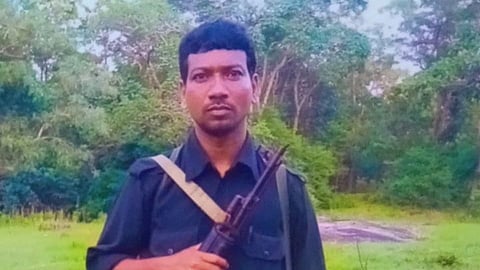
RAIPUR — Madvi Hidma, one of India’s most-wanted Maoist commanders and a top strategist in the outlawed CPI (Maoist), was killed in a fierce gun battle with security forces on Tuesday morning, marking a significant setback for the Maoist insurgency.
Operation Details
- The encounter took place in the Maredumilli forest, located in Alluri Sitarama Raju district, Andhra Pradesh, near the tri-junction region of Andhra Pradesh, Chhattisgarh, and Odisha.
- The operation was carried out by the Greyhounds, Andhra Pradesh’s elite anti-Naxal force, along with local police, based on precise intelligence about a large Maoist group moving through the forest.
- Security forces confirmed that six Maoists were killed during the operation, including Hidma and his wife, Madakam Raje (alias Rajakka), who was also a divisional committee member of the CPI (Maoist)
Who Was Madvi Hidma?
- Hidma was the commander of People’s Liberation Guerrilla Army (PLGA) Battalion No. 1, which is considered one of the most powerful and lethal Maoist units.
- He was a Central Committee member of the CPI (Maoist), and often described as one of its most dangerous leaders.
- Born in Puvarti village in the Sukma region (present-day Chhattisgarh), Hidma belonged to the Muriya tribal community.
- Security agencies had placed a bounty of over ₹ 1 crore on his head.
Role in Major Maoist Attacks
Hidma is believed to have masterminded or played a leading role in at least 26 major attacks on security forces:
- 2010 Dantewada (Tadmetla) Ambush: An ambush in Dantewada district, Chhattisgarh, which killed 76 CRPF personnel.
- 2013 Jhiram Valley / Darbha Valley Massacre: An attack that killed senior Congress leaders and other prominent figures.
- 2017 Sukma (Burkapal–Chintagufa) Attack: One of the deadliest ambushes, resulting in heavy CRPF casualties.
- 2021 Sukma–Bijapur Encounter: Part of his long history of involvement in violent encounters.
- He has also been linked to multiple other attacks, including IED blasts, ambushes, and killings of security personnel.
Strategic Impact of His Elimination
- Officials view his death as a major blow to the Maoist insurgency, especially in the Bastar region, where his battalion and operations were deeply rooted.
- As a tribal leader and the youngest member of the Maoist Central Committee, his elimination has both symbolic and strategic significance, weakening the Maoists’ foothold in crucial forest zones.
- Analysts say this could mark a turning point in the government’s long fight against left-wing extremism.
Aftermath and Ongoing Operations
- After the gunfight, security forces have launched search and combing operations in the forest to ensure no surviving Maoist cadres escape.
- Authorities are also assessing the broader impact on Maoist operations across the tri-state region, since Hidma’s network allegedly spanned Andhra Pradesh, Chhattisgarh, and Odisha.