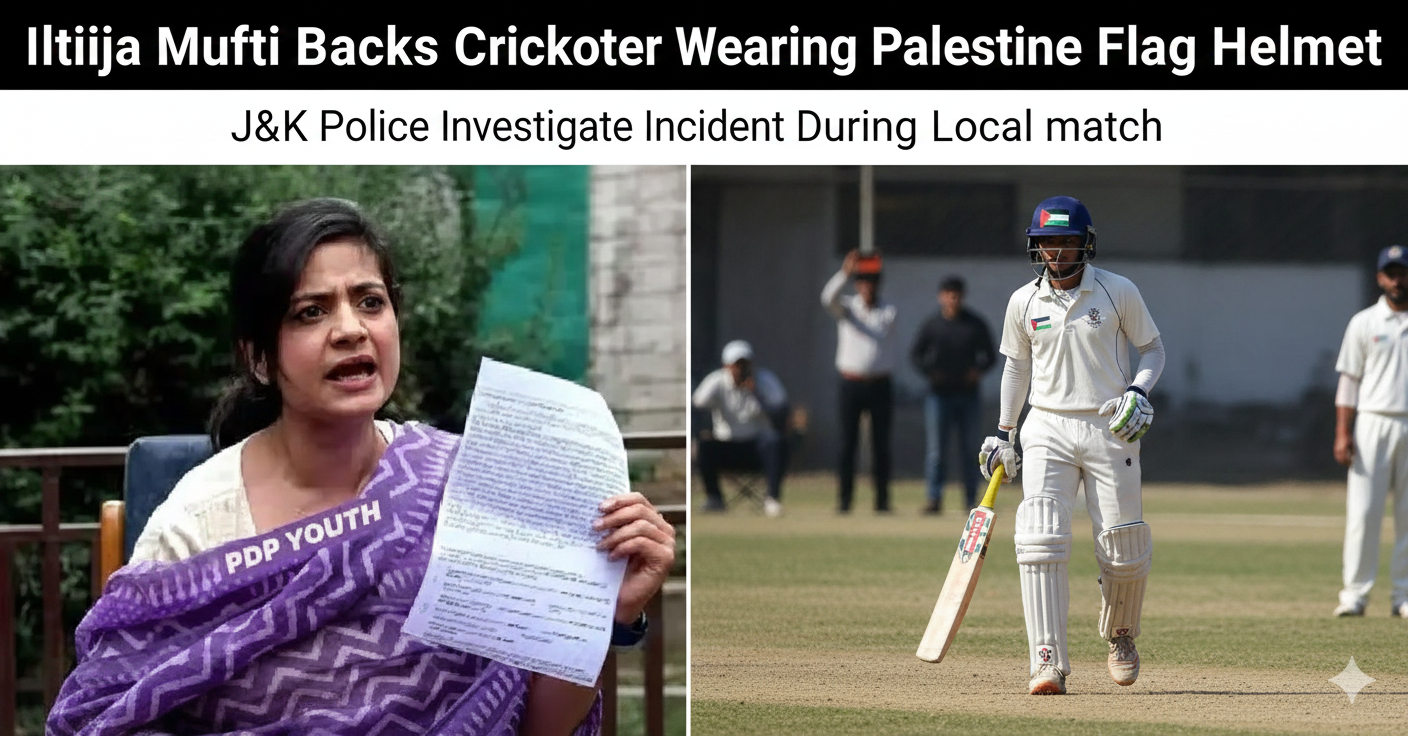
Srinagar:Iltija Mufti, senior leader of the People’s Democratic Party (PDP) and daughter of former Jammu and Kashmir Chief Minister Mehbooba Mufti, has come out in support of a cricketer who sparked controversy by wearing a helmet bearing the Palestinian flag while playing in a competitive match.
The incident drew widespread attention on social media and in political circles, with critics accusing the player of politicising sport and violating established codes of conduct. However, Iltija Mufti defended the cricketer’s action, describing it as a symbolic expression of solidarity with the Palestinian people amid the ongoing humanitarian crisis in Gaza.
In a statement shared on social media, Iltija Mufti said that sport has historically been a platform for peaceful protest and moral expression, and that showing solidarity with oppressed communities should not be viewed as a crime. She argued that freedom of expression, particularly when exercised non-violently, must be protected in a democratic society.
“Silencing voices of empathy and conscience will not erase the suffering of innocent civilians. Expressing solidarity through symbols is a humane response, not an act of provocation,” she said, without naming the cricketer or the tournament involved.
The controversy erupted after visuals of the cricketer wearing the helmet went viral online, prompting debates over whether international political symbols should be displayed on the field of play. Several sports administrators and commentators stressed that cricketing regulations generally discourage political messaging during matches, insisting that sports should remain neutral.
Despite the backlash, Iltija Mufti reiterated that selective outrage over symbolic gestures reflects a shrinking space for dissent and compassion. She also criticised what she termed as “double standards” in global responses to conflicts, stating that expressions of solidarity are often judged differently depending on the cause.
The PDP leader’s remarks have further intensified the debate, especially in Jammu and Kashmir, where political expressions related to international conflicts often resonate deeply. Supporters of Iltija Mufti praised her for taking a principled stand, while opponents accused her of endorsing the mixing of politics with sports.
As the debate continues, the incident has once again highlighted the complex intersection of sports, politics, and freedom of expression, raising questions about where the line should be drawn between neutrality and moral stance in the sporting arena.