Madurai | January 2026
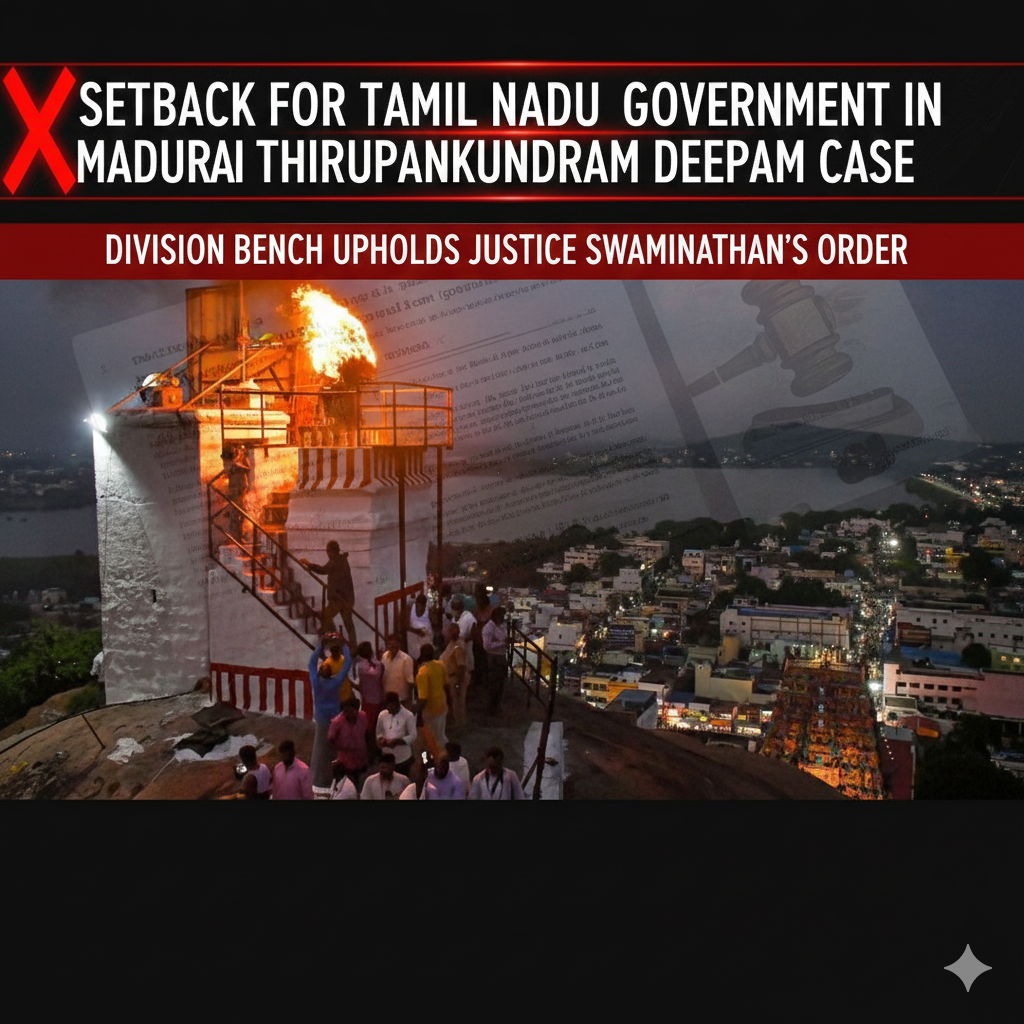
In a significant legal setback to the Tamil Nadu government, the Madras High Court Division Bench has upheld the order permitting the lighting of the traditional Deepam at the Thiruparankundram hill shrine in Madurai, rejecting the state’s appeal that cited security and law-and-order concerns.
The Division Bench comprising Justice G. Jayachandran and Justice K.K. Ramakrishnan affirmed the earlier ruling of Justice G.R. Swaminathan, who had allowed the lighting of the Deepam near the Dargah adjacent to the ancient Murugan temple.
Court Rejects Government’s Appeal
Dismissing the government’s plea, the Bench ruled that the Tamil Nadu administration failed to provide any reasonable or concrete justification for denying permission to light the Deepam at the designated lamp pillar (deepa thoon).
“Lighting the Deepam at an elevated place is meant to ensure that devotees can witness it from afar. There are no valid or compelling reasons for the temple administration to deny the long-standing religious practice demanded by devotees,” the Bench observed.
The court further noted that the government’s objections were based on speculative fears rather than tangible evidence, remarking that the state was “spreading imaginary apprehensions” instead of addressing the issue objectively.
Historical and Religious Significance
Thiruparankundram is one of the six sacred abodes (Arupadai Veedu) of Lord Murugan, with historical references dating back over 2,000 years. Ancient Tamil literature, including Sangam-era texts, describe ritual lamp lighting on hilltops as an integral part of Murugan worship, symbolizing divine victory over darkness and ignorance.
Historians point out that Deepam traditions in Tamil Nadu predate medieval times, serving both religious and social purposes — guiding pilgrims and signifying auspicious occasions visible across vast distances.
“The practice of lighting Deepam on hills is deeply rooted in Tamil spiritual history and cannot be casually dismissed as a modern innovation,” the court noted, referencing established customs.
Dargah Proximity Not a Valid Objection
Addressing concerns about the proximity of the Dargah, the Bench clarified that religious coexistence has historically defined the region, and the presence of another place of worship cannot automatically negate Hindu ritual practices.
Justice Swaminathan’s original order had emphasized that permission had earlier been granted to light the Deepam in the same area, and no untoward incident had occurred.
“When harmony has prevailed historically, denying a religious practice based on hypothetical threats is unjustified,” the court reiterated.
Key Observations by the Court
- The Deepam must be lit on the lamp pillar itself, as demanded by devotees
- The temple administration lacked sound reasons for rejecting devotees’ requests
- Law-and-order concerns raised by the government were not supported by material evidence
- Religious practices rooted in history deserve constitutional protection
Impact of the Verdict
The ruling is being seen as a strong reaffirmation of religious freedom and traditional rights under Articles 25 and 26 of the Constitution. Devotees and Hindu organisations have welcomed the verdict, calling it a victory for faith, heritage, and constitutional values.
Legal experts say the judgment could serve as an important precedent in cases where state authorities cite vague security concerns to restrict long-established religious practices.
As preparations resume to light the Deepam at Thiruparankundram, the verdict underscores the judiciary’s message: ancient faith practices cannot be curtailed by administrative hesitation or imagined fears.