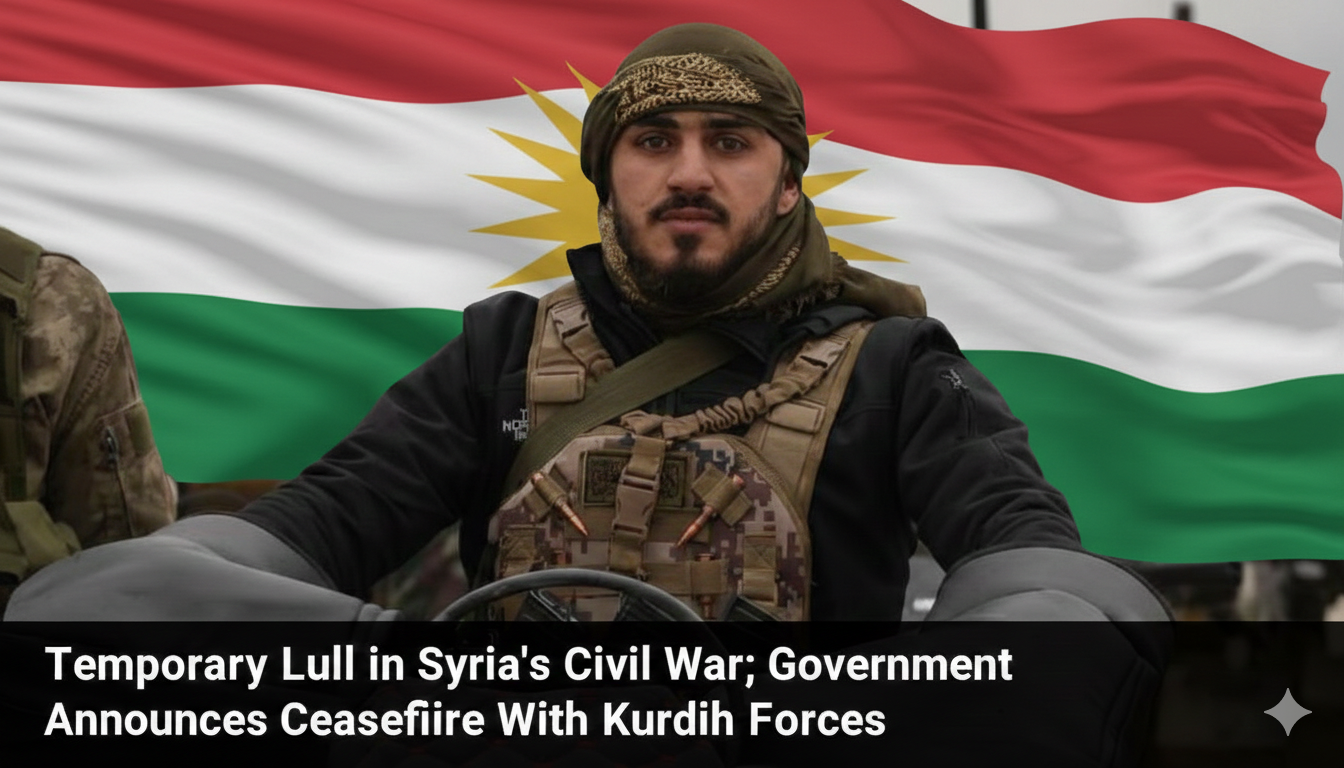
Damascus: Offering temporary relief to a country ravaged by more than a decade of civil war, the Syrian government has announced a ceasefire with Kurdish forces. Reports say Damascus has reached an understanding with the Kurdish-led Syrian Democratic Forces (SDF), which operate mainly in northeastern Syria. The move is expected to halt military operations in conflict zones for the time being and facilitate the delivery of humanitarian aid.
Kurds: One People, Four Countries
The Kurds are one of the largest stateless peoples in the world. An estimated 30–40 million Kurds live spread across Turkey, Syria, Iraq, and Iran. After the collapse of the Ottoman Empire following World War I, the Kurds were promised an independent state, but this never materialized. Instead, new national borders left them as minorities within different states, where their language, culture, and political rights were often suppressed.
Historical Background of the Kurdish Issue in Syria
Kurds constitute roughly 10 percent of Syria’s population. During decades of Ba’ath Party rule under the Assad family, they faced systematic discrimination:
- Thousands were denied Syrian citizenship
- Restrictions were imposed on the Kurdish language and culture
- Kurds were marginalized in land ownership, employment, and education
When the Syrian civil war erupted in 2011, government forces withdrew from several regions. The Kurds used this vacuum to establish self-administered areas in northeastern Syria, collectively known as “Rojava.”
Civil War and the Rise of Kurdish Power
With the emergence of the Islamic State (IS), Kurdish forces—particularly the YPG and later the SDF—became the backbone of the US-led coalition fighting the extremist group. While they played a decisive role in defeating IS, this also significantly enhanced Kurdish military and political influence.
This growing power alarmed both the Syrian government and, more critically, Turkey, which views the YPG as an extension of the outlawed Kurdistan Workers’ Party (PKK).
Current Disputes With the Syrian Government
Key points of contention between Damascus and the Kurds include:
- Autonomy: Kurds seek a federal or autonomous system; the Syrian government rejects this.
- Military Control: Damascus demands that the SDF be fully integrated into the Syrian army.
- Control of Resources: Oil- and gas-rich areas are largely under Kurdish control, making them central to economic disputes.
- Political Recognition: Kurds want constitutional and international recognition of their self-administration.
Political and Economic Dimensions
Northeastern Syria’s oil fields and fertile agricultural lands are vital for reviving the country’s war-shattered economy, especially amid sanctions and isolation. Regaining control over these resources is crucial for Damascus. At the same time, these assets form the economic backbone of the Kurdish administration.
Politically, the continued—though limited—support extended by the United States to Kurdish forces, alongside Russia and Iran’s backing of the Syrian government, has created a complex and fragile balance of power.
Significance of the Ceasefire
Whether this ceasefire will lead to a lasting political settlement remains uncertain. However, analysts believe it could ease humanitarian suffering in devastated regions and open space for renewed dialogue.
Caught between a government determined to preserve territorial unity and a people seeking redress for decades of marginalization, the Kurdish question remains central to Syria’s future. Whether a durable political compromise can be achieved between these competing visions will ultimately shape the country’s path forward.