C Mahesh
Thirunavaya (Kerala) | Special Report
A spiritual chapter that lay dormant for over 271 years is being rewritten on the banks of the Bharathapuzha river as the Mahamagha Mahotsavam, often described as Kerala’s Kumbh Mela, unfolds at Thirunavaya in Malappuram district. Organised under the leadership of the Juna Akhada, the grand religious congregation has transformed the historic riverbank into a vibrant centre of spiritual activity, drawing lakhs of devotees every day.
The arrival of Naga sadhus and Aghori ascetics from North India has added rare spiritual intensity and nationwide attention to the event, making it one of the most significant religious gatherings Kerala has witnessed in recent decades.

Massive Daily Turnout, Tight Security Arrangements
From early morning till late night, Thirunavaya remains abuzz with Vedic chants, rituals, and devotional gatherings. Devotees from across Kerala and neighbouring states are arriving in large numbers to participate in sacred baths and rituals.
A temporary bridge has been constructed across the Bharathapuzha to facilitate smooth movement of pilgrims from the Navamukunda Temple premises to the Manappuram festival ground. The bridge and surrounding areas remain under strict police surveillance and crowd management protocols, coordinated jointly by the police and festival organisers.
Juna Akhada Leads the Mahotsavam
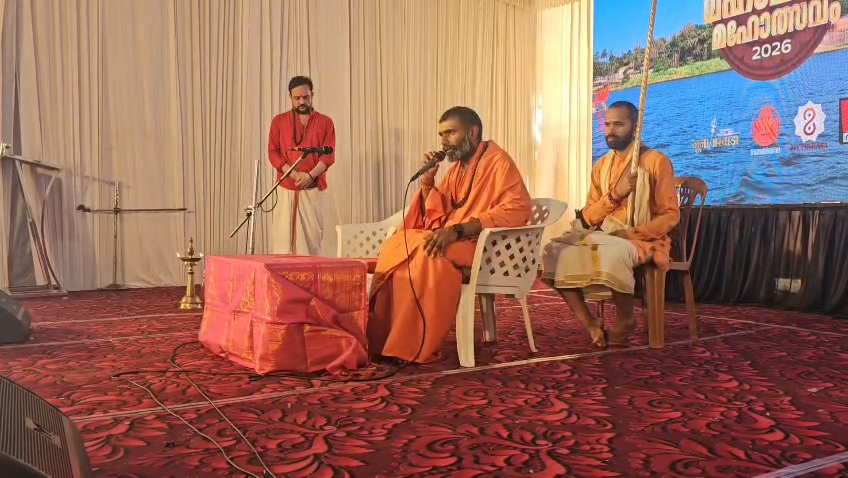
The Mahamagha Mahotsavam is being conducted under the leadership of Swami Anandavanam Bharati, a Mahamandaleshwar of the Juna Akhada. He was elected as Mahamandaleshwar representing Kerala during the Prayagraj Kumbh Mela, making his leadership a landmark moment for the state.
Interestingly, Swami Anandavanam Bharati was, in his pre-monastic life, a district-level leader of the Students’ Federation of India (SFI) in Thrissur. His journey from student politics to spiritual leadership has drawn widespread attention, symbolising an unusual yet compelling transition.
Who Is Swamini Avantika Bharati?

Another major point of interest at the Mahotsavam is Swamini Avantika Bharati, who is frequently seen alongside Swami Anandavanam Bharati at key rituals and events. Her presence sparked curiosity among devotees and visitors.
Swamini Avantika Bharati was formerly a leader of the SFI at Jawaharlal Nehru University (JNU), New Delhi, and is also the sister of well-known Malayalam film actor Nikhila Vimal.
She embraced monastic life a year ago after receiving sannyasa diksha from Acharya Mahamandaleshwar Swami Avdheshanand Giri Maharaj, head of the Juna Peeth. She is a disciple of Abhinava Balanandabhairava and is deeply engaged in scriptural studies and spiritual practice.
From Academia to Asceticism
Born to renowned classical dancer Kalamandalam Vimala Devi and M.R. Pavithran, Swamini Avantika Bharati (formerly Akhila) and her sister Nikhila were trained in classical dance from an early age.
After completing her doctoral research in Theatre Arts at JNU, Akhila pursued higher studies in the United States and was a Fellow at Harvard University’s Mellon School of Theatre and Performance Research. Following years of spiritual pursuit, she chose the path of renunciation and is now actively participating in the Mahamagha Mahotsavam.
Naga and Aghori Sadhus Add Spiritual Gravitas.

As part of the Mahotsavam, Naga sadhus and Aghori ascetics have arrived from major spiritual centres such as Kashi, Prayagraj, Haridwar, and Nashik. Known for intense austerities, Shiva worship, and extreme ascetic practices, the presence of Aghori sadhus has given the festival a rare and powerful spiritual dimension.
Devotees say the gathering reflects the true spirit of ancient Indian ascetic traditions, rarely witnessed in southern India.
Nila Aarti: The Daily Highlight.

A key attraction of the Mahotsavam is the daily Nila Aarti, conducted every evening at seven specially prepared ghats along the heart of the Bharathapuzha river.
The aarti is performed by the same group of priests who conduct the famed Ganga Aarti at Dashashwamedh Ghat in Varanasi, lending grandeur and authenticity to the ritual. Facilities have been arranged for sacred bathing, and each day features special pujas, homams, and gatherings of ascetics.
A Land Steeped in History and Legend
Thirunavaya Manappuram holds immense historical and mythological significance. It is believed to be the site of Lord Brahma’s yagna and a confluence of the Trimurti — Brahma, Vishnu, and Shiva.
Historical records suggest that during the reign of Cheraman Perumal, a Mahamagha festival was held here once every 12 years. The region was later under the rule of the Zamorin of Calicut and famously hosted the Mamankam, a grand assembly held during the Magha month to select rulers and settle political matters.
Free Meals, Rare Rituals, and Spiritual Discourses Mark Kerala’s Kumbhamela at Thirunavaya.

The Kerala Kumbhamela at the historic Thirunavaya on the banks of the Bharathapuzha has transformed into a major spiritual and cultural congregation, drawing devotees from across the state and beyond. With lakhs of pilgrims arriving every day, the mela has become a unique blend of devotion, service, and traditional rituals.A key highlight of this year’s Kumbhamela is the large-scale free food distribution (annadanam) arranged for devotees. Renowned culinary expert Pazhayidam Mohanan Namboothiri, famous for his temple cuisine and traditional Kerala flavors, is overseeing the preparation of meals. His presence has added both spiritual and cultural value to the mela, with thousands praising the taste, hygiene, and authenticity of the food served.Social and spiritual organisations have also stepped in to support the massive arrangements. Seva Bharati, along with several volunteer groups, is actively involved in coordinating food distribution, crowd management, and essential services for pilgrims. According to organisers, thousands of volunteers are working in shifts to ensure that no devotee leaves hungry.The mela is also witnessing daily unique and rare rituals, many of which are seldom performed outside major sacred congregations. Special homams, tantric poojas, river rituals, and Vedic ceremonies are being conducted under the guidance of learned priests and acharyas. Each day is dedicated to different deities and spiritual traditions, attracting devotees seeking specific blessings.

Adding intellectual and spiritual depth to the event, discourses by prominent spiritual leaders, scholars, and public figures are being held throughout the mela.
These talks focus on Sanatana Dharma, Indian spiritual heritage, social harmony, and the relevance of ancient wisdom in modern life. Large crowds are attending these sessions, especially during the evenings.Organisers state that all arrangements are being carried out in coordination with local authorities, temple committees, and volunteer organisations to ensure safety, cleanliness, and smooth conduct of the mela. With free food, sacred rituals, and enlightening discourses, the Kerala Kumbhamela at Thirunavaya is emerging as a major spiritual landmark, reflecting the state’s deep-rooted tradition of devotion and service.
Grand Conclusion on February 3
The Mahamagha Mahotsavam will conclude on February 3, the Magha star day, with the Amrita Snanam (holy dip) and Yati Puja, marking the ceremonial culmination of the festival.
As sadhus, devotees, history, and mythology converge on the banks of the Bharathapuzha, the revived Mahamagha Mahotsavam is being hailed as a historic spiritual renaissance, firmly establishing Thirunavaya as a major pilgrimage destination in South India.