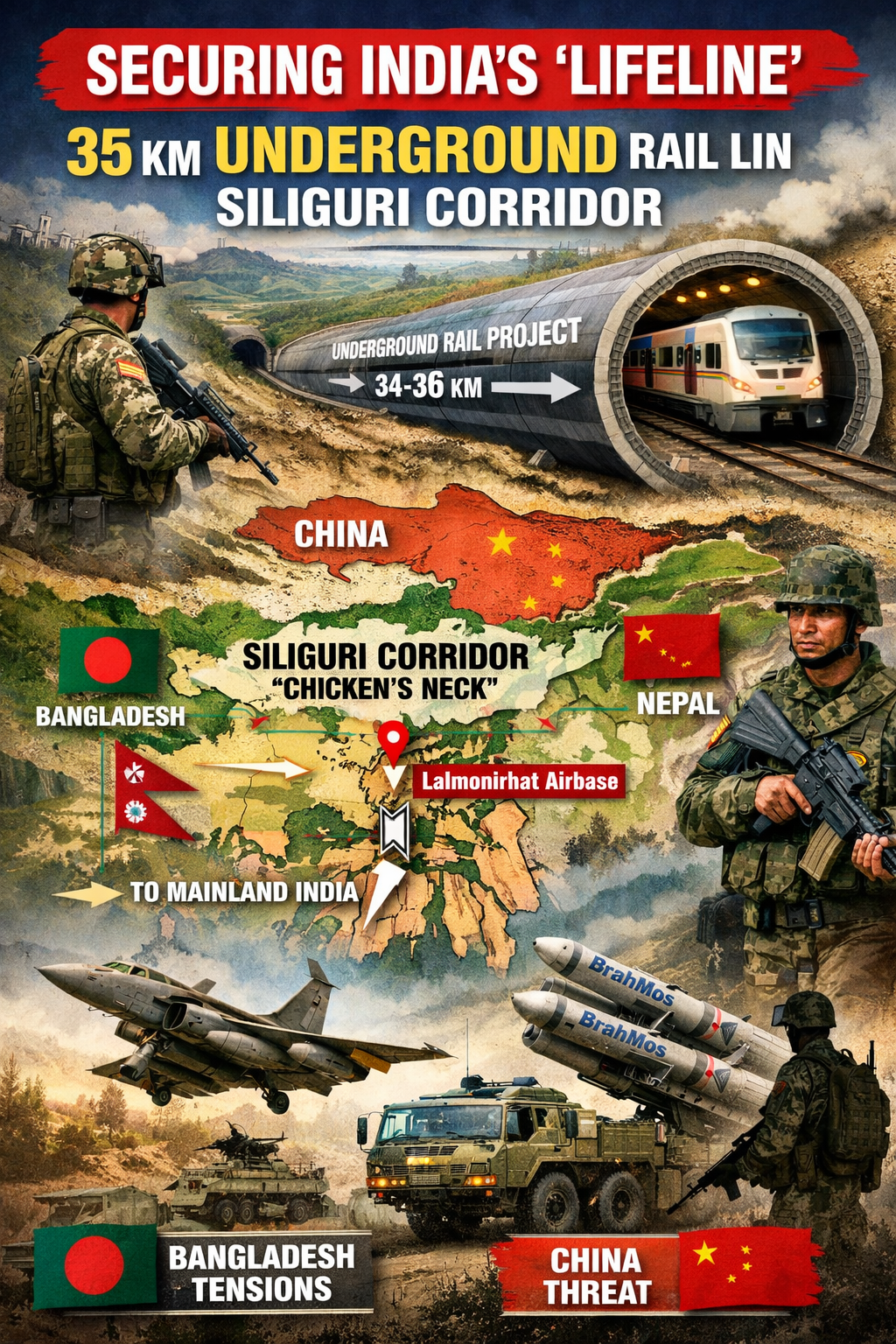
New Delhi/Guwahati: has announced plans to construct an approximately 34–36 km underground railway line through the strategically vital Siliguri Corridor, the narrow land strip that connects India’s northeastern states to the mainland. The project is aimed at ensuring safer, uninterrupted transportation while reducing geopolitical vulnerabilities, according to reports.
Officials believe the underground route will significantly improve transport capacity and strengthen connectivity with the Northeast, reinforcing both economic and security infrastructure.
Key Project Details
- The rail line will pass through the Siliguri Corridor, commonly known as the “Chicken’s Neck.”
- The proposed alignment is expected to link Tinmile Hat, Rangapani, and Bagdogra.
- The Chief Minister of described the project as a historic step toward addressing a long-standing strategic weakness in the region.
Geographical Importance — Why It Is Called India’s “Lifeline”
The Siliguri Corridor serves as the primary land route between mainland India and the Northeast, making its geography a major security concern.
Key factors include:
Extremely Narrow Stretch:
The corridor becomes particularly narrow between areas near the border and the town of Panitanki near , increasing vulnerability to disruptions or military pressure.
Proximity to China:
The corridor lies close to the India-Bhutan-China tri-junction and the controlled by . Infrastructure activity in this region has previously contributed to tensions such as the standoff.
Potential “Chokepoint”:
Security analysts warn that coordinated pressure from multiple directions could block the passage, potentially isolating northeastern states from the rest of the country.
Bangladesh Factor — What Raises Concern?
- Reports suggest efforts to revive the , located roughly 12–15 km from the Indian border.
- Defense experts caution that any foreign technical presence in nearby facilities could enable monitoring of key transport routes.
- Analysts note that in a crisis, even limited disruption—rather than a full-scale invasion—could impact connectivity.
Some strategic assessments also point to the possibility of overlapping regional interests influencing security calculations.
Strategic “Severing” Risk — A Broader View
With China to the north, Bangladesh to the south, and nearby, the corridor’s geography makes it militarily sensitive. Studies have also flagged concerns such as smuggling, trafficking, and counterfeit currency along porous borders.
Measures to Strengthen Security
India has already increased its strategic focus on the region, turning it into one of the country’s more heavily monitored zones. The underground rail project is seen as part of a broader effort to enhance logistical resilience and ensure continuity during emergencies.
Overall Assessment
The underground railway is more than a routine infrastructure initiative:
It supports military, economic, and logistical security
Reduces the risk of the Northeast being cut off
Reflects India’s response to evolving geopolitical dynamics
In conclusion:
Though geographically small, the Siliguri Corridor holds immense strategic value for India’s national security. Experts view the proposed underground rail line as an attempt to transform a long-recognized vulnerability into a strategic strength.