Background
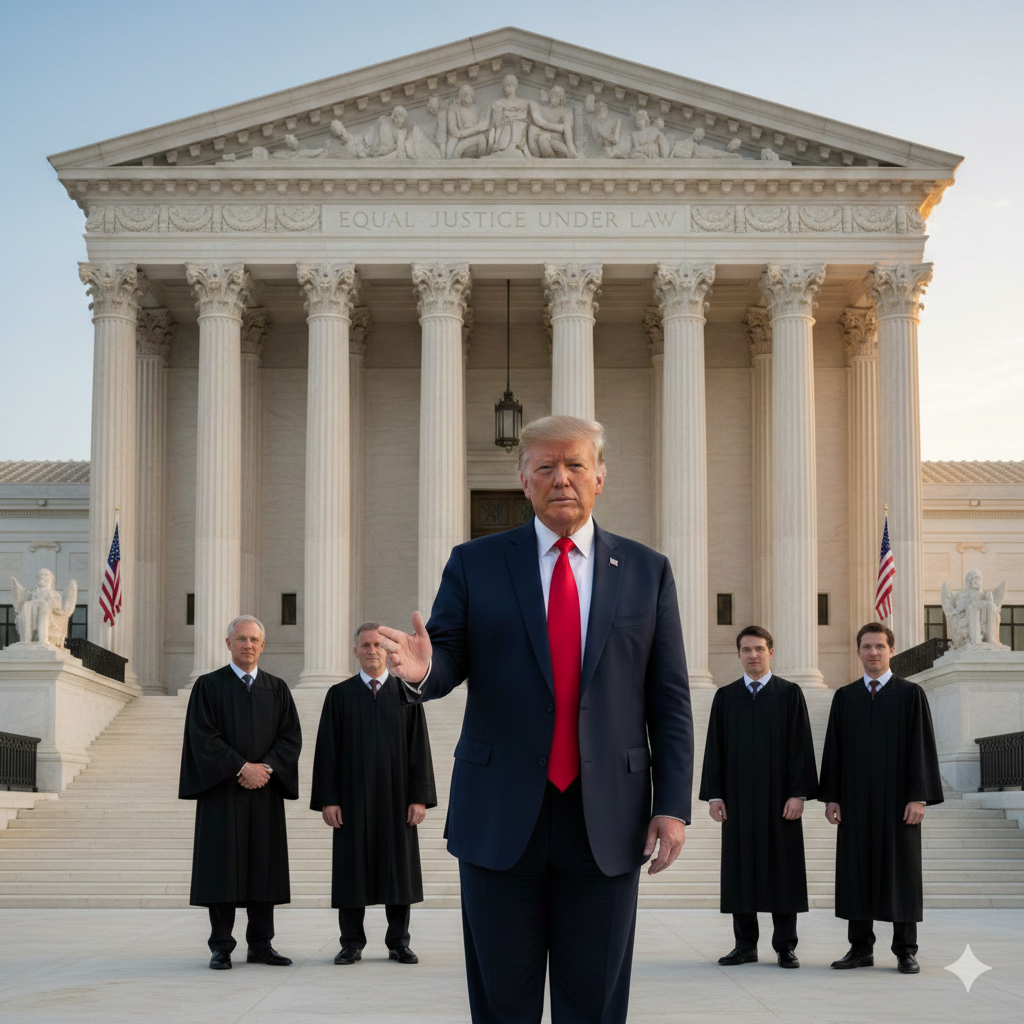
On February 20, 2026, the the Supreme Court of United States of America delivered a landmark 6–3 ruling invalidating sweeping global tariffs imposed by former U.S. President Donald Trump.
The tariffs had been introduced under the International Emergency Economic Powers Act (IEEPA) of 1977, a federal law that grants the president certain powers during a declared national emergency. The Trump administration argued that persistent trade deficits and unfair trade practices constituted an economic emergency justifying broad import duties on multiple countries, including India, China, Mexico, Canada, and European Union nations.
However, the Supreme Court rejected that interpretation.
The Court’s Ruling
Majority Decision (6–3)
Chief Justice John Roberts authored the majority opinion, joined by five other justices.
The Court held that:
- Tariffs are a form of taxation, and under the U.S. Constitution, the power to impose taxes rests primarily with Congress.
- The IEEPA does not grant the President unlimited authority to impose sweeping tariffs without explicit congressional authorization.
- Emergency economic powers cannot be interpreted so broadly as to override Congress’s constitutional role in regulating commerce.
The ruling concluded that the tariff program exceeded statutory authority and therefore was unlawful.
Legal Reasoning in Detail
Presidential Authority Is Not Unlimited
The Court clarified that while presidents possess certain delegated trade powers, those powers must be clearly authorized by Congress. The justices found no language in IEEPA that explicitly permits across-the-board tariffs on virtually all trading partners.
Separation of Powers
The Constitution grants Congress authority:
- To regulate commerce with foreign nations
- To impose duties and tariffs
The majority emphasized that allowing the executive branch to independently impose broad global tariffs would disrupt the constitutional balance of power.
Limits of Emergency Powers
The Court ruled that the administration’s interpretation of IEEPA was overly expansive. Economic policy disagreements or trade imbalances do not automatically qualify as the type of emergency envisioned under the statute.
Dissenting Opinion
Justices Clarence Thomas, Samuel Alito, and Brett Kavanaugh dissented.
Their key arguments:
- The Court should have narrowly interpreted the statute rather than broadly limiting presidential tariff authority.
- Presidents historically have exercised significant discretion in trade matters.
- Judicial overreach could constrain executive flexibility in responding to global economic threats.
International Impact
Impact on India
India had been subject to higher U.S. import duties under the tariff program. Key sectors affected included:
- Pharmaceuticals
- Steel and aluminum
- Textiles
- Engineering goods
With the ruling:
- Several tariff increases (including reported 18% duties on certain exports) are likely invalidated.
- Analysts estimate that approximately 55% of Indian exports to the U.S. could be relieved from higher duties, depending on administrative follow-up and implementation.
This is expected to:
- Improve export competitiveness
- Reduce trade friction
- Stabilize supply chains
Impact on Other Countries
The ruling also benefits:
- China
- Mexico
- Canada
- European Union member states
Because the legal foundation for reciprocal tariff increases was struck down, affected nations may see:
- Reduced trade barriers
- Potential reimbursement claims
- Renewed trade negotiations
Financial Implications
Refunds & Compensation
One major unresolved issue is whether importers can seek refunds for tariffs already collected.
- Legal experts suggest that billions of dollars could be subject to reimbursement claims.
- Additional litigation is likely to clarify refund eligibility and administrative procedures.
Political & Economic Reactions
Response from Donald Trump
Donald Trump strongly criticized the ruling, reportedly calling it a “disgrace.”
He announced plans to pursue alternative statutory authorities to reimpose tariffs temporarily, including a proposed 10% global tariff for 150 days, potentially under different trade legislation.
This indicates continued political and legal tension over U.S. trade authority.
Business and Congressional Reaction
Many U.S. businesses welcomed the decision, citing:
- Reduced import costs
- Greater predictability
- Improved supply chain stability
Several lawmakers across party lines emphasized that the ruling reaffirms Congress’s constitutional role in trade policy.
Why This Decision Matters
This ruling is considered one of the most significant separation-of-powers decisions in recent trade law history.
It:
- Reinforces constitutional checks and balances
- Clarifies limits on emergency economic authority
- Restricts broad executive action in trade matters
- Strengthens congressional oversight of tariff policy
Legal scholars view it as a precedent-setting case that may influence future presidential trade actions.
Case Summary Table
| Aspect | Details |
|---|---|
| Court | Supreme Court of the United States |
| Decision Date | February 20, 2026 |
| Vote | 6–3 |
| Majority Author | Chief Justice John Roberts |
| Core Issue | Presidential authority under IEEPA |
| Outcome | Global tariffs invalidated |
| Impact on India | Likely removal of higher duties on many exports |
| Future Outlook | Possible new tariff actions under alternate statutes |
Conclusion
The Supreme Court’s decision marks a decisive limitation on executive power in trade policy. By ruling that sweeping global tariffs require clear congressional authorization, the Court reaffirmed the constitutional balance between legislative and executive branches.
For India and other affected nations, the judgment may ease trade tensions and restore predictability to international commerce, while domestically it reshapes the boundaries of presidential economic authority.