From Confrontation Under Trudeau to a Cautious Reset Under Carney
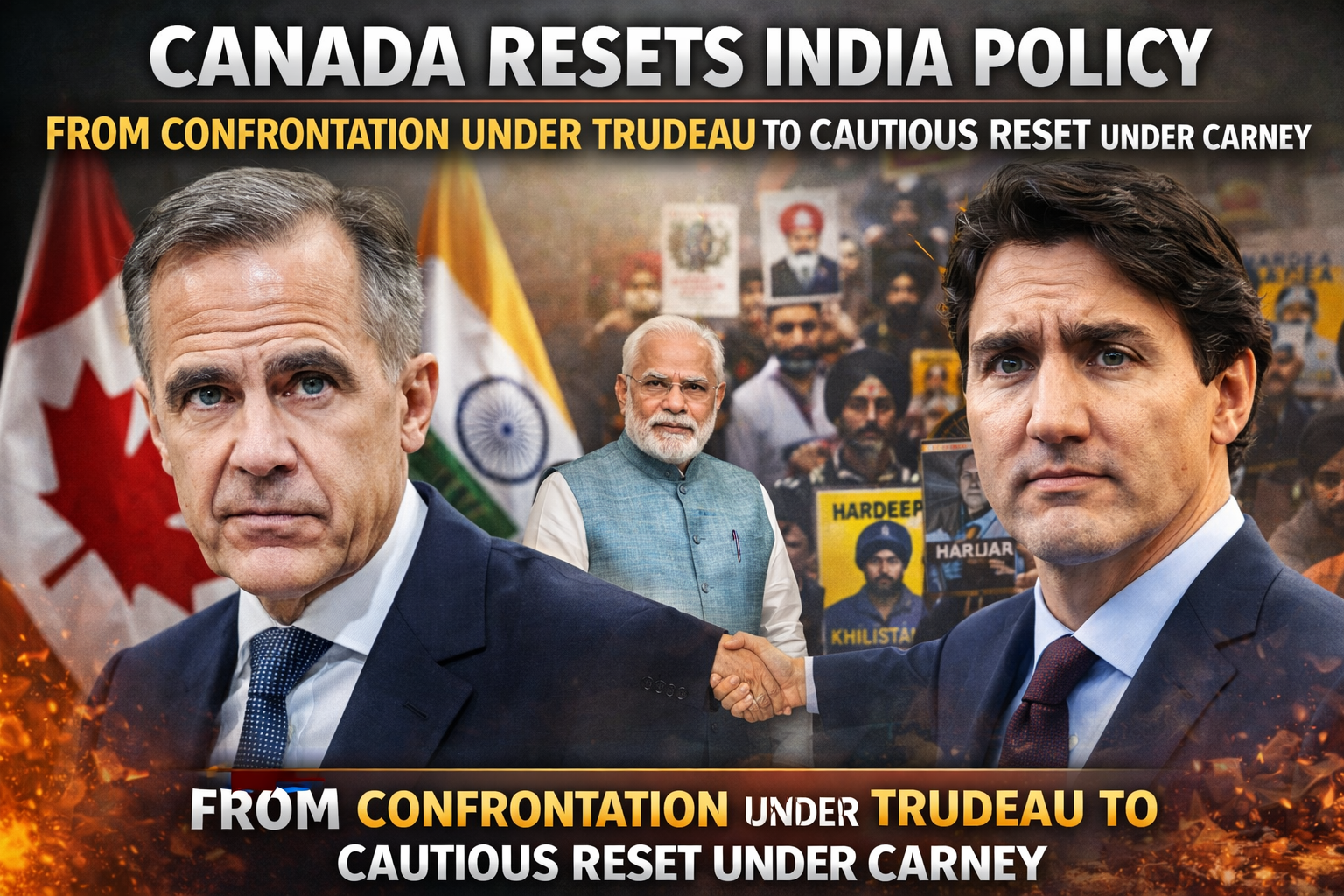
Ottawa/New Delhi: Canada is adjusting its approach toward India following several years of diplomatic strain linked to the Khalistan issue and allegations of foreign interference. The shift signals a move away from the public confrontation that characterized relations under former Prime Minister Justin Trudeau, toward a more measured and engagement-focused strategy under Prime Minister Mark Carney .
Officials and analysts describe the transition as a strategic reset shaped by new political leadership in Ottawa, evolving economic priorities, and a broader recognition of India’s growing geopolitical influence.
Diplomatic Strains Under Trudeau
Relations between Canada and India deteriorated sharply in September 2023 after Trudeau informed Parliament that Canadian security agencies had identified “credible allegations” linking agents of the Indian government to the killing of Hardeep Singh Nijjar, a pro-Khalistan activist who was shot outside a Sikh temple in British Columbia.
India rejected the allegation as “absurd” and politically motivated. The dispute escalated rapidly, resulting in:
- The expulsion of senior diplomats by both countries
- Suspension of trade negotiations
- Public exchanges concerning sovereignty and foreign interference
At the center of the disagreement was the long-standing Khalistan movement, which advocates for an independent Sikh state in India’s Punjab region. While the Trudeau government emphasized Canada’s commitment to freedom of expression and due process, Indian officials argued that Ottawa was not sufficiently addressing extremist networks operating within Canada.
Canada maintained that peaceful political advocacy is protected under its laws, while any criminal conduct would be handled through legal and law enforcement mechanisms. Nevertheless, the episode marked one of the most serious diplomatic rifts between the two countries in recent decades.
A Strategic Reset Under Carney
After assuming office in March 2025, Prime Minister Carney signaled a shift in tone. Without retracting the seriousness of the ongoing Nijjar investigation, his government prioritized stabilizing relations and rebuilding diplomatic engagement with New Delhi.
According to diplomatic sources, the revised approach centers on three key elements:
Re-engagement: Canada and India have resumed high-level discussions and restored full diplomatic staffing, reopening channels that had been reduced during the crisis.
Economic Diplomacy: Trade and investment talks have regained momentum, including renewed discussions on a Comprehensive Economic Partnership Agreement (CEPA). Canadian officials view India as a critical partner in supply chain diversification and Indo-Pacific strategy.
Security Dialogue: In early 2026, Canadian officials stated that they do not currently assess India as being linked to ongoing violent crimes in Canada. Observers interpreted this as a moderation in rhetoric, even as legal cooperation continues.
Policy Comparison
| Feature | Under Trudeau (Pre-2025) | Under Carney (2025–2026) |
|---|---|---|
| Primary Focus | Human rights and foreign interference | Trade, stability and strategic engagement |
| Diplomatic Tone | Publicly confrontational | Cautiously pragmatic |
| Trade Relations | Suspended negotiations | Renewed engagement |
| Security Framing | Allegations made publicly | Emphasis on law enforcement dialogue |
Expert Views
Foreign policy analysts describe the shift as recalibration rather than reversal. They argue that middle powers such as Canada must balance values-based diplomacy with geopolitical and economic realities.
Experts also point to global supply chain realignments and economic uncertainty as factors encouraging Canada to deepen ties with major emerging markets. India’s expanding economy and demographic scale make it an important partner in that context.
At the same time, domestic political considerations remain significant. Canada is home to a large Sikh diaspora, and governments must navigate the intersection of civil liberties, national security, and community relations carefully.
Broader Implications
For India, improved relations with Canada reduce diplomatic friction and support broader Indo-Pacific cooperation. For Canada, renewed engagement offers opportunities in trade, technology, clean energy, education, and critical minerals.
Although legal questions related to the 2023 allegations remain under investigation, diplomatic engagement between the two countries has shifted toward quieter, more structured dialogue.
The recalibration reflects a broader international trend in which democratic governments seek to balance principled foreign policy with strategic and economic interests in an increasingly multipolar world.