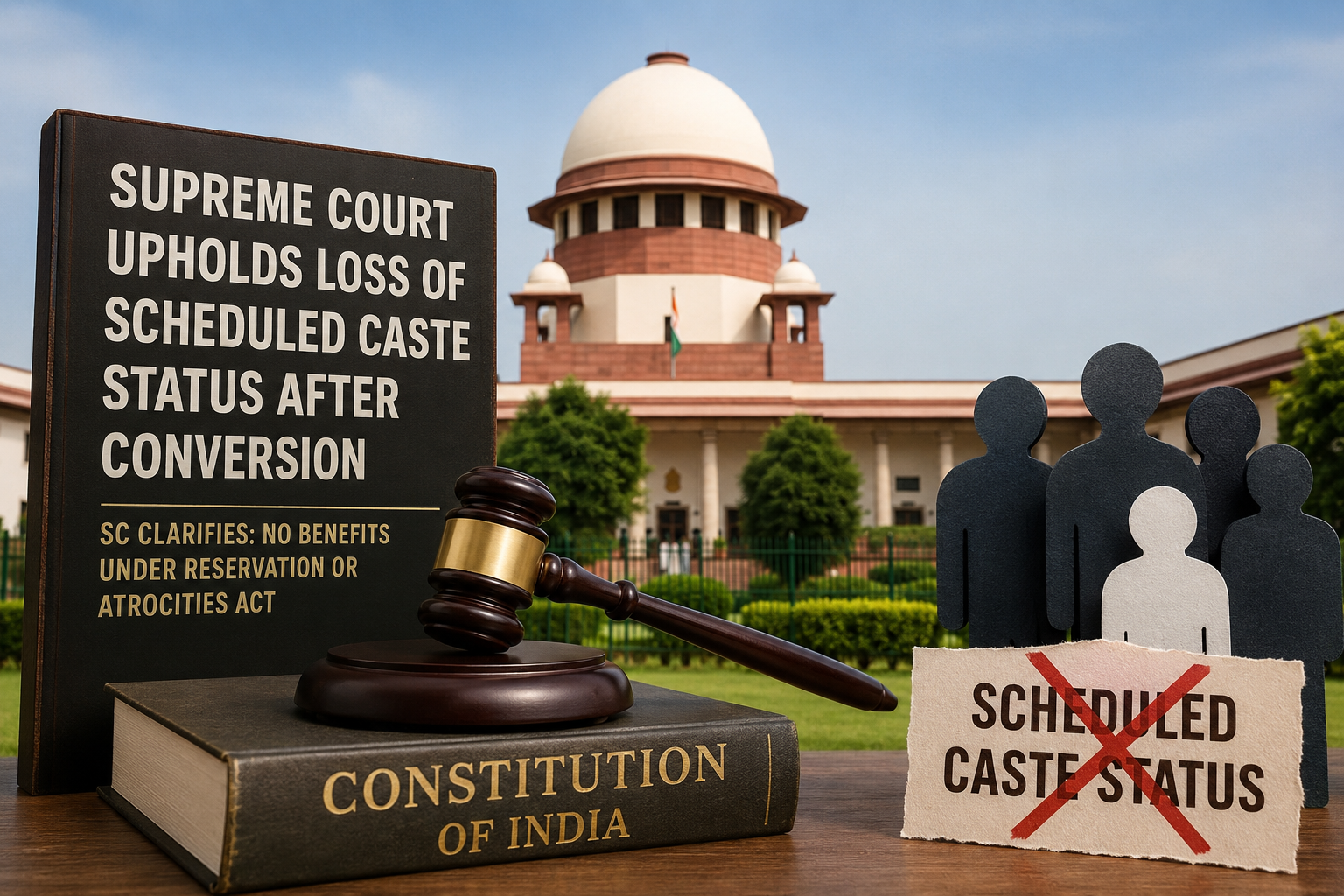
New Delhi, July 2026: The Supreme Court of India has upheld its March 24, 2026 judgment that a person born into a Scheduled Caste (SC) loses Scheduled Caste status upon converting to any religion other than Hinduism, Sikhism or Buddhism. The Court also dismissed a review petition seeking reconsideration of the ruling, holding that there was no error in its earlier judgment and no grounds to reopen the case.
A Bench comprising Justice Prashant Kumar Mishra and Justice Manmohan observed that there was no apparent error in the March 24 judgment and declined the request for an oral hearing.
The ruling effectively confirms that a person who converts from Hinduism to Christianity, Islam, or any other religion not recognised under the Constitution (Scheduled Castes) Order, 1950, ceases to enjoy Scheduled Caste status and the constitutional benefits attached to it, including reservation and the protections available under the Scheduled Castes and Scheduled Tribes (Prevention of Atrocities) Act, 1989.
Background of the Case
The case arose from Andhra Pradesh, where a man born into a Scheduled Caste later converted to Christianity and became a pastor. He subsequently filed a complaint under the SC/ST (Prevention of Atrocities) Act, alleging that certain individuals had insulted him by referring to his caste.
The accused challenged the First Information Report (FIR) before the Andhra Pradesh High Court, arguing that the complainant was no longer a member of a Scheduled Caste after embracing Christianity and therefore could not invoke the provisions of the Atrocities Act.
The High Court accepted the contention and quashed the criminal proceedings. The complainant appealed to the Supreme Court, which affirmed the High Court’s decision.
The Supreme Court held that a person who has voluntarily embraced Christianity is no longer entitled to claim Scheduled Caste status or seek protection under the SC/ST (Prevention of Atrocities) Act.
Constitutional Basis
The judgment is founded on Article 341 of the Constitution of India and Clause 3 of the Constitution (Scheduled Castes) Order, 1950, which restricts Scheduled Caste recognition to persons professing Hinduism, Sikhism or Buddhism.
The Court observed that conversion to Christianity, Islam or any other religion outside those specified in the Presidential Order results in the immediate loss of Scheduled Caste status under the existing constitutional framework.
Reconversion and Restoration of SC Status
The Supreme Court reiterated that Scheduled Caste status may be restored after genuine reconversion to Hinduism, Sikhism or Buddhism, provided three conditions are fulfilled:
- The individual must have originally been born into a Scheduled Caste.
- The reconversion must be genuine and bona fide.
- The original Scheduled Caste community must accept the individual back into the community.
Failure to satisfy any one of these conditions would render the claim for restoration of Scheduled Caste status unsustainable.
Review Petition Dismissed
In July 2026, the Supreme Court dismissed the review petition challenging its March 24 judgment. The Bench held that there was no error warranting review and refused the request for a fresh hearing, thereby allowing the original judgment to stand.
Judicial Sources
- Chinthada Anand v. State of Andhra Pradesh & Others, Criminal Appeal No. 1580 of 2026.
- Supreme Court of India Judgment dated 24 March 2026.
- 2026 SCC OnLine SC 466.
- 2026 LiveLaw (SC) 288.
The judgment clarifies that, under the current constitutional and statutory framework, conversion from Hinduism to Christianity, Islam, or any religion other than Sikhism or Buddhism results in the loss of Scheduled Caste status and the legal protections and reservation benefits associated with that status. The Court emphasised that it was interpreting the existing constitutional provisions rather than creating new law.