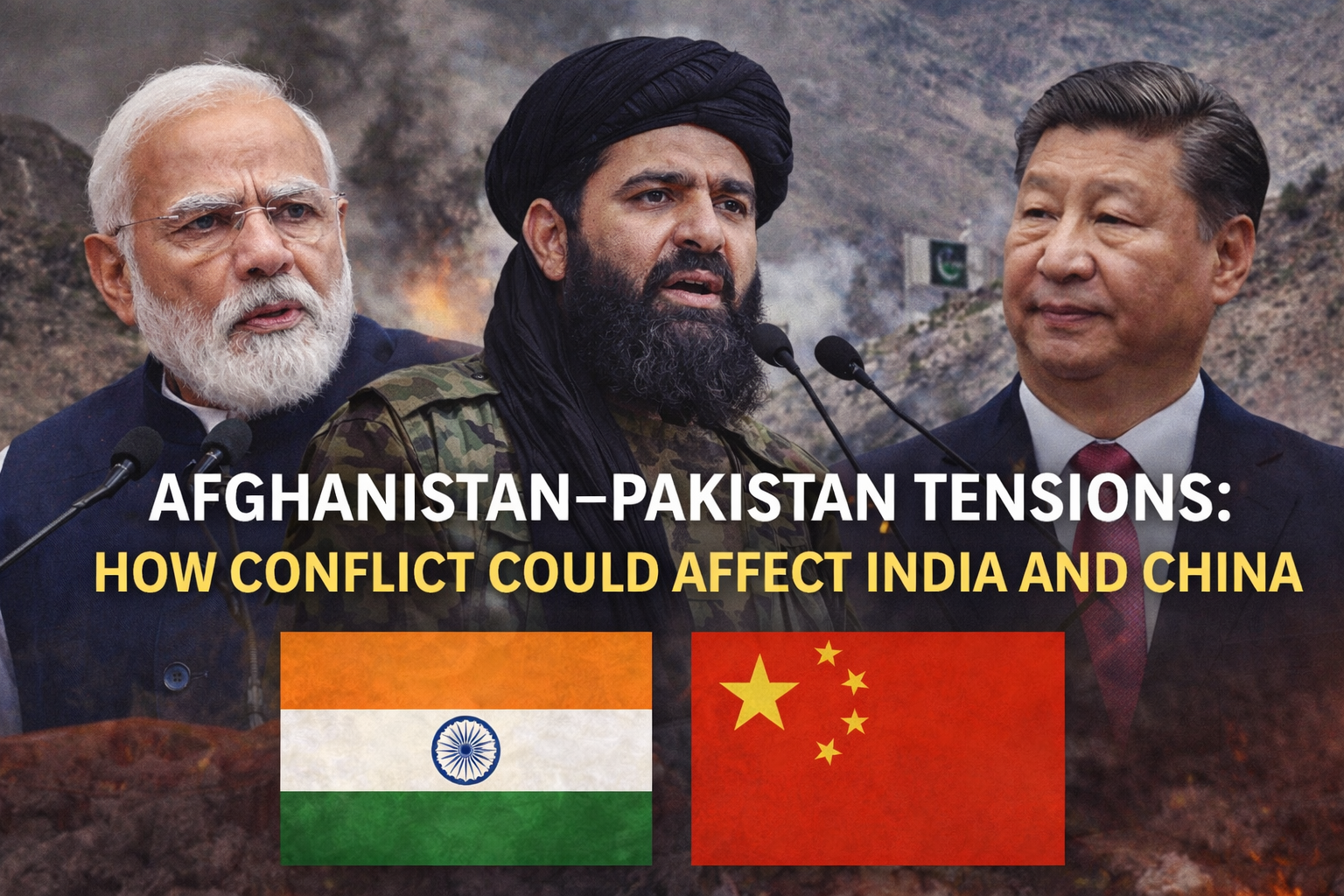
Rising tensions between Afghanistan and Pakistan are drawing attention from major regional powers, particularly India and China. Analysts warn that any serious escalation along the Afghanistan–Pakistan border could reshape the geopolitical balance across South and Central Asia.
The growing friction is linked to disputes over the Durand Line border, militant activity by groups such as Tehrik-i-Taliban (TTP), and mutual accusations between Islamabad and the Taliban-led government in Kabul.
Impact on India
For India, instability between Afghanistan and Pakistan carries both risks and strategic implications.
Security Concerns
India has long been concerned about militant groups operating in the region. Increased instability could create space for extremist organizations to regroup.
According to a report by Observer research foundation:
“Instability in Afghanistan and Pakistan can directly affect the security environment in South Asia.”
India fears that militant networks could expand their activities across the region if the Afghanistan–Pakistan conflict escalates.
Strategic Opportunity
At the same time, tensions between Kabul and Islamabad may open diplomatic opportunities for India to rebuild relations with the Afghan leadership.
India previously maintained strong development partnerships in Afghanistan, including infrastructure, education, and humanitarian projects.
A South Asia expert quoted by The Diplomat said:
“If relations between Pakistan and the Taliban deteriorate further, India could find more room to re-engage with Kabul.”
Impact on China
China also closely monitors developments in the region because of its strategic and economic interests.
Belt and Road Concerns
Pakistan is a key partner in China’s flagship infrastructure initiative, the Belt and Road initiative, particularly through the China–Pakistan Economic Corridor (CPEC).
Any conflict along the Afghanistan–Pakistan border could threaten infrastructure and trade routes linked to this project.
Security in Xinjiang
China is also concerned about potential militant activity affecting the sensitive Xinjiang region.
Beijing has repeatedly urged the Taliban government to prevent militant groups from using Afghan territory to launch cross-border attacks.
According to analysis by Council on Foreign Relations:
“China’s primary concern in Afghanistan is preventing instability from spreading into Xinjiang.”
Regional Power Competition
The Afghanistan–Pakistan tensions also reflect a broader geopolitical competition involving multiple global and regional powers.
Key players include:
- India
- China
- Russia
- United States
Each country has strategic interests ranging from security cooperation to economic connectivity projects.
Possible Future Scenarios
Experts suggest several possible outcomes if tensions continue:
- Limited border clashes without full-scale war.
- Increased militant activity in the border regions.
- Greater involvement of regional powers trying to stabilize the situation.
- Diplomatic negotiations between Kabul and Islamabad.
The Bigger Picture
The relationship between Afghanistan and Pakistan has historically been complex, influenced by the Durand Line dispute, ethnic Pashtun politics, and militant networks.
If tensions continue to rise, the consequences could extend far beyond the two countries, affecting security, trade, and political stability across South and Central Asia.