C.Mahesh| Special Report
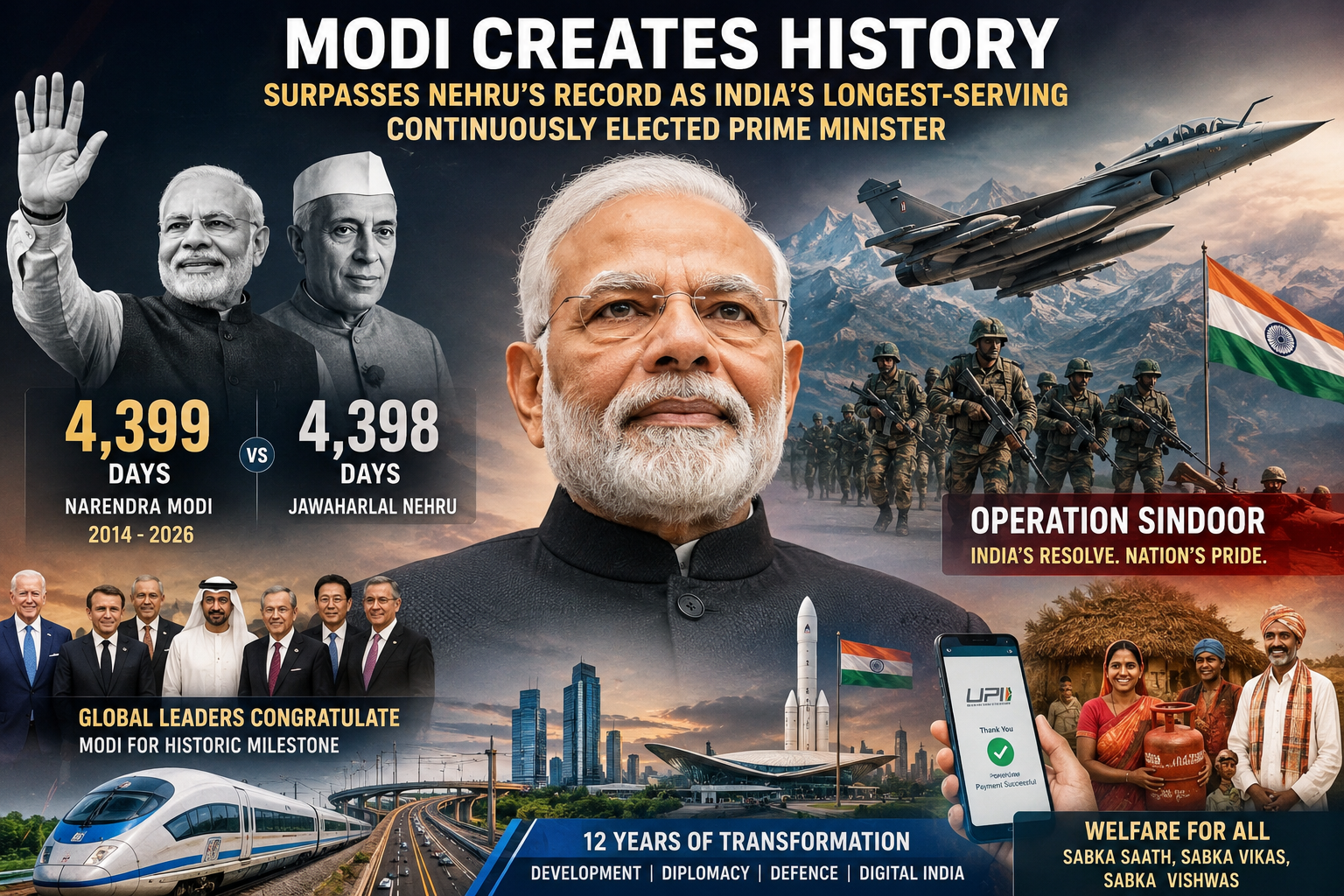
June 10, 2026, has been recorded as a landmark day in Indian political history. Having served continuously as Prime Minister since May 26, 2014, Narendra Modi completed 4,399 days in office, surpassing the 4,398-day record of Jawaharlal Nehru as India’s longest-serving continuously elected Prime Minister.
With victories in the 2014, 2019, and 2024 general elections, Modi became the first Bharatiya Janata Party (BJP) leader to secure three consecutive terms as Prime Minister, cementing his place among the most influential leaders in modern Indian politics.
Congratulations Pour In From World Leaders
Following the historic milestone, leaders from around the world congratulated Modi, praising his leadership and India’s growing economic and geopolitical influence.
Leaders from the United States, France, the United Kingdom, Japan, Australia, the United Arab Emirates, Saudi Arabia, and Russia highlighted his role in strengthening bilateral ties and elevating India’s voice on the global stage.
Many acknowledged India’s increasing strategic importance under his leadership and praised its expanding role in international affairs.
How National Media Viewed the Milestone
Times of India
The Times of India noted that under Modi’s leadership, India witnessed major advances in economic development, infrastructure, digital governance, and welfare programs.
“World leaders lauded Modi’s leadership and contributions to India’s development.”
Economic Times
The Economic Times described Modi as a leader who transformed not only electoral politics but also the broader grammar of governance in India.
“Modi has transformed the grammar of politics.”
Livemint
Livemint observed that Modi’s third consecutive term marked a new chapter in Indian politics and highlighted his sustained public support over more than a decade.
International Media Assessments
Reuters
Reuters highlighted India’s growing diplomatic influence and pointed to Modi’s international engagements with countries including France and Slovakia as evidence of India’s expanding global partnerships.
Encyclopaedia Britannica
Britannica described Modi’s rise from a modest background in Gujarat to the office of Prime Minister as one of the most remarkable political journeys in contemporary democratic history.
From Vadnagar to the Prime Minister’s Office
Born on September 17, 1950, in Vadnagar, Gujarat, Narendra Modi’s early life story is often associated with helping his family at a tea stall before entering public life.
His political journey included:
- Service as a worker in the Rashtriya Swayamsevak Sangh (RSS)
- Organizational responsibilities within the BJP
- Chief Minister of Gujarat from 2001 to 2014
- Prime Minister of India in 2014
- Re-election in 2019
- Third consecutive victory in 2024
His rise is frequently cited as one of the most notable democratic political success stories of the modern era.
Expanding India’s Global Footprint
During his tenure, India’s diplomatic presence expanded significantly.
Among the countries visited by Modi were:
- United States
- France
- United Kingdom
- Japan
- Australia
- Russia
- United Arab Emirates
- Saudi Arabia
- Israel
- Germany
- Italy
- Brazil
- South Africa
These visits played a key role in strengthening strategic partnerships, attracting investments, and expanding India’s global influence.
Major International Agreements
United States
- Defense cooperation initiatives
- Semiconductor investments
- Technology partnerships
- Space collaboration
France
- Rafale fighter aircraft agreement
- Maritime security cooperation
- Civil nuclear partnership
United Arab Emirates
- CEPA trade agreement
- Large-scale investment commitments
- Energy cooperation
Japan
- Bullet train project
- Mumbai-Ahmedabad High-Speed Rail Corridor
Australia
- Critical minerals cooperation
- Defense partnership initiatives
International Honors and Awards
Modi received several prestigious foreign honors during his tenure, including:
- Order of Zayed (United Arab Emirates)
- King Abdulaziz Sash (Saudi Arabia)
- Legion of Merit (United States)
- Order of St. Andrew the Apostle (Russia)
- Order of the Nile (Egypt)
- Grand Cross of the Order of Honour (Greece)
- Dominica Award of Honour (Dominica)
Supporters point to these recognitions as evidence of India’s enhanced global standing.
Strengthening India’s Defense Capabilities
The Modi government oversaw significant modernization of India’s military.
Military Modernization
- Induction of Rafale fighter jets
- Deployment of S-400 air defense systems
- Expansion of indigenous warship programs
- Indigenous helicopter production
- Advanced drone capabilities
Atmanirbhar Bharat in Defense
- Expansion of Make in India initiatives
- Growth of domestic defense manufacturing
- Record increases in defense exports
National Security and Strategic Operations
Major security-related developments during his tenure included:
- 2016 Surgical Strikes
- 2019 Balakot Air Strike
- Expansion of border infrastructure
- Intensified counter-terrorism measures
Supporters view these actions as key components of a stronger national security doctrine.
Operation Sindoor: The Mission That Captured Global Attention
One of the most discussed security operations of recent years was Operation Sindoor, which was reported in 2025 and became a major topic in international strategic circles.
According to Indian authorities, the operation involved precision military action against targets that India linked to terrorist activities following a deadly attack in Kashmir.
Officials described the mission as a coordinated effort involving intelligence agencies, air-defense networks, and multiple branches of the armed forces.
Global Media Focus on Operation Sindoor
The operation drew widespread international attention.
Analysts and media reports highlighted:
- Long-range precision strike capability
- Integrated military command structures
- Advancements in defense technology
- Strengthened border security posture
Some observers described India’s response as swift and calculated, while others focused on its strategic implications for regional security.
Impact on Modi’s Defense Leadership Image
Supporters argued that Operation Sindoor represented a continuation of India’s evolving security doctrine following:
- The 2016 Surgical Strikes
- The 2019 Balakot Air Strike
They viewed the operation as a demonstration of India’s willingness to respond decisively to security threats.
Showcasing India’s Defense Preparedness
Air Defense
- Advanced radar networks
- Missile defense systems
- Integrated aerial surveillance
Indigenous Defense Production
- Locally developed strategic systems
- Indian-made drones and surveillance technologies
Intelligence Coordination
- Enhanced inter-agency cooperation
- Real-time monitoring and intelligence sharing
Infrastructure Transformation
Roads
- Expansion of national highways
- New expressways
- Rural connectivity projects
Railways
- Vande Bharat trains
- Station modernization
- Dedicated Freight Corridors
Airports
- UDAN regional connectivity scheme
- New airport development
- Expansion of aviation infrastructure
Ports
- Sagarmala program
- Increased cargo handling capacity
Digital India: A New Technological Era
Key initiatives included:
- Aadhaar integration
- UPI digital payments
- DigiLocker
- CoWIN platform
- Direct Benefit Transfer (DBT)
UPI has emerged as one of the world’s largest digital payment ecosystems.
Welfare and Social Programs
Major welfare initiatives included:
- Pradhan Mantri Jan Dhan Yojana
- Ujjwala Yojana
- Ayushman Bharat
- Jal Jeevan Mission
- PM Awas Yojana
These programs expanded access to banking, healthcare, housing, clean cooking fuel, and drinking water.
Economy and Investment
During Modi’s tenure:
- India emerged as one of the world’s leading economies
- Startup India fueled entrepreneurship
- Foreign investment increased
- India became a major mobile manufacturing hub
- Semiconductor investments expanded
- Manufacturing capacity grew significantly
G20 and Global Leadership
India’s presidency of the G20 New Delhi Summit 2023 was widely regarded as a major diplomatic achievement.
Key outcomes included:
- Admission of the African Union as a G20 member
- Greater focus on Global South priorities
- Strengthening India’s international image
India’s Rising Global Influence
Under Modi’s leadership, India’s diplomatic engagement expanded across Europe, the Middle East, Africa, and the Indo-Pacific.
International observers have described him as:
- One of the world’s most popular political leaders
- A transformational electoral strategist
- A leader who enhanced India’s global influence
- A central figure in India’s economic and digital transformation
Modi’s Message
Marking 12 years in office, Prime Minister Modi stated:
“Will continue to move forward relentlessly.”
Conclusion
From surpassing Jawaharlal Nehru’s record as India’s longest-serving continuously elected Prime Minister to overseeing major economic reforms, infrastructure expansion, digital transformation, defense modernization, and internationally discussed security operations such as the Surgical Strikes, Balakot Air Strike, and Operation Sindoor, Narendra Modi’s 12-year tenure has become one of the most consequential and widely debated periods in contemporary Indian history.
Supporters describe it as the rise of a “New India,” while political observers regard it as an era that has profoundly shaped India’s governance, diplomacy, economy, and global standing.